Ouranosaurus
Ouranosaurus nigeriensis
Image: Image sourced via web search (Fair use / Educational)
About Ouranosaurus
Ouranosaurus nigeriensis was a remarkable and highly distinctive basal hadrosauriform dinosaur that inhabited the terrestrial ecosystems of what is now northern Africa during the Aptian stage of the Early Cretaceous period, approximately 115 to 110 million years ago. Its name, translating to 'brave monitor lizard' or 'courageous reptile' from Arabic and Greek roots, reflects both its imposing physical presence and its evolutionary significance. As a large herbivorous ornithopod, Ouranosaurus represents a crucial transitional form in dinosaur evolution, bridging the anatomical gap between the earlier, more generalized iguanodontids and the highly specialized, duck-billed hadrosaurs that would come to dominate Late Cretaceous ecosystems worldwide. The discovery of Ouranosaurus in the fossil-rich deposits of the Elrhaz Formation in Niger has provided paleontologists with an unprecedented window into the diverse and bizarre dinosaurian faunas of Early Cretaceous Gondwana. Its most striking feature—a prominent sail or hump running along its back—has made it a subject of intense scientific study and public fascination, serving as a focal point for ongoing debates regarding dinosaur thermoregulation, social display, and biomechanics.
In terms of physical description, Ouranosaurus was a large, robustly built animal, measuring approximately 7 to 8.3 meters (23 to 27 feet) in length and weighing an estimated 2.2 to 4 metric tons. When compared to modern animals, its bulk would have been roughly equivalent to that of a large African elephant, though distributed over a much longer, bipedal-capable frame. The most visually arresting characteristic of Ouranosaurus was undoubtedly the tall neural spines projecting from its dorsal, sacral, and proximal caudal vertebrae. These spines, which reached lengths of up to 60 centimeters (24 inches) over the back, formed a continuous, elevated structure that sloped gently downward toward the tail. The skull of Ouranosaurus was notably elongated and flattened compared to its iguanodontian predecessors, measuring about 67 centimeters in length. It featured a broad, toothless, keratinous beak at the front of the snout, which was perfectly adapted for cropping vegetation. Behind the beak, the jaws were lined with tightly packed rows of leaf-shaped cheek teeth designed for grinding tough plant matter. The animal possessed a relatively long and flexible neck, a deep ribcage to house a massive digestive tract, and powerful hind limbs built for both weight-bearing and moderate speed. Its forelimbs were robust and highly specialized; the hands featured a thumb modified into a conical spike, similar to but smaller than that of Iguanodon, which may have been used for defense or foraging. The middle three digits ended in hooves, indicating that Ouranosaurus spent a significant amount of time walking on all fours, while the fifth digit was flexible and could have been used for grasping vegetation.
Paleobiological studies of Ouranosaurus reveal a highly successful and adaptable herbivore. Its diet consisted entirely of the tough, fibrous vegetation prevalent in its Early Cretaceous environment, such as ferns, cycads, and early angiosperms. The broad beak allowed it to crop large mouthfuls of low-lying and mid-canopy foliage, while the complex dental batteries and kinetic skull joints enabled a sophisticated chewing motion—a precursor to the highly efficient grinding mechanisms seen in later hadrosaurs. Locomotion in Ouranosaurus was likely facultatively bipedal; it would have spent most of its time browsing and walking slowly on all four limbs, utilizing its hoofed hands for support, but it retained the ability to rear up on its powerful hind legs to reach higher vegetation or to run bipedally when fleeing from predators. The function of its spectacular dorsal sail has been the subject of extensive paleobiological inquiry. Initially interpreted as a thermoregulatory device similar to the sail of the Permian synapsid Dimetrodon, the structure would have allowed the dinosaur to absorb heat quickly in the morning sun or dissipate excess body heat during the hottest parts of the day. However, more recent histological and biomechanical analyses suggest the spines may have supported a thick, fatty hump rather than a thin skin sail. This hump could have served as a vital energy reserve to sustain the animal during seasonal droughts, much like the humps of modern camels or bison. Alternatively, or additionally, the structure may have functioned as a prominent visual display for species recognition, sexual selection, or establishing social dominance within a herd. Growth patterns inferred from bone histology indicate that Ouranosaurus, like many large dinosaurs, experienced rapid growth during its juvenile stages, reaching adult size within a few decades, supported by a relatively high, perhaps mesothermic, metabolic rate.
Ecologically, Ouranosaurus inhabited a dynamic and challenging environment. During the Aptian stage, the region that is now the Ténéré Desert in Niger was a lush, low-lying floodplain crisscrossed by broad, meandering river systems and dotted with extensive lakes and swamps. The climate was generally warm and subtropical, but it was characterized by pronounced wet and dry seasons, which would have exerted significant selective pressures on the local flora and fauna. Ouranosaurus shared this verdant but seasonally volatile habitat with a diverse array of extraordinary creatures. It browsed alongside other large herbivores, including the heavily built, semi-aquatic iguanodontian Lurdusaurus, and the long-necked sauropod Nigersaurus, which specialized in low-level browsing with its bizarre, vacuum-cleaner-like mouth. The waterways were dominated by enormous aquatic predators, most notably Sarcosuchus imperator, a gigantic crocodyliform capable of ambushing large dinosaurs at the water's edge. Terrestrial threats were equally formidable; Ouranosaurus had to remain vigilant against apex theropod predators such as the sail-backed Suchomimus, which, while primarily piscivorous, was large enough to pose a threat to juvenile or weakened individuals, and the abelisaurid Kryptops, a robust scavenger and opportunistic hunter. In this complex food web, Ouranosaurus occupied the role of a primary consumer, converting the abundant plant biomass into energy and, inevitably, serving as a crucial prey item for the ecosystem's top carnivores. Its herd behavior, inferred from the presence of multiple individuals in the same fossil horizons, would have provided a vital defense mechanism against these predators, relying on many eyes to spot danger and collective bulk to deter attacks.
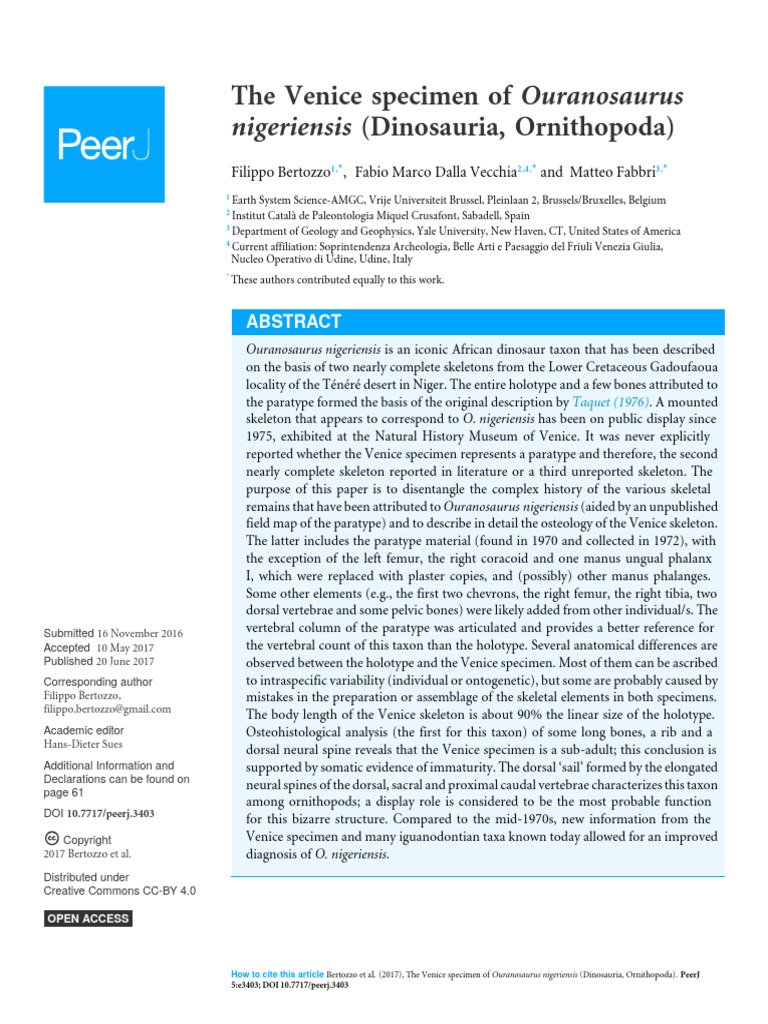
The discovery history of Ouranosaurus is a testament to the perseverance of paleontologists working in some of the world's most unforgiving environments. The first fossils of this remarkable dinosaur were unearthed during a series of groundbreaking French paleontological expeditions to the Sahara Desert in the 1960s. In January 1965, a team led by the eminent French paleontologist Philippe Taquet discovered the remains of a large ornithopod in the Gadoufaoua region of the Ténéré Desert in Niger. The site, part of the Elrhaz Formation, proved to be an extraordinary fossil graveyard. Over the course of several field seasons, Taquet and his team excavated nearly complete skeletons of this new dinosaur. The exceptional preservation of the material, which included articulated skulls and postcranial skeletons, allowed for an unusually detailed reconstruction of the animal's anatomy. In 1976, Philippe Taquet formally described and named the genus and species Ouranosaurus nigeriensis. The generic name 'Ouranosaurus' is derived from the Arabic word 'ourane,' meaning 'courageous' or 'brave'—a local Tuareg term for the desert monitor lizard—combined with the Greek 'sauros' for lizard. The specific epithet 'nigeriensis' honors the country of Niger, where the fossils were found. The holotype specimen, designated MNHN GDF 300, is an almost complete skeleton with a skull, currently housed in the Muséum National d'Histoire Naturelle in Paris. The discovery of Ouranosaurus was a watershed moment in African paleontology, providing the first comprehensive look at an Early Cretaceous ornithopod from the continent and significantly expanding our understanding of dinosaur biogeography during the breakup of the supercontinent Gondwana.
In terms of evolutionary significance, Ouranosaurus occupies a pivotal position on the ornithopod family tree. It is classified as a basal member of the Hadrosauriformes, the clade that includes the Iguanodontidae and the Hadrosauroidea. Ouranosaurus exhibits a fascinating mosaic of primitive and derived anatomical traits that clearly illustrate the evolutionary trajectory from the robust, spike-thumbed iguanodonts of the Early Cretaceous to the highly specialized, duck-billed hadrosaurs that dominated the Late Cretaceous. Its primitive features include the retention of a distinct thumb spike and the overall robust construction of its forelimbs. However, its skull reveals several advanced characteristics that foreshadow the hadrosaurs. The elongation of the snout, the broadening of the toothless beak, and the absence of a premaxillary tooth represent significant steps toward the specialized feeding apparatus of the duck-billed dinosaurs. Furthermore, the development of a diastema—a gap between the beak and the cheek teeth—allowed for more efficient manipulation of food in the mouth. The presence of Ouranosaurus in Africa also provides crucial data for understanding the paleobiogeography of the Early Cretaceous. Its close evolutionary relationships with European and Asian iguanodontians suggest that significant faunal exchanges were still occurring between the northern and southern landmasses (Laurasia and Gondwana) during the Aptian, before the continued fragmentation of the continents led to more isolated and distinct regional dinosaur faunas.
Despite the excellent quality of its fossil remains, Ouranosaurus continues to be the subject of lively scientific debates and ongoing research. The most prominent controversy centers around the true nature and function of its elongated neural spines. While Taquet's original description favored the interpretation of a skin-covered sail used for thermoregulation, subsequent researchers, notably Jack Bowman Bailey in 1997, argued that the spines of Ouranosaurus, which are relatively thick and robust compared to the slender spines of Dimetrodon, were better suited to supporting a fleshy, fat-filled hump. This 'hump hypothesis' aligns with the animal's seasonally arid environment, suggesting the structure was an adaptation for storing energy and water during times of drought. The debate remains unresolved, with some modern paleontologists suggesting a compromise: a structure that was thicker than a simple sail but perhaps not as massive as a camel's hump, potentially serving dual roles in fat storage and visual display. Another area of ongoing discussion involves the precise taxonomic placement of Ouranosaurus. While generally agreed to be a basal hadrosauriform, its exact relationship to other transitional ornithopods, such as the Asian Altirhinus and the African Muttaburrasaurus, frequently shifts depending on the specific phylogenetic matrices used in different studies. These debates highlight the dynamic nature of paleontological science, where new analytical techniques and comparative studies continually refine our understanding of even well-known extinct animals.
The fossil record of Ouranosaurus is geographically restricted but exceptionally rich in terms of specimen quality. All known fossils of Ouranosaurus nigeriensis have been recovered from the Gadoufaoua locality within the Elrhaz Formation in the Agadez Region of central Niger. Gadoufaoua, which translates to 'the place where camels fear to go,' is renowned as one of the most productive Early Cretaceous fossil sites in the world. The preservation quality of the Ouranosaurus specimens found here is generally excellent. The fossils are typically found in cross-bedded sandstones, representing ancient river channels and point bars where the animals' carcasses were rapidly buried by floodwaters. This rapid burial protected the bones from extensive scavenging and weathering, resulting in the preservation of articulated skeletons and delicate cranial elements that are often lost in other fossil deposits. To date, several relatively complete skeletons have been recovered, along with numerous isolated bones and partial skulls. This abundance of high-quality material has allowed paleontologists to reconstruct the osteology of Ouranosaurus with a high degree of confidence, making it one of the best-understood dinosaurs of the African Early Cretaceous. The site continues to be a vital resource for paleontologists, yielding not only Ouranosaurus but a complete ecosystem of contemporaneous flora and fauna.
Culturally, Ouranosaurus has achieved a moderate but enduring level of recognition, largely due to its unique and visually striking appearance. Its distinctive sail-backed silhouette makes it instantly recognizable, and it frequently appears in dinosaur encyclopedias, children's books, and educational documentaries as a prime example of the bizarre adaptations found in the dinosaur kingdom. Notable museum displays of Ouranosaurus include the spectacular mounted skeleton at the Muséum National d'Histoire Naturelle in Paris, which continues to draw millions of visitors and serves as a testament to the success of the French Saharan expeditions. Casts of this skeleton are also exhibited in various natural history museums around the world, including in Niger, where it stands as a symbol of the country's rich paleontological heritage. In popular media, Ouranosaurus has made appearances in video games such as 'Jurassic World Evolution' and various paleontology-themed television series, where it is often depicted navigating the dangerous, predator-filled floodplains of Cretaceous Africa. Its educational importance lies in its ability to clearly illustrate the concepts of evolutionary transition and anatomical adaptation, making it an invaluable subject for teaching the principles of paleobiology and the dynamic history of life on Earth.
Classification
Time Period
Discovery
Location
Niger
Formation
Elrhaz Formation
Frequently Asked Questions
What is Ouranosaurus?
Ouranosaurus nigeriensis was a remarkable and highly distinctive basal hadrosauriform dinosaur that inhabited the terrestrial ecosystems of what is now northern Africa during the Aptian stage of the Early Cretaceous period, approximately 115 to 110 million years ago. Its name, translating to 'brave ...
When did Ouranosaurus live?
Ouranosaurus lived during the cretaceous period of the mesozoic era approximately 115-110 million years ago.
Where was Ouranosaurus discovered?
Fossils of Ouranosaurus were discovered in Niger in the Elrhaz Formation.
What did Ouranosaurus eat?
Ouranosaurus was a herbivore. It lived in terrestrial habitats.
What type of fossil is Ouranosaurus?
Ouranosaurus is preserved as a body fossil. The preservation quality is excellent.
Related Specimens
From the mesozoic era · body fossils