Ophiacodon
Ophiacodon retroversus
Image: Image sourced via web search (Fair use / Educational)
About Ophiacodon
Ophiacodon, whose name translates to snake tooth, represents a fascinating and critical genus of early synapsids that roamed the Earth during the Late Carboniferous and Early Permian periods, approximately 306 to 280 million years ago. As a member of the family Ophiacodontidae, this prehistoric organism is recognized as one of the most basal members of the eupelycosaur lineage, a group that ultimately gave rise to modern mammals. Thriving primarily in what is now North America, particularly in the regions of Texas, Oklahoma, and New Mexico, Ophiacodon retroversus stands as a testament to the early diversification of amniotes as they fully conquered terrestrial and semi-aquatic environments. Its significance in paleontology cannot be overstated, as it provides a vital window into the anatomical and physiological transitions that occurred at the very root of the mammalian family tree, long before the age of dinosaurs. By studying Ophiacodon, paleontologists can better understand the evolutionary steps that led from primitive, lizard-like ancestors to the highly complex, endothermic mammals of the modern era.
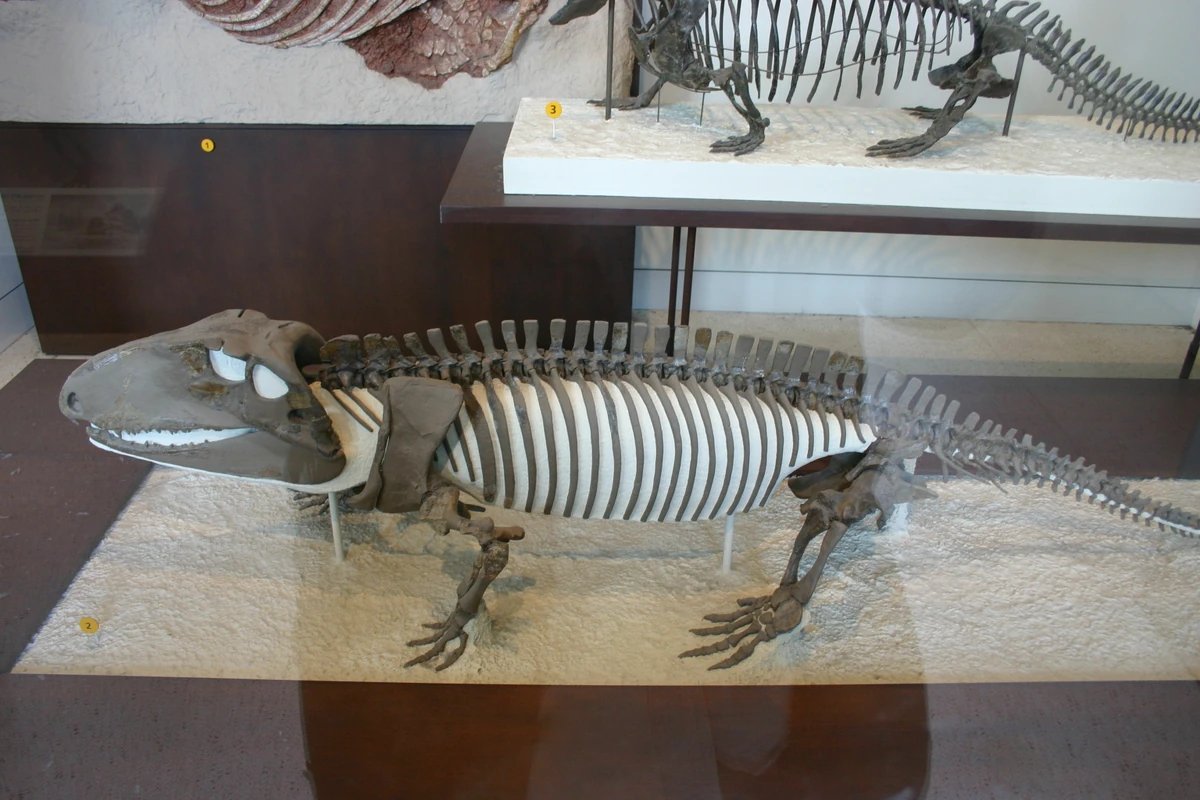
In terms of physical description, Ophiacodon retroversus was a substantial animal for its time, with adult specimens estimated to have reached lengths of 150 to 300 centimeters, or roughly 5 to 10 feet, and weighing anywhere from 30 to 50 kilograms. Its most distinctive feature was its remarkably large, elongated, and narrow skull, which was disproportionately massive compared to the rest of its body. This deep skull was lined with numerous small, sharp, conical teeth—resembling those of modern snakes, which inspired its generic name. Unlike its more famous relative Dimetrodon, Ophiacodon lacked a dramatic dorsal sail, possessing instead a robust, heavily built postcranial skeleton with a sprawling posture typical of early synapsids. Its limbs were relatively short but powerful, ending in broad, five-toed feet equipped with sharp claws. The vertebral column was strong, supporting a barrel-shaped ribcage that housed a large digestive tract. Soft tissue inferences suggest it had tough, glandular skin rather than the scales seen in modern reptiles, reflecting its synapsid heritage. When compared to modern animals, Ophiacodon might have superficially resembled a very large, heavily built monitor lizard or a small crocodilian, albeit with a much deeper and narrower snout designed for a specific mode of feeding.
The paleobiology of Ophiacodon has been a subject of intense study and reconstruction. Its dentition, characterized by many uniform, pointed teeth, strongly suggests a carnivorous diet, with a particular specialization for piscivory, or fish-eating. The narrow snout would have been highly effective at snapping up slippery aquatic prey in shallow waters, much like the modern gharial. However, it was likely an opportunistic predator, also feeding on amphibians, smaller early reptiles, and large invertebrates that shared its habitat. Its sprawling locomotion indicates that while it may not have been a fast runner over long distances, it was capable of sudden, powerful bursts of speed, useful for ambushing prey along the water's edge. Social behavior inferences are limited, but the lack of obvious display structures like sails or horns suggests it may have been a solitary hunter, relying on stealth rather than complex social coordination. Growth patterns analyzed through bone histology indicate that Ophiacodon grew relatively quickly during its early life stages before reaching a plateau, a pattern more advanced than the slow, continuous growth of contemporary amphibians. Furthermore, recent studies on its bone microstructure have hinted at a higher resting metabolic rate than previously assumed, suggesting early steps toward the endothermy that would eventually define its mammalian descendants.
The ecological context of Ophiacodon was set in the lush, tropical to subtropical environments of the Late Carboniferous and Early Permian equatorial regions of the supercontinent Pangea. The world during this time was transitioning from the vast, humid coal swamps of the Carboniferous to the increasingly arid and seasonally dry climates of the Permian. Ophiacodon inhabited the extensive river systems, deltaic floodplains, and swampy margins that characterized the famous Red Beds of Texas and Oklahoma. It shared this dynamic ecosystem with a diverse array of prehistoric life. In the waterways, it coexisted with large, predatory amphibians like Eryops and the bizarre, boomerang-headed Diplocaulus, as well as abundant freshwater sharks and bony fishes that likely formed the bulk of its diet. On land, it shared its territory with other early synapsids, including the apex predator Dimetrodon and the herbivorous, sail-backed Edaphosaurus. In this complex food web, Ophiacodon occupied a niche as a mid-to-large-sized semi-aquatic predator, bridging the gap between the aquatic and terrestrial realms. It likely faced competition from large amphibians in the water and terrestrial predators on land, while its juveniles would have been vulnerable to a wide range of opportunistic carnivores.
The discovery history of Ophiacodon is deeply intertwined with the early, pioneering days of North American paleontology. The genus was first described by the eminent paleontologist Othniel Charles Marsh in 1878, during the height of the infamous Bone Wars—a period of intense and often bitter fossil-hunting competition between Marsh and his rival, Edward Drinker Cope. The initial fossils were discovered in the fossil-rich Permian deposits of the southwestern United States. Over the subsequent decades, numerous additional specimens were unearthed, leading to a complex and sometimes confusing naming history as various fragmentary remains were assigned to different species or even different genera. It was not until the mid-20th century, culminating in the comprehensive 1940 monograph by Alfred Sherwood Romer and Llewellyn Ivor Price, that the taxonomy of Ophiacodon and its relatives was thoroughly revised and stabilized. Romer and Price's meticulous work on the pelycosaurs helped establish Ophiacodon retroversus as a distinct and well-understood species. Key specimens, including beautifully preserved skulls and nearly complete articulated skeletons housed in major institutions, have since provided the foundation for all modern research on this pivotal genus.
The evolutionary significance of Ophiacodon lies in its position near the very base of the synapsid family tree. Synapsids are the group of animals that includes modern mammals and all their extinct relatives, distinguished primarily by the presence of a single temporal fenestra—an opening low in the skull roof behind each eye, which allowed for the attachment of larger and stronger jaw muscles. Ophiacodon is classified within the Eupelycosauria, the specific lineage that leads directly to therapsids and, eventually, mammals. While it retained many primitive, ancestral traits, such as a sprawling gait and a relatively small braincase, its specialized skull and jaw mechanics demonstrate the early evolutionary experimentation that set the stage for mammalian jaw development. By studying the transitional features present in Ophiacodon, scientists can trace the gradual modification of the skull, the differentiation of teeth, and the initial shifts in posture and metabolism that occurred over tens of millions of years. It serves as a crucial morphological link, demonstrating how early amniotes began to diverge from the lineage that would lead to modern reptiles and birds, embarking instead on the evolutionary path that would culminate in the immense diversity of the mammalian class.
Scientific debates surrounding Ophiacodon have frequently centered on its lifestyle and habitat preferences. For many years, the prevailing consensus, championed by early paleontologists like Romer, was that Ophiacodon was a predominantly aquatic or semi-aquatic animal, a conclusion drawn from its short limbs, presumed heavy body, and fish-catching snout. However, more recent biomechanical analyses and detailed studies of its skeletal proportions have challenged this view, with some researchers arguing that its limb structure was perfectly capable of supporting a fully terrestrial lifestyle. Another major area of ongoing controversy involves its metabolism. A groundbreaking 2013 study by Shelton and colleagues analyzed the bone histology of Ophiacodon and discovered the presence of fibrolamellar bone—a type of fast-growing bone tissue typically associated with endothermic (warm-blooded) animals like modern mammals and birds. This finding sparked intense debate, as it suggested that elevated metabolic rates may have evolved much earlier in the synapsid lineage than previously believed, fundamentally altering our understanding of early mammalian evolution and physiological development.
The fossil record of Ophiacodon is relatively robust, particularly when compared to many other early Permian tetrapods. The vast majority of fossils have been recovered from the Lower Permian Red Beds of Texas, Oklahoma, and New Mexico, with some related material found as far afield as the Joggins Fossil Cliffs in Nova Scotia, Canada, and parts of Europe. Dozens of specimens are known, ranging from isolated teeth and fragmented jawbones to spectacular, nearly complete articulated skeletons. The preservation quality in the Texas Red Beds is often good to excellent, allowing for detailed three-dimensional reconstruction of the skull and postcranial skeleton. Typically, the robust limb bones, vertebrae, and the massive jaws are the most commonly preserved parts, as they are highly resistant to taphonomic degradation. Famous fossil sites, such as the Geraldine Bonebed in Texas, have yielded significant concentrations of Ophiacodon remains, providing invaluable data on population variations, growth stages, and the specific paleoenvironmental conditions in which these animals lived and died.
While Ophiacodon may not enjoy the same level of widespread cultural fame as its sail-backed contemporary Dimetrodon, it remains a staple of paleontological education and museum exhibitions. Notable displays of Ophiacodon skeletons can be found in major institutions such as the Field Museum of Natural History in Chicago and the American Museum of Natural History in New York. In popular culture, it occasionally appears in documentaries and books focusing on the Paleozoic era and the origins of mammals, serving as a prime example of the bizarre and diverse fauna that predated the dinosaurs. Its public fascination stems from its role as an ancient, distant cousin to humanity, offering a tangible connection to the deep evolutionary past and highlighting the incredible transformations that life on Earth has undergone over hundreds of millions of years.
Classification
Time Period
Discovery
Location
United States
Formation
Texas Red Beds
Frequently Asked Questions
What is Ophiacodon?
Ophiacodon, whose name translates to snake tooth, represents a fascinating and critical genus of early synapsids that roamed the Earth during the Late Carboniferous and Early Permian periods, approximately 306 to 280 million years ago. As a member of the family Ophiacodontidae, this prehistoric orga...
When did Ophiacodon live?
Ophiacodon lived during the permian period of the paleozoic era approximately 306-280 million years ago.
Where was Ophiacodon discovered?
Fossils of Ophiacodon were discovered in United States in the Texas Red Beds.
What did Ophiacodon eat?
Ophiacodon was a carnivore. It lived in semi-aquatic habitats.
What type of fossil is Ophiacodon?
Ophiacodon is preserved as a body fossil. The preservation quality is good.
Related Specimens
From the paleozoic era · body fossils