Hesperocyon
Hesperocyon gregarius
Image: Image sourced via web search (Fair use / Educational)
About Hesperocyon
Hesperocyon gregarius represents one of the earliest and most fundamental branches in the evolutionary history of canids, the family that includes modern dogs, wolves, and foxes. This small, carnivorous mammal lived in North America during the Late Eocene and Early Oligocene epochs, approximately 40 to 31 million years ago. Its discovery and study have provided crucial insights into the origins of Canidae, illustrating the initial anatomical and behavioral adaptations that would set the stage for the diversification of one of the world's most successful predatory lineages. Hesperocyon is not merely a primitive canid; it is a key transitional fossil that documents the divergence of caniforms from their miacid ancestors and the establishment of the canid body plan.
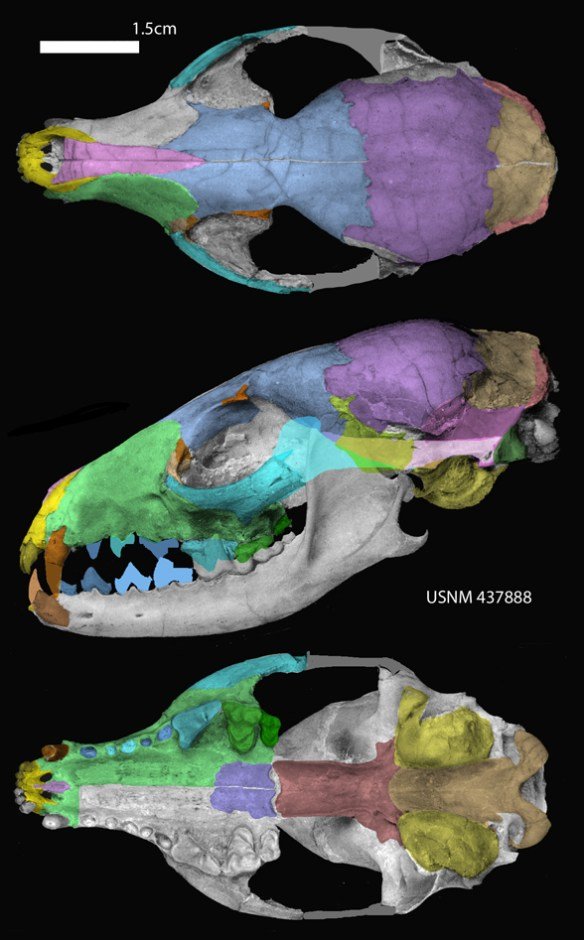
The physical appearance of Hesperocyon was a mosaic of primitive and derived traits, resembling a modern-day genet or a long-bodied fox more than a typical dog. It was a relatively small animal, with an estimated body length of around 80 centimeters from nose to tail tip and a shoulder height of about 20-25 centimeters. Weight estimates place it between 2 and 5 kilograms, comparable to a small domestic cat or a fennec fox. Its skeleton was gracile and elongated, with a long, flexible back and a lengthy, slender tail that likely served as a counterbalance during rapid movements. The limbs were proportionally short compared to modern running canids, suggesting a mode of locomotion that was more agile and adaptable than specialized for endurance running. The feet were digitigrade, meaning it walked on its toes, an advancement over the more plantigrade stance of its miacid ancestors. Its skull, while distinctly canid, retained primitive features. The snout was elongated, and the braincase was relatively small. A key diagnostic feature is its dentition; Hesperocyon possessed the full placental mammal tooth count of 42 teeth, but it was among the first carnivorans to show the loss of the third upper molar, a trend that would continue in later canids. The carnassial teeth (the fourth upper premolar and first lower molar) were well-developed for shearing meat, confirming its carnivorous diet.
The paleobiology of Hesperocyon reveals an adaptable and successful predator navigating a changing world. Its dentition, particularly the sharp carnassials and piercing canines, points unequivocally to a carnivorous diet. Analysis of tooth wear and jaw mechanics suggests it was a hypercarnivore, primarily consuming small vertebrates like lizards, birds, rodents, and other early mammals. Unlike later, larger canids that may have hunted cooperatively, Hesperocyon was likely a solitary or pair-bonded hunter, using stealth and agility to ambush its prey in the undergrowth of woodlands and grasslands. Its skeletal structure, with flexible limbs and a long back, indicates it was a capable and nimble runner, but not a long-distance pursuit predator like modern wolves. Instead, it probably relied on short, rapid bursts of speed to catch its prey. Some paleontologists have suggested, based on its limb proportions and flexible spine, that Hesperocyon may have been partially scansorial, capable of climbing trees to escape larger predators or to find food, much like a modern gray fox. The specific epithet 'gregarius' (meaning sociable) was assigned by Edward Drinker Cope, who found multiple individuals fossilized together, leading him to speculate that they lived in social groups. While direct evidence of pack behavior is absent, these fossil assemblages could suggest family units or communal denning, hinting at the nascent sociality that would become a hallmark of many later canid species.
During the Late Eocene and Early Oligocene, Hesperocyon inhabited a North American landscape undergoing significant environmental transformation. The warm, humid, and heavily forested world of the Eocene was gradually giving way to the cooler, drier conditions of the Oligocene, leading to the expansion of open woodlands and savannas. This environmental shift, known as the Eocene–Oligocene extinction event or the 'Grande Coupure', drove significant faunal turnover. Hesperocyon was well-suited to this new world. It shared its habitat with a diverse array of other mammals, placing it within a complex food web. Potential prey would have included early rodents like Ischyromys, small oreodonts like Merycoidodon, and primitive rabbits like Palaeolagus. However, Hesperocyon was far from the apex predator of its time. It faced competition and predation from larger, more formidable carnivores. These included the nimravids, or 'false saber-toothed cats,' such as Hoplophoneus, and the massive, bear-like hyaenodonts like Hyaenodon horridus. As a small mesopredator, Hesperocyon would have had to be wary and opportunistic, likely using its agility and potential climbing ability to avoid these larger threats while securing its own meals. Its success in this dynamic ecosystem is evidenced by its widespread and abundant fossil record across the Great Plains.
The discovery history of Hesperocyon is rooted in the great 'Bone Wars' of the late 19th century, a period of intense and competitive fossil hunting in the American West. The species Hesperocyon gregarius was first described by the renowned American paleontologist Edward Drinker Cope in 1873. The fossils were collected from the rich Oligocene deposits of the White River Badlands in northeastern Colorado. Cope, in his rush to name new species and outperform his rival Othniel Charles Marsh, initially placed the genus within the family Canidae, recognizing its dog-like characteristics. The name 'Hesperocyon' translates from Greek as 'western dog,' a fitting name for this early North American canid. The holotype specimen, upon which the species description is based, consists of partial skull and jaw fragments. Since Cope's initial work, numerous more complete specimens have been unearthed, particularly from the White River Formation of South Dakota, Nebraska, and Wyoming. These subsequent discoveries, including articulated skeletons, have provided a much clearer picture of its anatomy and lifestyle. There are no single, famously nicknamed specimens of Hesperocyon akin to 'Lucy' the Australopithecus, but the sheer quantity of well-preserved fossils has made it one of the best-understood early carnivorans.
Hesperocyon holds a pivotal position in the evolutionary history of mammals. It is widely recognized as one of the earliest members of the family Canidae, representing the basal stock from which all subsequent canids, both extinct and extant, evolved. It belongs to the now-extinct subfamily Hesperocyoninae, which was the dominant canid group in North America for nearly 25 million years. This subfamily gave rise to the other two major canid subfamilies: the Borophaginae (the 'bone-crushing dogs') and the Caninae (which includes all living canids). Hesperocyon's anatomy provides a perfect example of a transitional form. It retains primitive features from its miacid ancestors, such as the full set of 42 teeth and a less specialized running skeleton. At the same time, it displays key derived traits that define the canid lineage, including the characteristic structure of the auditory bulla (a hollow bony structure on the skull that encloses parts of the middle and inner ear) and the initial loss of the rearmost upper molar. The evolution of the fully ossified auditory bulla is a critical diagnostic feature for the order Carnivora, and its specific structure in Hesperocyon helps link it firmly to the canid branch. By studying Hesperocyon, paleontologists can trace the stepwise acquisition of traits that led to the modern canid form, from changes in dentition reflecting a hypercarnivorous diet to limb modifications for more efficient locomotion.
Despite its well-established position as a basal canid, some aspects of Hesperocyon's biology and classification remain subjects of scientific discussion. One area of debate revolves around its precise mode of life, particularly the extent of its potential climbing ability. While its flexible spine and limb anatomy are suggestive of scansorial habits, similar to a modern raccoon or gray fox, the lack of specialized features like rotatable ankles makes the degree of its arboreality uncertain. It was likely more of a terrestrial generalist with some climbing capability rather than a dedicated tree-dweller. Another point of discussion concerns the diversity within the genus itself. Several species have been assigned to Hesperocyon over the years, but some, like Hesperocyon coloradensis, have since been re-evaluated and are now considered synonyms of H. gregarius or assigned to other genera. Ongoing research, utilizing advanced techniques like CT scanning to analyze internal skull structures, continues to refine our understanding of its sensory capabilities and its exact relationships to other early caniforms. These studies help clarify the subtle evolutionary divergences that occurred as the first true dogs appeared.
The fossil record of Hesperocyon is remarkably robust, making it a cornerstone for understanding early carnivoran evolution in North America. Fossils are particularly abundant in the White River Formation, a vast geological deposit spanning parts of Nebraska, Wyoming, and South Dakota. This formation is famous for its exceptional preservation of Oligocene mammal fossils, often found as complete and articulated skeletons. Dozens, if not hundreds, of Hesperocyon specimens are known, ranging from isolated teeth and jaw fragments to nearly complete skeletons. This abundance has allowed for detailed studies of individual variation, growth, and paleopathology. The Chadron Formation in the same regions also yields significant Hesperocyon material. The quality of preservation is generally good to excellent, providing clear anatomical detail. This wealth of fossil evidence is why Hesperocyon is frequently used as a textbook example of a basal member of an important mammalian family. Major collections of Hesperocyon fossils are housed in prominent institutions like the American Museum of Natural History in New York and the Field Museum in Chicago.
While not a household name like Tyrannosaurus or Triceratops, Hesperocyon has a notable presence in educational contexts and museum displays. Its importance as the 'ancestor of all dogs' makes it a compelling subject for exhibits on canid evolution. Skeletons and life reconstructions of Hesperocyon can be found in many major natural history museums, often featured in dioramas depicting the Oligocene environment of the White River Badlands. It serves as a crucial educational tool to illustrate the concept of a basal ancestor and to trace the deep evolutionary roots of a familiar modern animal. Although it rarely appears in mainstream popular culture like films or television shows, its image is common in paleontological literature, documentaries on prehistoric mammals, and educational materials, where it effectively represents the dawn of the dog family.
Classification
Time Period
Discovery
Location
North America (specifically, the White River Badlands of South Dakota, Nebraska, and Wyoming)
Formation
White River Formation, Chadron Formation
Frequently Asked Questions
What is Hesperocyon?
Hesperocyon gregarius represents one of the earliest and most fundamental branches in the evolutionary history of canids, the family that includes modern dogs, wolves, and foxes. This small, carnivorous mammal lived in North America during the Late Eocene and Early Oligocene epochs, approximately 40...
When did Hesperocyon live?
Hesperocyon lived during the paleogene period of the cenozoic era approximately 40-31 million years ago.
Where was Hesperocyon discovered?
Fossils of Hesperocyon were discovered in North America (specifically, the White River Badlands of South Dakota, Nebraska, and Wyoming) in the White River Formation, Chadron Formation.
What did Hesperocyon eat?
Hesperocyon was a carnivore. It lived in terrestrial (woodlands and open plains) habitats.
What type of fossil is Hesperocyon?
Hesperocyon is preserved as a body fossil. The preservation quality is good.
Related Specimens
From the cenozoic era · body fossils