Plesiosaur
Plesiosaurus dolichodeirus
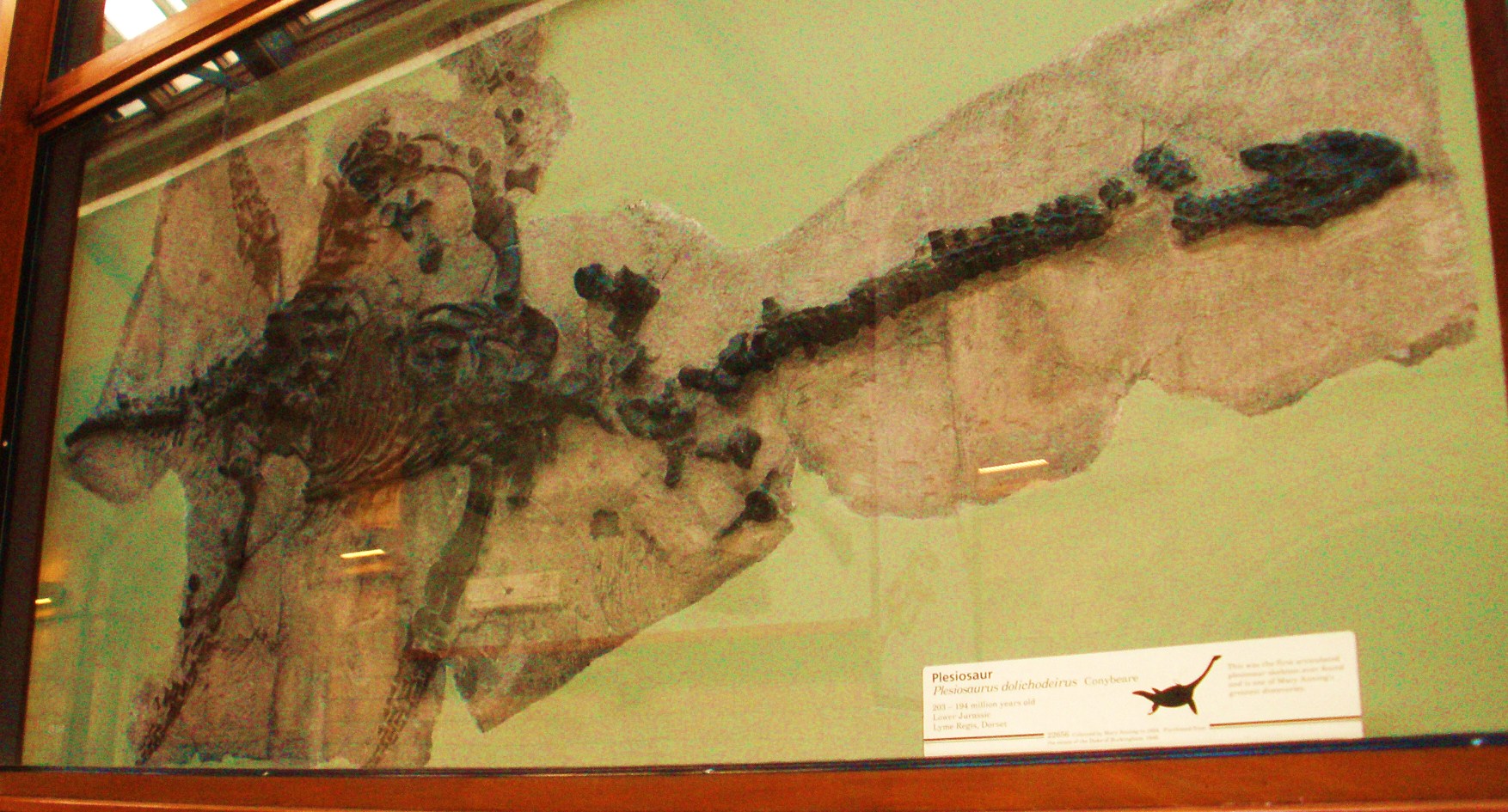
Image: File:Plesiosaurus dolichodeirus.JPG - Wikimedia Commons (CC BY-SA)
About Plesiosaur
Plesiosaurus dolichodeirus is an iconic marine reptile that navigated the shallow seas of the Early Jurassic period, approximately 201 to 199 million years ago. As the archetypal member of the order Plesiosauria, its discovery was a landmark event in the history of paleontology, providing one of the first definitive glimpses into the strange and wonderful ecosystems of the Mesozoic Era. Found primarily in the marine deposits of what is now Lyme Regis, England, this creature's unique anatomy, particularly its extraordinarily long neck, has captured both scientific and public imagination for two centuries, making it a symbol of prehistoric marine life.
The physical anatomy of Plesiosaurus dolichodeirus presents a remarkable combination of features adapted for a fully aquatic existence. The most striking characteristic was its exceptionally long, serpentine neck, which accounted for a significant portion of its total body length of 3 to 3.5 meters. This neck was not merely long but also structurally complex, composed of an astonishing 38 to 42 cervical vertebrae—a number far exceeding that of most other vertebrates, including its terrestrial reptilian ancestors. This vertebral count endowed the neck with considerable flexibility, though biomechanical studies suggest its movement was more akin to a stiff, controllable crane than a hyper-flexible snake, primarily allowing for side-to-side and up-and-down motions. The head perched at the end of this neck was relatively small and streamlined, equipped with a jaw lined with numerous sharp, conical teeth ideal for piercing and securing slippery prey. The torso was broad, flattened, and somewhat rigid, often described as turtle-like in shape, providing a stable core for its powerful locomotive system. Four large, oar-like flippers, each supported by a robust limb girdle, propelled the animal through the water. These flippers, modified from ancestral terrestrial limbs, were hydrodynamically shaped and likely provided the primary thrust for locomotion. An adult Plesiosaurus is estimated to have weighed between 100 and 200 kilograms, a moderate size for a marine predator of its time.
The paleobiology of Plesiosaurus reveals a creature finely tuned to its role as a mid-level predator in the Early Jurassic seas. Its diet consisted primarily of small, fast-moving prey, a conclusion supported by the structure of its teeth and the contents of fossilized stomach remains, known as bromalites, found in related plesiosaurs. These remains indicate a preference for fish and cephalopods, particularly belemnites, which were abundant in the shallow epicontinental seas it inhabited. The long, flexible neck was a key hunting tool, allowing Plesiosaurus to dart its small head into schools of fish or probe crevices for hidden prey without betraying its presence with the movement of its much larger body. This ambush or pursuit strategy would have been highly effective in the clear, well-lit waters of its habitat. Locomotion was achieved through a unique method of "underwater flight," where all four flippers were moved in a coordinated, figure-eight pattern, similar to the way modern sea lions and penguins swim. This method would have provided both powerful propulsion for pursuit and exceptional maneuverability for navigating complex underwater environments. While direct evidence for social behavior is scarce, the discovery of multiple individuals in close proximity suggests they may have lived in groups or congregated in specific feeding or breeding areas. Growth patterns, inferred from bone histology, indicate a relatively rapid growth rate during their juvenile stages, typical of many marine reptiles.
Plesiosaurus lived in the warm, shallow epicontinental seas that covered much of Europe during the Hettangian and Sinemurian stages of the Early Jurassic. The climate of this period was significantly warmer and more humid than today, with no polar ice caps, resulting in high sea levels that flooded continental lowlands. The specific environment preserved in the Blue Lias Formation of Lyme Regis was a subtropical marine shelf, characterized by a seafloor of soft mud and clay. This ecosystem was teeming with life, creating a complex and competitive food web. Plesiosaurus shared these waters with a diverse array of other marine reptiles, placing it in the middle of the predatory hierarchy. It was preyed upon by larger predators such as the formidable ichthyosaur Temnodontosaurus and potentially early pliosaurs. Its own prey included a variety of bony fish like Dapedium, as well as abundant cephalopods such as belemnites and ammonites. The seafloor was rich with invertebrates, including crinoids, bivalves, and gastropods, which formed the base of the food web. This rich biodiversity indicates that Plesiosaurus was part of a dynamic and mature marine ecosystem, occupying a niche as a specialized hunter of small, agile prey, distinct from the larger apex predators that dominated the open waters.
The discovery history of Plesiosaurus is inextricably linked with the birth of paleontology as a formal science and the pioneering work of Mary Anning. While fragmentary remains had been found earlier, the first nearly complete and articulated skeleton of Plesiosaurus dolichodeirus was unearthed in the winter of 1823 by Anning from the cliffs of the Blue Lias Formation at Lyme Regis, Dorset, England. This remarkable specimen, now housed in the Natural History Museum in London, was so bizarre that its authenticity was initially questioned by prominent scientists, including the French anatomist Georges Cuvier. However, after careful examination, Cuvier famously declared it the most monstrous creature yet discovered. The fossil was acquired by the geologist and paleontologist William Conybeare, who, along with Henry De la Beche, formally described and named the genus in 1821 based on earlier, less complete finds. The specific name, *dolichodeirus*, meaning "long-necked," was assigned to Anning's 1823 specimen to highlight its most defining feature. This discovery was monumental, providing irrefutable evidence of a lost world inhabited by giant, extinct reptiles and challenging prevailing views on the history of life. It helped solidify the concept of extinction and fueled the "Dinosaur Mania" that swept through Victorian England, forever changing our perception of Earth's ancient past.
In the grand tapestry of evolution, Plesiosaurus holds a crucial position as the namesake and a foundational member of the superorder Sauropterygia, a highly successful and diverse clade of Mesozoic marine reptiles. Sauropterygians originated in the Triassic period from land-dwelling reptilian ancestors, gradually adapting to a marine lifestyle. Plesiosaurus and its relatives represent the pinnacle of this aquatic adaptation, having completely severed their ties to land for locomotion and reproduction, likely giving birth to live young at sea. The evolutionary lineage of plesiosaurs is still a subject of active research, but they are generally placed within the Eusauropterygia, a group that also includes the short-necked pliosaurs. The unique four-flippered swimming style of Plesiosaurus is a key evolutionary innovation, a mode of propulsion not seen in any living reptile today, though it is analogous to that of sea turtles and penguins. While sauropterygians have no direct living descendants, their closest modern relatives are thought to be either turtles or archosaurs (the group containing crocodiles and birds), though their precise placement within the reptile family tree remains one of the major unresolved questions in vertebrate paleontology. The success of the plesiosaur body plan is underscored by its persistence for over 135 million years, from the Late Triassic until the mass extinction event at the end of the Cretaceous.
Despite its long history of study, Plesiosaurus remains the subject of several scientific debates. One of the most persistent controversies revolves around the function and flexibility of its long neck. Early artistic reconstructions depicted it as a hyper-flexible, swan-like appendage capable of striking far out of the water. However, modern biomechanical analyses by paleontologists such as Leslie Noè and Adam Smith have demonstrated that the vertebral structure would have prevented such extreme movements. The neck was likely much stiffer, used for sweeping side-to-side or darting downwards to catch prey beneath the body, rather than for serpentine contortions. Another area of debate concerns taxonomy. For many years, the genus Plesiosaurus became a "wastebasket taxon," with numerous species from around the world being assigned to it. A major revision in the 21st century, led by paleontologist Frank Robin O'Keefe, has since restricted the genus to only the type species, *Plesiosaurus dolichodeirus*, from the Early Jurassic of England. This taxonomic cleanup has clarified the evolutionary relationships within Plesiosauria but has also highlighted how much remains to be learned about the group's early diversity and distribution. The exact method of its four-flippered locomotion also continues to be modeled and debated, with questions remaining about the precise coordination and power stroke of the fore and hind limbs.
The fossil record of Plesiosaurus dolichodeirus is geographically and temporally restricted, primarily known from the Lower Lias Group, specifically the Blue Lias Formation, of Dorset and Somerset in England. This region, often referred to as the Jurassic Coast, is a UNESCO World Heritage Site renowned for its exceptionally well-preserved Early Jurassic marine fossils. The holotype specimen discovered by Mary Anning in 1823 remains one of the most complete and historically significant plesiosaur skeletons ever found. Several other partial to nearly complete skeletons of *P. dolichodeirus* have since been recovered from the same geological formation, providing a solid anatomical basis for the species. The quality of preservation is often excellent, with many specimens found in articulation, their bones still arranged in their life positions within nodules of limestone. This high-fidelity preservation has allowed for detailed studies of its anatomy, from the delicate bones of the skull to the complex structure of the limb girdles. While fossils once attributed to Plesiosaurus have been reported from other parts of the world, modern taxonomic revisions have reassigned these to other genera, confirming that the true Plesiosaurus was, as far as is currently known, an inhabitant of the seas covering Early Jurassic Europe.
From the moment of its discovery, Plesiosaurus has had a profound cultural impact, shaping both scientific thought and popular imagination. Its strange and elegant form made it an instant star in the 19th century, featured prominently in early paleontological art, such as the famous 1830 painting "Duria Antiquior" by Henry De la Beche. Skeletons of Plesiosaurus are prized exhibits in major museums worldwide, including the Natural History Museum in London, where Mary Anning's original find continues to awe visitors. Its distinctive silhouette has made it a recurring figure in popular culture, appearing in books, films, and documentaries about prehistoric life. Perhaps most famously, the long-necked, four-flippered body plan of the plesiosaur has served as the dominant archetype for depictions of the mythical Loch Ness Monster, cementing its place in modern folklore. As one of the first major extinct reptiles to be scientifically described, Plesiosaurus played a crucial educational role, helping to introduce the public to the concepts of deep time, extinction, and the existence of ancient worlds vastly different from our own.
Classification
Time Period
Discovery
Location
Lyme Regis, Dorset, England
Formation
Blue Lias
Frequently Asked Questions
What is Plesiosaur?
Plesiosaurus dolichodeirus is an iconic marine reptile that navigated the shallow seas of the Early Jurassic period, approximately 201 to 199 million years ago. As the archetypal member of the order Plesiosauria, its discovery was a landmark event in the history of paleontology, providing one of the...
When did Plesiosaur live?
Plesiosaur lived during the jurassic period of the mesozoic era approximately 201-199 million years ago.
Where was Plesiosaur discovered?
Fossils of Plesiosaur were discovered in Lyme Regis, Dorset, England in the Blue Lias.
What did Plesiosaur eat?
Plesiosaur was a carnivore. It lived in marine habitats.
What type of fossil is Plesiosaur?
Plesiosaur is preserved as a body fossil. The preservation quality is excellent.
Related Specimens
From the mesozoic era · body fossils