Pyrotherium
Pyrotherium romeroi
Image: Image sourced via web search (Fair use / Educational)
About Pyrotherium
Pyrotherium romeroi represents one of the most enigmatic and visually striking large mammals of the South American Cenozoic, a continent that for millions of years was an isolated island laboratory of evolution. This massive herbivore lived during the Late Oligocene epoch, approximately 30 to 25 million years ago, inhabiting the woodlands and savannas of what is now Argentina. Its name, meaning 'fire beast,' hints at its discovery in volcanic ash deposits, and its unique combination of features has long puzzled paleontologists, making it a key subject for understanding the strange evolutionary paths taken by the endemic fauna of ancient South America.
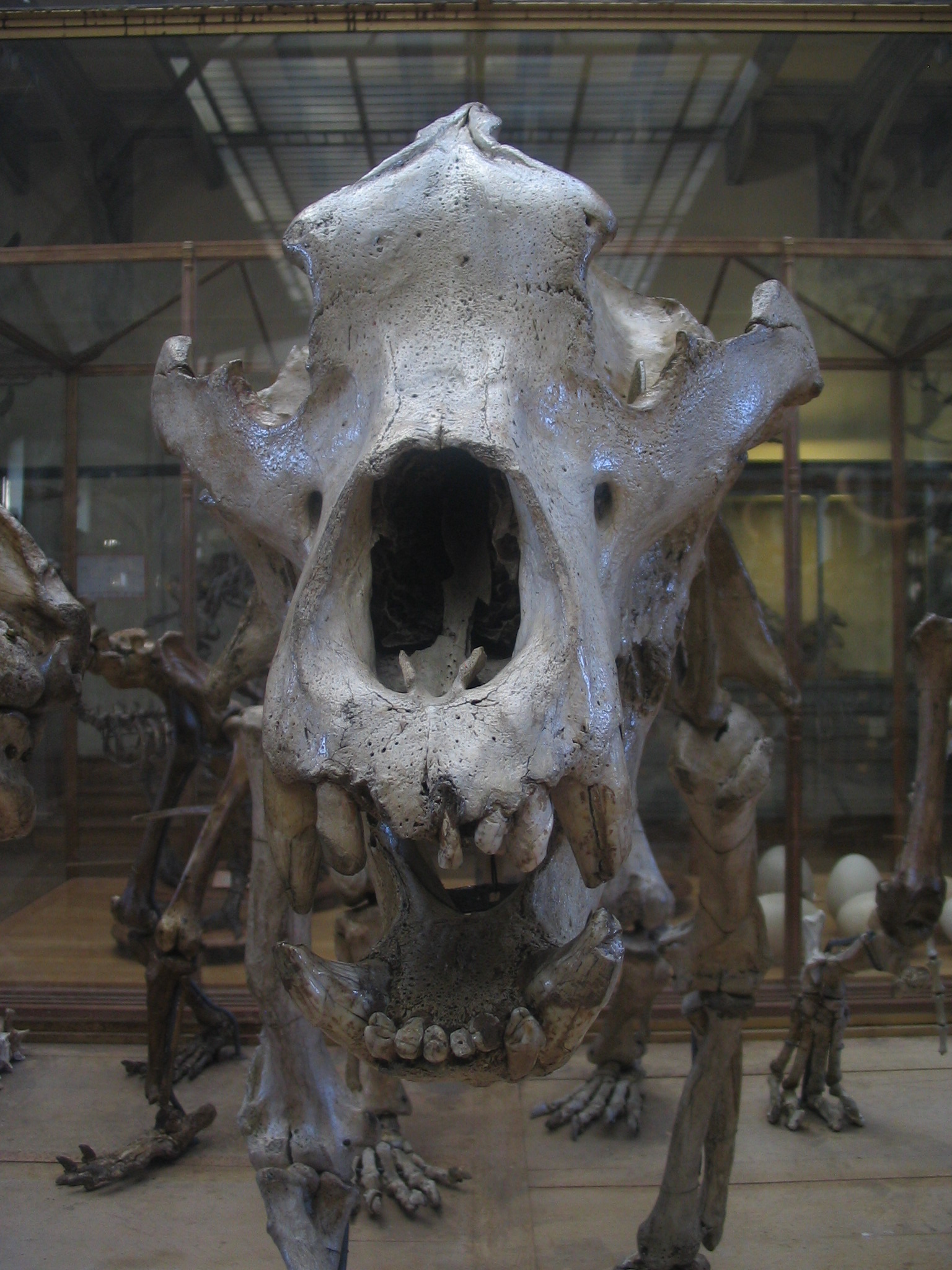
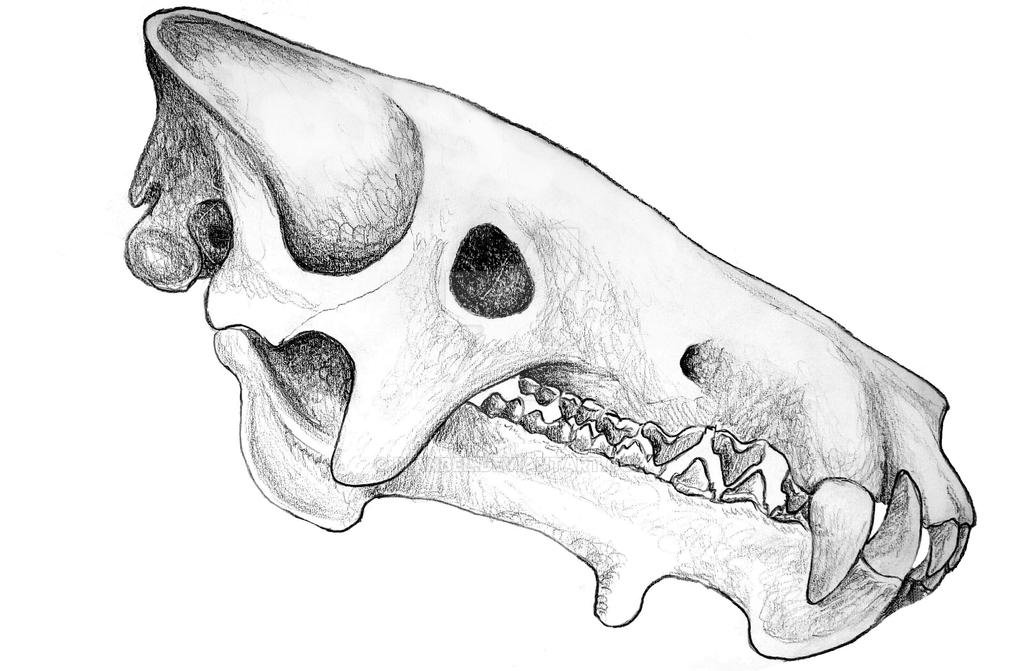
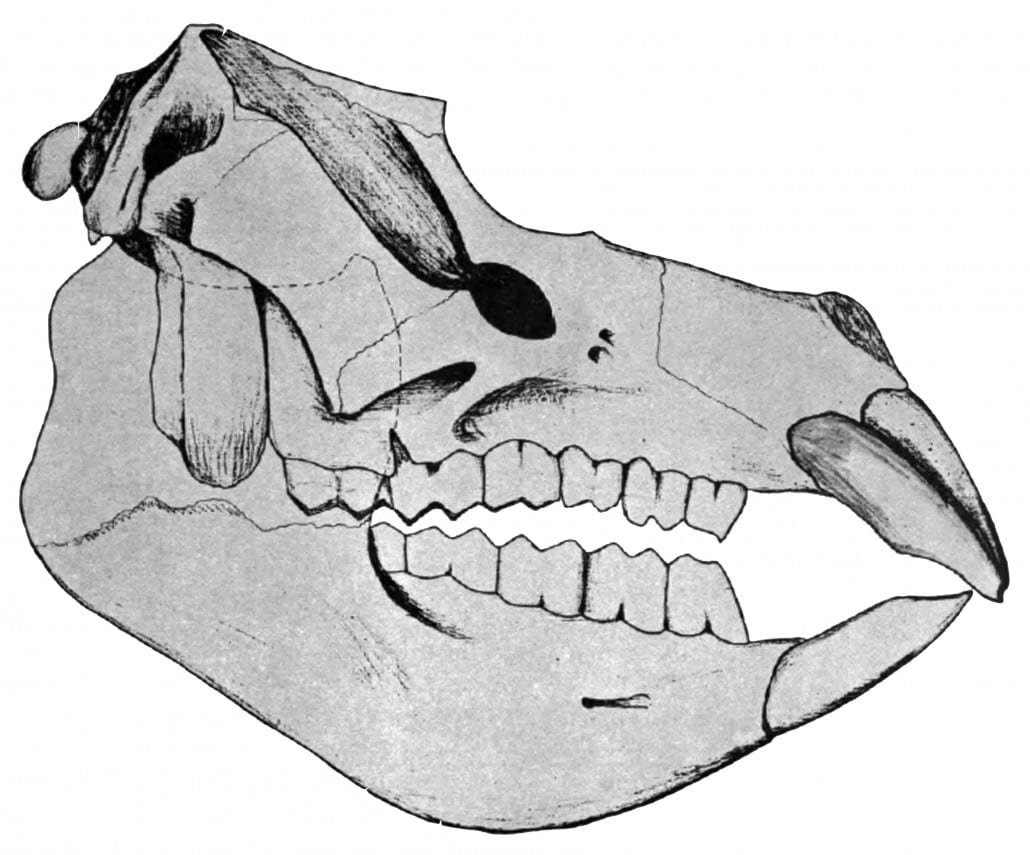
Standing approximately 1.5 meters (5 feet) tall at the shoulder and reaching a body length of 3 to 3.5 meters (10 to 11.5 feet), Pyrotherium was a heavily built, graviportal animal, meaning its limbs were adapted to support immense weight, much like modern elephants or rhinoceroses. Weight estimates vary but generally place it in the range of 1,000 to 3,500 kilograms (2,200 to 7,700 pounds), with larger individuals potentially exceeding this. Its overall body plan was robust and barrel-chested, supported by short, pillar-like legs ending in broad, five-toed feet. The most distinctive features were found in its skull. Pyrotherium possessed a short, deep skull with high-set nasal openings, a feature that strongly suggests the presence of a fleshy, muscular proboscis or trunk, similar to that of a tapir or perhaps a small elephant. Its dentition was equally bizarre. At the front of its jaw were four large, tusk-like incisors—two in the upper jaw and two in the lower—that projected forward and slightly outward. These were ever-growing and likely used for defense, display, or stripping bark and vegetation. Behind these tusks was a gap, or diastema, followed by a series of massive, low-crowned, broad molars and premolars designed for grinding tough plant material. The structure of its skeleton, particularly the robust vertebrae and limb bones, confirms it was a slow-moving, powerful creature built for bulk rather than speed.
The paleobiology of Pyrotherium is inferred from its unique anatomy and the environment it inhabited. Its dental morphology, with large, flat grinding molars, unequivocally points to a herbivorous diet. The wear patterns on its teeth suggest it fed on a variety of abrasive plant matter, including tough leaves, stems, and possibly fruits. The presence of a proboscis would have been a highly effective tool for foraging, allowing it to grasp and manipulate branches, pull vegetation into its mouth, and perhaps even uproot smaller plants. Its forward-facing tusks could have been used to strip bark from trees, dig for roots, or push through dense undergrowth. Locomotion was strictly terrestrial and graviportal; Pyrotherium was a slow, deliberate walker, incapable of running or leaping. Its sheer size would have been its primary defense against the few large predators of its time. While direct evidence of social behavior is absent, many large herbivores today live in herds for mutual protection and foraging efficiency. It is plausible that Pyrotherium exhibited similar social structures, perhaps living in small family groups or larger aggregations, especially around water sources. Its large body size suggests a relatively slow metabolism and a long lifespan, with growth patterns likely extending over many years, similar to modern megafauna like elephants.
During the Late Oligocene, South America was an island continent, completely isolated from North America and other landmasses. This isolation fostered the evolution of a unique and often strange fauna. The climate of Patagonia, where Pyrotherium lived, was warmer and wetter than today, supporting a mosaic of subtropical woodlands, open savannas, and riverine forests. Pyrotherium shared this ecosystem with a diverse array of other endemic mammals. These included large, flightless predatory birds known as phorusrhacids ('terror birds'), which were likely apex predators capable of preying on young or infirm Pyrotherium. Other contemporary herbivores included various notoungulates, such as the sheep-like Interatherium and the larger, rhino-like Homalodotherium, as well as litopterns like the camel-like Theosodon. The food web placed Pyrotherium as a primary consumer, a high-volume browser or mixed feeder that played a significant role in shaping the vegetation structure of its habitat. Its main predators, besides terror birds, may have included large, carnivorous sparassodonts—metatherian mammals that convergently evolved to fill niches occupied by placental carnivores elsewhere in the world. The environment was dynamic, with ongoing volcanic activity from the rising Andes mountain range periodically blanketing the landscape in ash, which, while destructive, also led to the exceptional preservation of fossils.
The discovery history of Pyrotherium is rooted in the late 19th-century paleontological explorations of Argentina, a period often called the 'Age of the Bone Wars' in South America. The genus was first described by the renowned Argentine paleontologist Florentino Ameghino in 1889. The initial fossils, including the type specimen of *Pyrotherium romeroi*, were collected from the volcanic ash layers of the Deseado Formation in Santa Cruz Province, Patagonia. The generic name *Pyrotherium*, meaning 'fire beast' (from Greek *pyr* for fire and *therion* for beast), was chosen by Ameghino specifically because the fossils were found in pyroclastic deposits, which he initially misinterpreted as Pliocene in age. The specific name, *romeroi*, honors Captain Antonio Romero, who assisted Ameghino during his expeditions. Over the following decades, more complete material, including skulls, jaws, and postcranial elements, was unearthed by Ameghino and other paleontologists like Carlos Ameghino and Santiago Roth. These subsequent finds, primarily from the Deseado and Sarmiento Formations, allowed for a more complete reconstruction of the animal and a better understanding of its anatomy, although its evolutionary relationships remained a persistent puzzle for over a century. No single, exceptionally complete individual skeleton akin to 'Sue' the T. rex has been found, but the composite material from various individuals provides a solid picture of the animal's appearance.
The evolutionary significance of Pyrotherium lies in its status as a prime example of the evolutionary experimentation that occurred on the isolated continent of South America. For decades, its phylogenetic placement was highly debated. Early paleontologists, noting its tusk-like incisors and trunk, initially classified it as a proboscidean, suggesting a close relationship with elephants. This was a classic case of convergent evolution, where unrelated organisms independently evolve similar traits to adapt to similar lifestyles. Later, it was grouped with other endemic South American ungulates, but its precise relationship to orders like Notoungulata and Astrapotheria remained unclear. For a long time, Pyrotheria was considered a distinct order of mammals with no known relatives outside of South America. However, a revolutionary 2021 study by palaeontologist Ross D. E. MacPhee and colleagues, based on ancient protein sequencing from collagen extracted from Pyrotherium fossils, provided a stunning breakthrough. The molecular data demonstrated that Pyrotherium was not closely related to other South American ungulates but was instead a sister taxon to the Notoungulata. This finding reshaped the family tree of South American mammals, confirming that these diverse ungulate groups formed a single, massive evolutionary radiation known as Meridiungulata, which is now understood to be distantly related to modern perissodactyls (horses, rhinos, and tapirs).
This recent molecular evidence has been pivotal in resolving some of the longest-standing scientific debates surrounding Pyrotherium. The controversy over its classification—whether it was a proboscidean, a unique order, or part of another South American group—persisted for over 130 years. The collagen analysis provided the first non-morphological evidence to definitively place it within the Meridiungulata clade, specifically as a close relative of the notoungulates. Another area of debate has been the exact function and size of its proboscis. While the high placement of the nasal opening is strong evidence for a trunk, its exact length, flexibility, and muscularity remain speculative. Interpretations range from a short, tapir-like prehensile snout to a more substantial, albeit short, elephant-like trunk. Without soft tissue preservation, this debate relies entirely on anatomical inference and comparison with living analogues, leaving room for varied interpretations among paleontologists.
The fossil record of Pyrotherium is geographically restricted to South America, primarily Argentina and Bolivia. The most significant and numerous specimens have been recovered from the Deseado and Sarmiento Formations in the Santa Cruz and Chubut provinces of Patagonia, Argentina. These geological units are famous for their rich Late Oligocene terrestrial vertebrate faunas. The fossils consist mostly of disarticulated and fragmentary remains, with skulls, mandibles, and teeth being the most commonly preserved elements due to their durability. Complete, articulated skeletons are exceptionally rare, and much of our understanding of the postcranial anatomy comes from piecing together bones from multiple individuals. The preservation quality is generally fair; while the bones themselves are often well-mineralized and robust, they are typically found isolated. The volcanic ash beds in which they are often found contributed to their rapid burial and preservation, protecting them from scavenging and extensive weathering, which is why a decent amount of material exists despite the lack of complete skeletons.
Despite its bizarre appearance and scientific importance, Pyrotherium has a relatively modest cultural impact compared to dinosaurs or Ice Age megafauna like mammoths. It is not a household name but is well-regarded in paleontological circles and among enthusiasts of prehistoric life. It occasionally appears in documentary series about prehistoric mammals, such as 'Walking with Beasts,' where it is often highlighted as an example of South America's unique evolutionary history. Several museums hold significant Pyrotherium fossils, with the most important collections housed in Argentine institutions like the Museo de La Plata and the Museo Argentino de Ciencias Naturales in Buenos Aires. These displays, often featuring striking skull casts or life-sized reconstructions, serve an important educational role, introducing the public to the fascinating and unfamiliar world of extinct South American megafauna and the powerful concept of convergent evolution.
Classification
Time Period
Discovery
Location
Argentina
Formation
Deseado Formation and Sarmiento Formation
Frequently Asked Questions
What is Pyrotherium?
Pyrotherium romeroi represents one of the most enigmatic and visually striking large mammals of the South American Cenozoic, a continent that for millions of years was an isolated island laboratory of evolution. This massive herbivore lived during the Late Oligocene epoch, approximately 30 to 25 mil...
When did Pyrotherium live?
Pyrotherium lived during the paleogene period of the cenozoic era approximately 30-25 million years ago.
Where was Pyrotherium discovered?
Fossils of Pyrotherium were discovered in Argentina in the Deseado Formation and Sarmiento Formation.
What did Pyrotherium eat?
Pyrotherium was a herbivore. It lived in terrestrial habitats.
What type of fossil is Pyrotherium?
Pyrotherium is preserved as a body fossil. The preservation quality is fair.
Related Specimens
From the cenozoic era · body fossils