Megatherium
Megatherium americanum
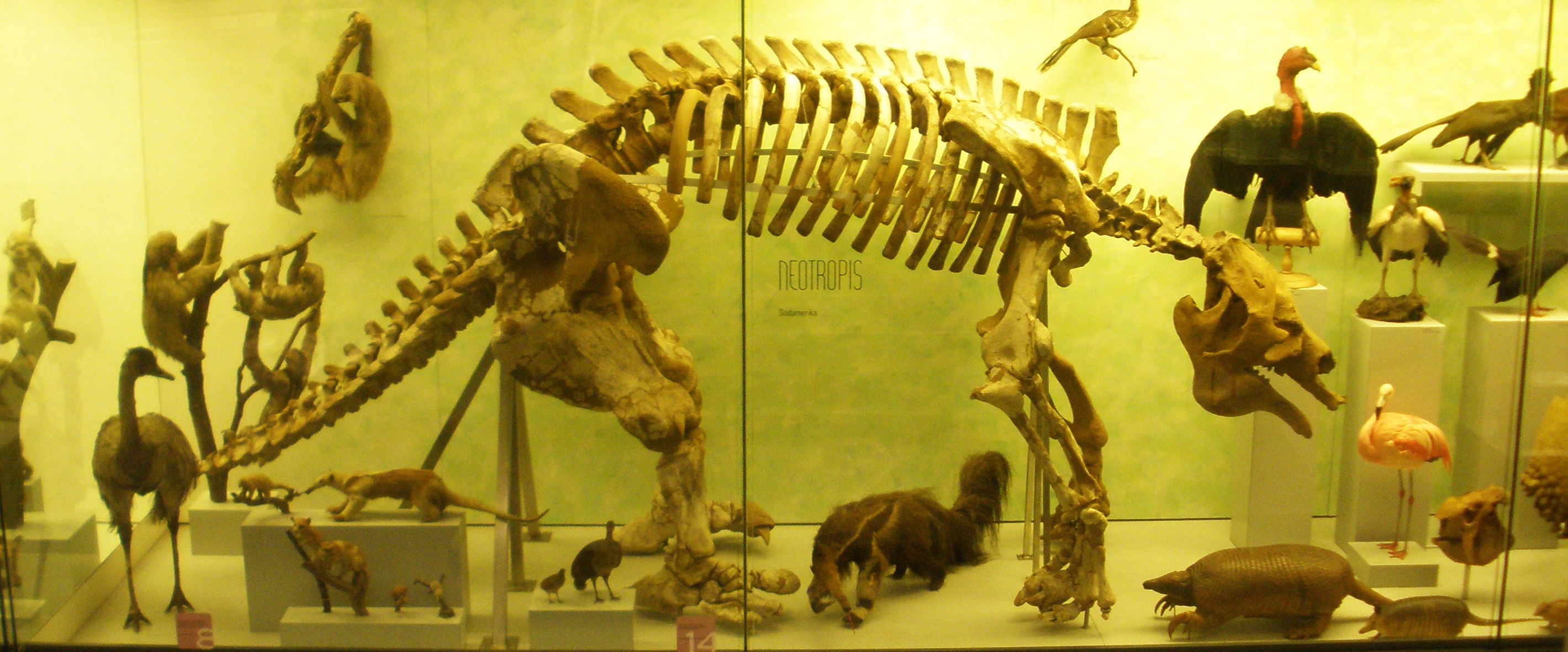
Image: File:Megatherium americanum.JPG - Wikimedia Commons (CC BY-SA)
About Megatherium
Megatherium americanum was a colossal species of ground sloth that inhabited the woodlands and grasslands of South America during the Pliocene and Pleistocene epochs. As one of the largest land mammals of the Cenozoic era, its immense size and unique adaptations made it a dominant megaherbivore in its ecosystem. The study of this remarkable creature, from its initial discovery in the late 18th century to modern paleontological analyses, has been instrumental in shaping our understanding of extinction, paleobiology, and the lost worlds of the Quaternary period.
The physical stature of Megatherium americanum was truly staggering, placing it among the largest terrestrial mammals to have ever lived. An adult individual could reach a length of up to 6 meters (approximately 20 feet) from snout to tail tip, with a shoulder height that approached 2.5 meters when on all fours. Its estimated body mass was around 4 tonnes (4,000 kilograms or 8,800 pounds), a weight comparable to that of a modern African bush elephant. The skeleton was exceptionally robust, built to support this immense bulk. The pelvic girdle was particularly broad and massive, providing a stable base for its powerful hind limbs. These hind legs, combined with a thick, muscular tail, formed a tripod-like structure that allowed the animal to rear up and stand bipedally for extended periods. This posture would have enabled it to browse on high tree branches, far beyond the reach of most contemporary herbivores. The forelimbs were long and possessed a remarkable degree of rotation, ending in hands equipped with enormous, curved claws, with the largest claw core measuring over 30 centimeters in length. Its skull was relatively small and elongated for its body size, featuring a deep jaw and high-crowned, ever-growing cheek teeth (hypsodont) adapted for grinding tough, fibrous plant matter. Unlike its modern relatives, Megatherium was a fully terrestrial animal, its skeletal architecture precluding any arboreal activity.
The paleobiology of Megatherium reveals a highly specialized megaherbivore adapted to a selective browsing diet. Isotopic analysis of its fossilized remains, particularly the collagen from its bones, suggests that it was not a generalist grazer but a browser that consumed a wide variety of trees, shrubs, and other high-growing vegetation. Its unique ability to stand bipedally, using its tail for support, was a key feeding strategy, allowing it to access foliage unavailable to other large herbivores. The powerful forelimbs and formidable claws were not primarily for predation but served as highly effective tools for manipulating its environment. It would have used these claws to hook and pull down large branches, strip bark from trees, and dig for nutritious roots and tubers. Locomotion was ponderous and slow; Megatherium was a graviportal animal, meaning its limbs were adapted to support great weight rather than for speed. It walked on the sides of its feet in a plantigrade or semi-plantigrade manner, with its large claws turned inward to avoid dulling them on the ground. This slow, deliberate movement pattern suggests it relied on its sheer size and formidable claws for defense rather than flight. While largely solitary, fossil trackways suggest they may have occasionally moved in small groups.
Megatherium americanum thrived in the dynamic environments of Pleistocene South America, a continent characterized by shifting climates and diverse habitats. It primarily inhabited the pampas, savannas, and open woodlands that expanded and contracted with glacial and interglacial cycles. The climate of this period, particularly in regions like the Luján Formation of Argentina where its fossils are abundant, was generally cooler and drier than today. This environment supported a rich megafaunal community, and Megatherium was a keystone species within this ecosystem. It shared its habitat with other large herbivores such as the glyptodonts Doedicurus and Glyptodon, the toxodontid Toxodon, and the giant camelid-like Macrauchenia. As a primary consumer of vast quantities of plant matter, Megatherium played a crucial role as an ecological engineer, shaping the landscape by creating clearings in wooded areas and influencing plant distribution. Its main predators were likely the formidable saber-toothed cat Smilodon populator and potentially packs of the giant short-faced bear Arctotherium. However, a fully grown Megatherium would have been a dangerous adversary, capable of inflicting mortal wounds with its powerful claws, making it a challenging target for even the apex predators of its time.
The discovery of Megatherium is a landmark event in the history of paleontology and played a pivotal role in establishing the scientific concept of extinction. The first documented fossil skeleton was unearthed in 1788 by Manuel de Torres on the banks of the Luján River in what is now Buenos Aires Province, Argentina. Recognizing its importance, the Viceroy of the Río de la Plata, the Marquis of Loreto, had the skeleton carefully excavated and shipped to the Royal Cabinet of Natural History in Madrid, Spain, where it was mounted by Juan Bautista Bru in 1789. This mounted skeleton, still on display today, became a scientific sensation. In 1796, the renowned French comparative anatomist Georges Cuvier received detailed drawings of the skeleton. By meticulously comparing its anatomy to that of living animals, Cuvier correctly identified it as a giant, extinct relative of modern tree sloths. He named it Megatherium, meaning "great beast," and his subsequent 1804 publication on the specimen provided irrefutable evidence that species could and did become extinct, a revolutionary idea that challenged the prevailing belief in a static, unchanging natural world. Cuvier's work on Megatherium helped lay the foundation for the modern sciences of paleontology and evolutionary biology.
Megatherium occupies a significant branch on the mammalian tree of life, belonging to the superorder Xenarthra, a group of mammals largely unique to the Americas that also includes modern sloths, armadillos, and anteaters. Within this group, it is classified in the family Megatheriidae, a lineage of ground sloths that included some of the largest members of the order Pilosa. Its evolutionary history is rooted in the long period of South American isolation following the breakup of Gondwana. For tens of millions of years, xenarthrans diversified in isolation, producing a remarkable array of forms. The ancestors of Megatherium were likely smaller, perhaps semi-arboreal creatures that gradually adapted to a terrestrial lifestyle, increasing in size to exploit new ecological niches. The development of its massive, robust skeleton, specialized dentition, and bipedal browsing capabilities represent key evolutionary adaptations. While it shares a common ancestry with modern two-toed (Choloepus) and three-toed (Bradypus) sloths, it is not a direct ancestor. Instead, Megatherium represents a highly successful but ultimately extinct branch of sloth evolution, showcasing the incredible adaptive radiation of this unique mammalian group during the Cenozoic.
Despite being one of the most well-studied fossil mammals, Megatherium continues to be the subject of scientific debate. One long-standing controversy revolved around its diet. While the herbivorous nature of the animal is now widely accepted based on its dental morphology and isotopic signatures, some early 20th-century paleontologists proposed a more carnivorous or scavenging lifestyle. They argued that its large claws could have been used to tear open carcasses of large animals. However, biomechanical studies of its skull and jaw show it was ill-suited for processing meat, and the overwhelming evidence points to a diet of tough, fibrous plants. Another area of debate concerns the function of its claws. While their use in pulling down branches and defense is clear, their potential role in constructing large burrows has also been proposed, based on the discovery of enormous "paleoburrows" in South America that match the size and shape of a giant ground sloth. The exact cause of its extinction also remains a topic of intense discussion, with arguments weighing the relative impacts of climate change at the end of the Pleistocene versus overkill by early human hunters.
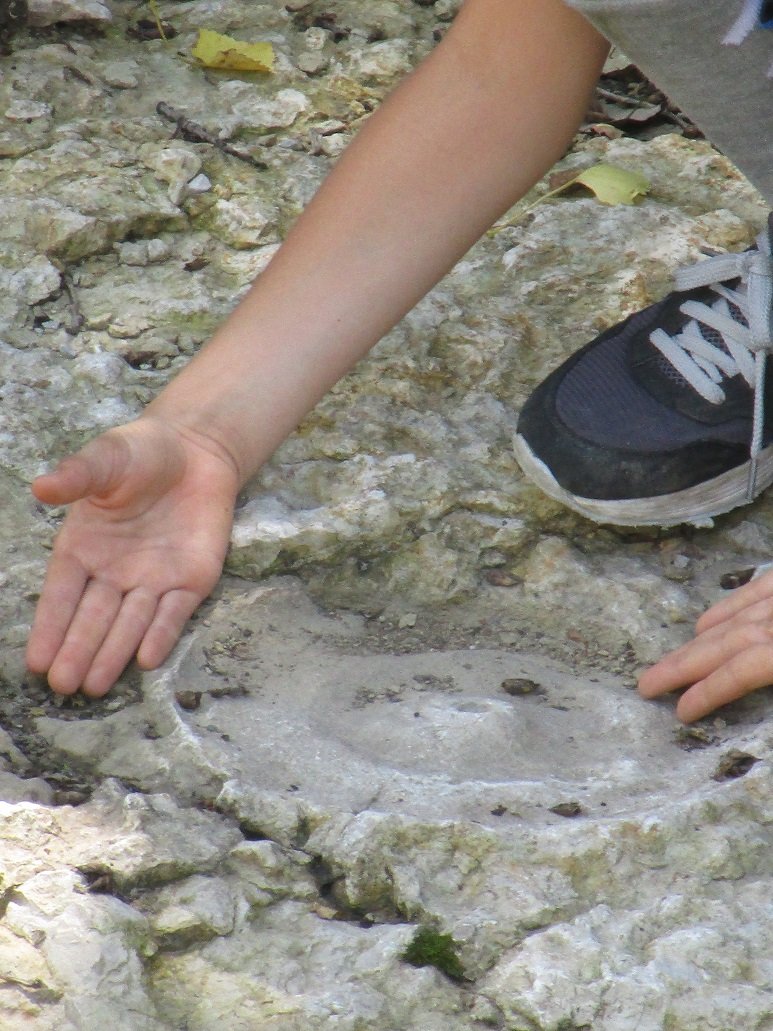
The fossil record of Megatherium americanum is exceptionally rich, providing paleontologists with a detailed picture of its anatomy and distribution. Its remains are found primarily in the Pleistocene deposits of the Pampas region of South America, with the most famous and complete specimens originating from the Luján and Pampean Formations in Argentina. Other fossils have been recovered from Uruguay, southern Brazil, Paraguay, and Bolivia, indicating a wide geographic range across the southern and central parts of the continent. The fossil record includes numerous complete and partial skeletons, isolated bones, skulls, and even preserved footprints (ichnofossils). The high quality of preservation at sites like the Luján River has allowed for detailed studies of its bone histology, revealing growth patterns, and the analysis of preserved biomolecules like collagen, which provides direct evidence of its diet. The abundance of fossils has made Megatherium a model organism for studying the paleobiology of Cenozoic megafauna.
Since its initial discovery, Megatherium has captured the public imagination and has become an iconic symbol of prehistoric life. Its colossal skeleton is a centerpiece exhibit in major natural history museums around the world, including the National Museum of Natural Sciences in Madrid, the Natural History Museum in London, and the Muséum National d'Histoire Naturelle in Paris. Its strange and imposing appearance has led to its inclusion in popular culture, featuring in documentaries, books, and films about the ice age. As one of the first extinct animals to be scientifically described and reconstructed, it holds a special place in the history of science and serves as a powerful educational tool for teaching concepts of evolution, extinction, and deep time.
Classification
Time Period
Discovery
Location
Luján, Buenos Aires Province, Argentina
Formation
Luján Formation
Frequently Asked Questions
What is Megatherium?
Megatherium americanum was a colossal species of ground sloth that inhabited the woodlands and grasslands of South America during the Pliocene and Pleistocene epochs. As one of the largest land mammals of the Cenozoic era, its immense size and unique adaptations made it a dominant megaherbivore in i...
When did Megatherium live?
Megatherium lived during the quaternary period of the cenozoic era approximately 2.5-0.0117 million years ago.
Where was Megatherium discovered?
Fossils of Megatherium were discovered in Luján, Buenos Aires Province, Argentina in the Luján Formation.
What did Megatherium eat?
Megatherium was a herbivore. It lived in terrestrial habitats.
What type of fossil is Megatherium?
Megatherium is preserved as a body fossil. The preservation quality is excellent.
Related Specimens
From the cenozoic era · body fossils