Walliserops
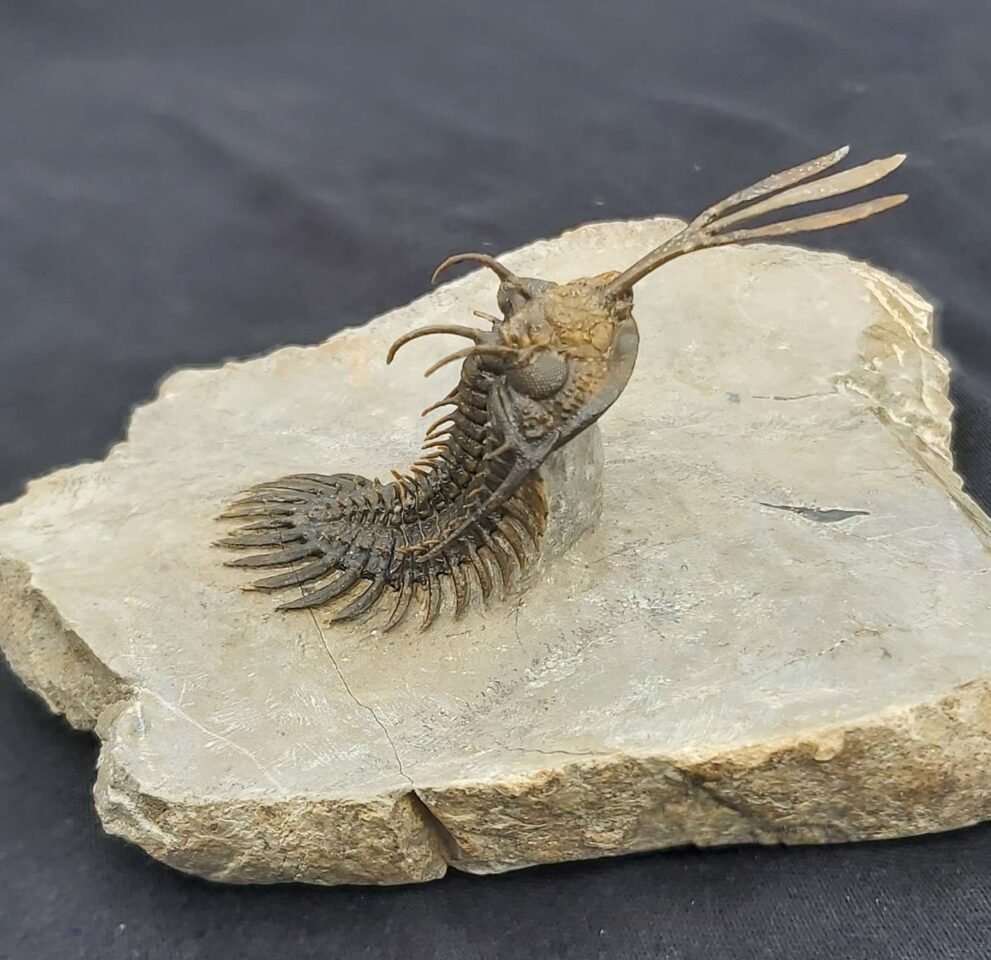
Walliserops trifurcatus
Image: Image sourced via web search (Fair use / Educational)
About Walliserops
Walliserops is a genus of phacopid trilobite that lived during the Emsian to Eifelian stages of the Lower to Middle Devonian period, approximately 393 to 383 million years ago. These distinctive marine arthropods inhabited the warm, shallow seas that covered the continental shelf of the supercontinent Gondwana, in a region that is now part of modern-day Morocco. The genus is renowned for its extraordinary and often bizarre cephalic ornamentation, most famously the long, trident-like fork extending from the front of its head, making it one of the most visually striking and enigmatic trilobites known to science.
Walliserops was a relatively small trilobite, with most adult specimens measuring between 5 and 10 centimeters (approximately 2 to 4 inches) in length, comparable to a large modern shrimp or a small crayfish. Its body plan followed the typical trilobite form, divided into three main sections: the cephalon (head), the segmented thorax, and the pygidium (tail shield). The cephalon was semi-circular and bore large, crescent-shaped schizochroal eyes, which were composed of multiple, relatively large, individually set calcite lenses. This advanced visual system would have provided Walliserops with a wide, high-resolution field of view, crucial for detecting predators and navigating its complex reef environment. The most defining feature, however, was its prominent rostral projection, a long spine extending forward from the glabella (the central raised lobe of the cephalon). In the type species, *Walliserops trifurcatus*, this spine terminates in a symmetrical, three-pronged fork, or trident. The function of this elaborate structure is a subject of intense scientific debate, with hypotheses ranging from sensory perception and defense to intraspecific combat and sexual display. The thorax consisted of 11 articulating segments, allowing for significant flexibility and the ability to enroll into a defensive ball, a common behavior among many trilobite groups. The pygidium was small and rounded, composed of fused segments. The entire dorsal exoskeleton was covered in fine granules and tubercles, providing both structural reinforcement and potentially a degree of camouflage against the seafloor substrate.
The paleobiology of Walliserops is largely inferred from its morphology and the paleoenvironment in which its fossils are found. Its well-developed eyes suggest it was an active creature, not a passive burrower. The robust, spiny legs, though rarely preserved, indicate it was a benthic organism, walking along the seafloor. Its diet likely consisted of detritus, microorganisms, and small invertebrates scavenged from the sediment. It would have used its multiple pairs of jointed legs to sift through the mud and sand, passing food particles forward to its mouth, which was located on the underside of the cephalon. The famous trident was unlikely to have been used directly for feeding, as its position and structure are not well-suited for manipulating food. Instead, its function may have been related to social behavior. One prominent theory, proposed by paleontologists like Brian Chatterton and Richard Fortey, suggests the trident was a sexually selected trait, used by males in ritualized combat for mating rights, similar to the antlers of modern stags. This is supported by observed asymmetry and evidence of repaired damage on some trident fossils, suggesting they were used in physical contests. Locomotion was achieved by walking on its legs, and it could likely swim for short distances by flexing its body and paddling with its appendages. Like all arthropods, Walliserops grew by molting, shedding its exoskeleton periodically to allow for an increase in size. The abundance of shed exoskeletons (exuviae) in the fossil record provides evidence of this growth process.
During the Devonian period, the world of Walliserops was a vibrant and complex marine ecosystem. It lived in the warm, shallow waters of the Rheic Ocean, which separated the supercontinents of Gondwana and Laurussia. The specific environment was a thriving reef system, analogous to modern coral reefs but built by different organisms, primarily stromatoporoid sponges, tabulate corals, and rugose corals. The climate was generally warm and stable. This ecosystem supported a tremendous diversity of life. Walliserops shared its habitat with a multitude of other trilobite species, including other spiny forms like *Koneprusia* and the giant *Drotops*. Other co-existing fauna included brachiopods, crinoids (sea lilies), gastropods, bivalves, and nautiloids. The apex predators of this environment were likely large placoderms (armored fish) such as *Dunkleosteus*, as well as early sharks and eurypterids (sea scorpions). Walliserops, with its spiny exoskeleton and ability to enroll, was well-defended against predation. Its position in the food web was that of a low-level consumer or detritivore, playing a crucial role in nutrient cycling on the seafloor. The intricate web of life in these Devonian reefs highlights a period of significant evolutionary innovation in marine ecosystems, often referred to as the "Age of Fishes," but it was equally an age of incredible arthropod diversity.
The discovery history of Walliserops is relatively recent and is deeply intertwined with the fossil trade in Morocco. While trilobite fossils have been known from the Anti-Atlas Mountains for decades, the specific genus Walliserops was not formally described until 2001 by paleontologists Brett S. K. Brezinski and Richard A. Fortey. The name honors Professor Otto Walliser, a German paleontologist who made significant contributions to Devonian biostratigraphy. The fossils were first brought to the attention of the scientific community by commercial fossil collectors and dealers who unearthed these spectacular specimens from the limestone quarries near Foum Zguid. The initial specimens were so unusual that their authenticity was questioned until detailed study confirmed they were genuine. The type species, *W. trifurcatus*, was named for its three-forked trident. Subsequently, other species within the genus have been identified, such as *W. hammii*, which possesses an asymmetrical trident, and *W. tridens*, which has a simple, non-branching spine. The discovery of these varied forms from the same geological layers has fueled much of the debate about their biological function and potential sexual dimorphism. There are no single, famous named specimens like 'Sue' the T. rex; rather, the collective discovery of numerous, exquisitely preserved individuals has defined our understanding of the genus.
In the grand tree of life, Walliserops belongs to the Order Phacopida, a major group of advanced trilobites that thrived during the Ordovician to the Devonian. Within this order, it is placed in the family Acastidae. Trilobites as a whole represent one of the most successful early animal groups, dominating marine ecosystems for over 270 million years before their final extinction at the end of the Permian period. Walliserops represents a pinnacle of trilobite morphological diversity and specialization that occurred during the Devonian, a time often called the "age of trilobites" due to their abundance and variety. The genus showcases the evolutionary trend towards increasingly complex and spinose exoskeletons, likely driven by an evolutionary arms race with increasingly effective predators like jawed fishes. The schizochroal eyes of Walliserops are a remarkable example of convergent evolution, as they are optically similar to the compound eyes of modern insects and crustaceans, yet evolved independently. While trilobites have no direct modern descendants, their closest living relatives are the chelicerates, a group that includes horseshoe crabs, spiders, and scorpions. Studying organisms like Walliserops provides invaluable insight into the evolutionary processes, such as sexual selection and predator-prey dynamics, that shaped complex life in Paleozoic oceans.
The most significant scientific debate surrounding Walliserops centers on the function of its extraordinary trident. The leading hypothesis, championed by Brian Chatterton, posits that it was a sexually dimorphic trait used in male-on-male combat for mates. The evidence includes the discovery of different trident morphologies (*W. trifurcatus* and *W. hammii*) in the same rock layers, which could represent males and females of the same species, or different species with different combat strategies. The observed asymmetry and repaired injuries on some tridents lend strong support to this idea. An alternative hypothesis suggests the trident may have served a sensory function, perhaps detecting chemical or vibrational signals in the water, or acting as a guard to protect the sensitive antennae. Another idea proposes it was used for digging or disturbing sediment to uncover food, though its delicate structure makes this less likely. A purely defensive role is also possible, making the trilobite harder for a predator to swallow. Recent research continues to explore these possibilities, with the sexual selection hypothesis currently holding the most favor among paleontologists. The debate highlights the challenges of inferring behavior from fossil evidence alone.
The fossil record of Walliserops is geographically restricted but locally abundant. Virtually all known specimens have been recovered from the Zguilma Formation in the Anti-Atlas mountain range of Morocco. This region is world-famous for its exceptionally well-preserved Devonian fossils. The preservation quality is often excellent, with the hard, calcified exoskeleton preserved in three dimensions with minimal distortion. The fine-grained limestone matrix allows for meticulous preparation by fossil experts, revealing intricate details of the spines, eye lenses, and surface ornamentation. While complete, articulated specimens are considered rare and highly prized by collectors, disarticulated parts of the exoskeleton are more common. The fossils are found in what are interpreted as former reef environments, often in dense assemblages suggesting mass mortality events, possibly caused by storms or anoxic bottom waters that buried the trilobite community rapidly, leading to their fantastic preservation. These Moroccan fossil sites provide a unique window into the diverse marine life of the Devonian period.
Due to its spectacular and almost alien appearance, Walliserops has captured the public imagination and has become an icon of trilobite diversity. Its fossils are highly sought after by private collectors and are star attractions in museum displays worldwide. Notable specimens can be seen at major institutions like the Houston Museum of Natural Science and the Senckenberg Natural History Museum in Frankfurt. While it has not achieved the mainstream fame of dinosaurs, within paleontological and fossil-collecting communities, Walliserops is a celebrity. It serves as a powerful educational tool, demonstrating the incredible variety of life that has existed on Earth and illustrating key evolutionary concepts like adaptation and sexual selection in a visually compelling way. Its unique trident makes it instantly recognizable and a favorite subject for paleoartists seeking to reconstruct the vibrant underwater world of the Devonian.
Classification
Time Period
Discovery
Location
Morocco
Formation
Zguilma Formation
Frequently Asked Questions
What is Walliserops?
Walliserops is a genus of phacopid trilobite that lived during the Emsian to Eifelian stages of the Lower to Middle Devonian period, approximately 393 to 383 million years ago. These distinctive marine arthropods inhabited the warm, shallow seas that covered the continental shelf of the supercontine...
When did Walliserops live?
Walliserops lived during the devonian period of the paleozoic era approximately 393-383 million years ago.
Where was Walliserops discovered?
Fossils of Walliserops were discovered in Morocco in the Zguilma Formation.
What did Walliserops eat?
Walliserops was a detritivore. It lived in marine reef habitats.
What type of fossil is Walliserops?
Walliserops is preserved as a body fossil. The preservation quality is excellent.
Related Specimens
From the paleozoic era · body fossils