Archaeopteryx
Archaeopteryx lithographica
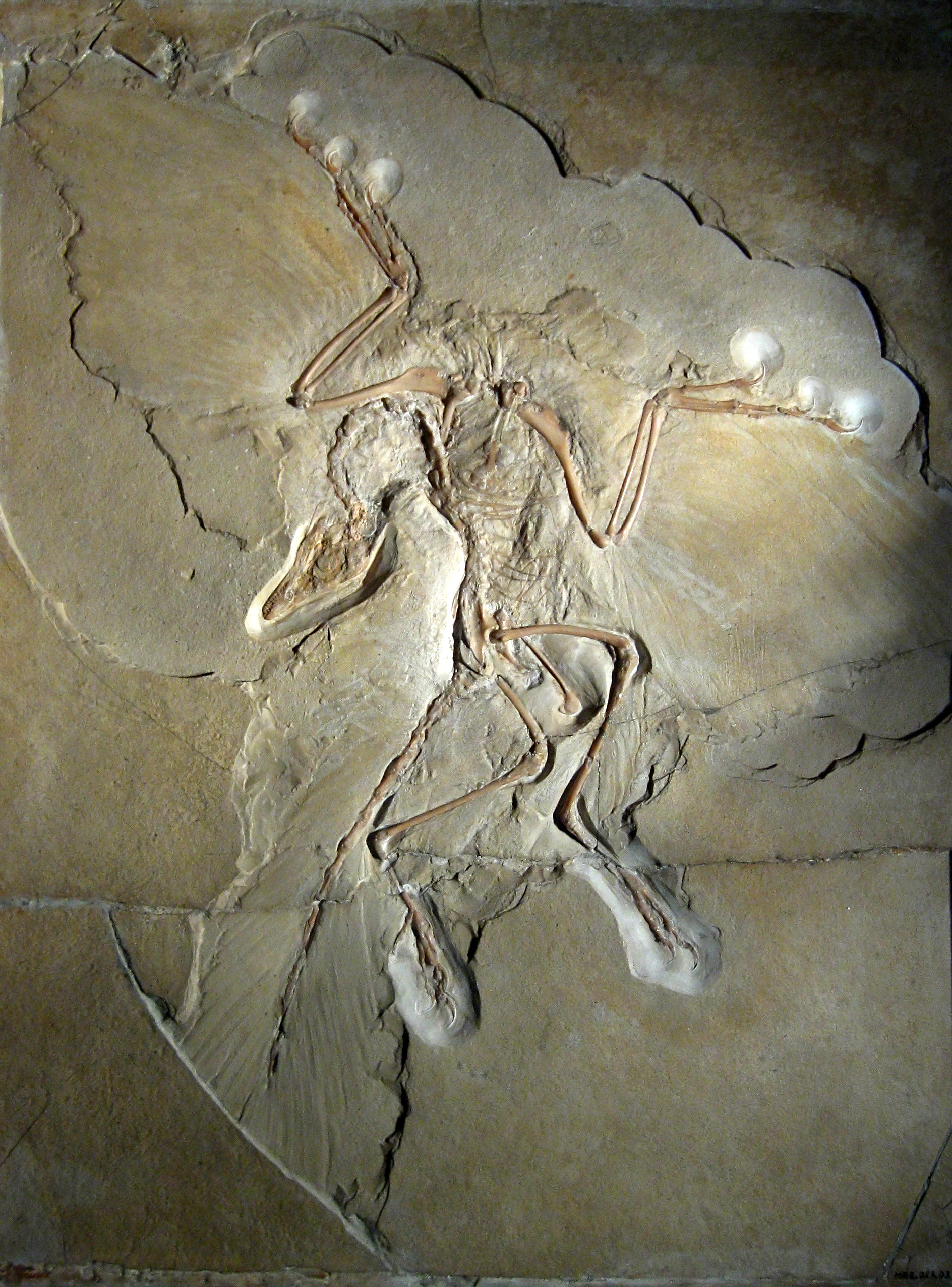
Image: File:Archaeopteryx lithographica (Berlin specimen).jpg - Wikimedia Commons (CC BY-SA)
About Archaeopteryx
Archaeopteryx lithographica is an iconic extinct species of bird-like dinosaur that represents one of the most profound transitional fossils ever discovered in the history of paleontology. Living during the Tithonian stage of the Late Jurassic period, approximately 150.8 to 148.5 million years ago, this creature inhabited the subtropical island archipelagos of what is now Solnhofen, Bavaria, in southern Germany. By bridging the anatomical gap between non-avian theropod dinosaurs and modern birds, Archaeopteryx has served as the ultimate touchstone for evolutionary biology since its initial discovery in the mid-nineteenth century, providing the first tangible fossil evidence for Charles Darwin's theory of evolution by natural selection.
In terms of physical description, Archaeopteryx lithographica was a relatively small animal, roughly the size of a modern common raven or European magpie. From the tip of its snout to the end of its long tail, adult individuals measured approximately fifty centimeters in length and are estimated to have weighed between point eight and one kilogram. Its anatomy was a striking mosaic of reptilian and avian characteristics. Unlike modern birds, which possess toothless keratinous beaks, Archaeopteryx had jaws lined with a full set of small, sharp, conical teeth perfectly adapted for grasping slippery prey. It also retained a long, bony tail composed of over twenty distinct caudal vertebrae, a feature completely absent in extant birds, which instead have a fused pygostyle. On its forelimbs, which were modified into wings, Archaeopteryx bore three distinct fingers, each armed with a sharp, curved claw used for climbing or grasping. These dinosaurian features closely mirrored those of small, contemporary theropods such as Compsognathus. However, its avian traits were equally undeniable. The creature possessed a furcula, or wishbone, formed by the fusion of the clavicles, and a highly modified foot with a reversed first toe, or hallux, which may have aided in perching. Most famously, Archaeopteryx was covered in well-developed, pennaceous feathers. The flight feathers on its wings and tail were distinctly asymmetrical, with a narrow leading edge and a wider trailing edge. This asymmetry is a critical aerodynamic adaptation found in modern flying birds, strongly suggesting that Archaeopteryx possessed some capacity for aerial locomotion.
The paleobiology of Archaeopteryx provides fascinating insights into the life of early avians. As a carnivore, its diet likely consisted of small terrestrial and arboreal prey, including insects, small lizards, and perhaps early mammals that inhabited the Jurassic islands. Its sharp teeth and clawed forelimbs would have been highly effective tools for snatching and subduing such prey. The locomotion of Archaeopteryx has been the subject of intense study. While its asymmetrical feathers indicate aerodynamic capabilities, its skeletal structure lacked the massive, keeled sternum found in modern birds, which serves as the attachment point for powerful flight muscles. Furthermore, its shoulder joint was oriented differently, restricting the upward stroke of the wing. This suggests that while Archaeopteryx could fly, its flight was likely not as strong or sustained as that of modern birds. It may have relied on short bursts of flapping flight, perhaps to escape predators or traverse gaps between vegetation, interspersed with gliding. Behavioral inferences drawn from its anatomy suggest it was comfortable both on the ground and in the trees, utilizing its clawed wings to clamber up trunks and branches. Studies of its bone histology have revealed that Archaeopteryx grew at a much slower rate than modern birds. Instead of reaching adult size in a matter of weeks or months, it likely took several years to mature, a growth pattern much more consistent with its non-avian dinosaur relatives.
The ecological context of the Late Jurassic period places Archaeopteryx in a unique and specialized environment. During this time, the region of Bavaria was situated much closer to the equator and consisted of a shallow, warm, subtropical sea dotted with a vast archipelago of small coral islands. The climate was generally arid to semi-arid, with distinct dry and wet seasons. The terrestrial flora on these islands was dominated by hardy, drought-resistant plants such as cycads, bennettitales, and conifers, while broad-leaved trees were largely absent. Archaeopteryx shared this island ecosystem with a diverse array of other animals. The skies were dominated by pterosaurs, such as the long-tailed Rhamphorhynchus and the short-tailed Pterodactylus, which likely competed with Archaeopteryx for small prey. On the ground, small theropod dinosaurs like Compsognathus roamed the scrubland. The surrounding lagoons and shallow seas teemed with marine life, including ammonites, horseshoe crabs, and various species of fish and marine reptiles. In this complex food web, Archaeopteryx occupied the niche of a small, agile, mid-level predator, hunting among the low vegetation and along the shorelines, while remaining vigilant against larger predatory dinosaurs or opportunistic pterosaurs.
The discovery history of Archaeopteryx is one of the most celebrated narratives in the history of science. The story began in 1861, when a single, beautifully preserved fossilized feather was unearthed in the lithographic limestone quarries of Solnhofen. The German paleontologist Christian Erich Hermann von Meyer described the feather and coined the name Archaeopteryx lithographica, which translates to ancient wing from the printing stone. Later that same year, the first skeletal specimen, missing only its head and neck, was discovered in nearby Langenaltheim. This specimen, known as the London Specimen, was acquired by the local physician Karl Häberlein, who eventually sold it to the Natural History Museum in London, where it was studied by the prominent anatomist Richard Owen. The discovery caused an immediate sensation, as it occurred just two years after Charles Darwin published On the Origin of Species. In 1876, an even more spectacular fossil, the Berlin Specimen, was discovered by a farmer named Jakob Niemeyer. This specimen, later described by Wilhelm Dames, was completely intact and featured a perfectly preserved skull with teeth, as well as exquisite feather impressions. Darwin himself referenced Archaeopteryx in later editions of his seminal work, recognizing it as the perfect transitional fossil that validated his predictions about the gradual nature of evolutionary change.
The evolutionary significance of Archaeopteryx cannot be overstated. It holds a foundational place in the tree of life as one of the earliest known members of the clade Avialae, the group that encompasses all modern birds and their closest extinct relatives. By exhibiting a blend of derived avian features, such as pennaceous flight feathers and a furcula, alongside primitive theropod traits, such as a long bony tail and toothed jaws, Archaeopteryx perfectly illustrates the concept of mosaic evolution. This is the phenomenon where different parts of an organism evolve at different rates. Its discovery prompted the British biologist Thomas Henry Huxley to propose, as early as the 1860s, that birds were the direct descendants of dinosaurs, specifically noting the profound skeletal similarities between Archaeopteryx and the small theropod Compsognathus. Although this dinosaur-bird hypothesis fell out of favor in the early twentieth century, it was spectacularly revived in the 1970s by John Ostrom and is now the overwhelming consensus in the scientific community. Archaeopteryx stands as the crucial morphological bridge that definitively links the fearsome bipedal predators of the Mesozoic era to the diverse avian species that populate our modern skies.
Despite its iconic status, Archaeopteryx has been the center of numerous scientific debates that continue to this day. One of the most enduring controversies surrounds the origin of avian flight. The trees-down, or arboreal, hypothesis suggests that flight evolved from gliding ancestors that climbed trees and leaped from branch to branch, a lifestyle that Archaeopteryx's clawed wings might support. Conversely, the ground-up, or cursorial, hypothesis argues that flight evolved in fast-running terrestrial bipeds that used their feathered arms to catch prey or gain traction while running up inclines. Archaeopteryx's anatomy has been used to argue both sides, and the debate remains unresolved. Taxonomy has also been a major point of contention. Over the years, researchers have debated whether the various Solnhofen specimens represent a single highly variable species, differences in age and sexual dimorphism, or multiple distinct species and genera. Some specimens have been assigned to separate species, such as Archaeopteryx siemensii, or even entirely different genera, like Wellnhoferia. Recent revisions and advanced imaging techniques, such as synchrotron microtomography, continue to refine our understanding of its skull anatomy and brain structure, revealing a brain that was intermediate in size and complexity between non-avian dinosaurs and modern birds, further fueling debates about its sensory capabilities and flight proficiency.
The fossil record of Archaeopteryx is remarkably sparse yet exceptionally detailed, owing entirely to the unique taphonomic conditions of the Solnhofen Limestone. To date, only twelve skeletal specimens and the original isolated feather have been definitively assigned to the genus. All of these fossils have been recovered from a highly localized geographic area in the Altmühl Valley of Bavaria, Germany. The preservation quality of these specimens is world-renowned. The Solnhofen formation consists of plattenkalk, a very fine-grained limestone that was originally deposited as calcareous mud at the bottom of stagnant, hypersaline lagoons. Because these lagoon bottoms were anoxic, devoid of oxygen, scavengers and decomposing bacteria could not survive. When an Archaeopteryx died and washed into the lagoon, it sank to the undisturbed bottom and was rapidly buried by fine sediment. This extraordinary depositional environment allowed for the preservation of delicate soft tissues, most notably the intricate barbs and barbules of the feathers, which are rarely fossilized elsewhere. Famous sites such as the quarries at Eichstätt, Solnhofen, and Langenaltheim have yielded these priceless specimens, each of which is heavily guarded and meticulously curated in institutions around the world.
The cultural impact of Archaeopteryx extends far beyond the confines of academic paleontology. It is arguably the most famous fossil in the world, universally recognized as the quintessential missing link in popular culture. Its image has graced the pages of countless biology and geology textbooks, serving as the premier educational example of evolutionary transition and the fossilization process. The original specimens are the crown jewels of major institutions, including the Natural History Museum in London and the Museum für Naturkunde in Berlin, drawing millions of visitors who wish to see the tangible evidence of life's interconnected history. Furthermore, Archaeopteryx frequently appears in documentaries, literature, and art, symbolizing the dynamic and ever-changing nature of the Earth's biosphere. It has also been a focal point in public debates regarding evolution, frequently cited by educators and scientists to counter creationist arguments. Ultimately, Archaeopteryx lithographica remains a powerful emblem of scientific discovery, a delicate creature imprisoned in stone that forever altered humanity's understanding of its place in the natural world.
Classification
Time Period
Discovery
Location
Solnhofen, Bavaria, Germany
Formation
Solnhofen Limestone
Frequently Asked Questions
What is Archaeopteryx?
Archaeopteryx lithographica is an iconic extinct species of bird-like dinosaur that represents one of the most profound transitional fossils ever discovered in the history of paleontology. Living during the Tithonian stage of the Late Jurassic period, approximately 150.8 to 148.5 million years ago, ...
When did Archaeopteryx live?
Archaeopteryx lived during the jurassic period of the mesozoic era approximately 150.8-148.5 million years ago.
Where was Archaeopteryx discovered?
Fossils of Archaeopteryx were discovered in Solnhofen, Bavaria, Germany in the Solnhofen Limestone.
What did Archaeopteryx eat?
Archaeopteryx was a carnivore. It lived in terrestrial, arboreal habitats.
What type of fossil is Archaeopteryx?
Archaeopteryx is preserved as a impression fossil. The preservation quality is exceptional.
Related Specimens
From the mesozoic era · impression fossils