Thylacosmilus
Thylacosmilus atrox
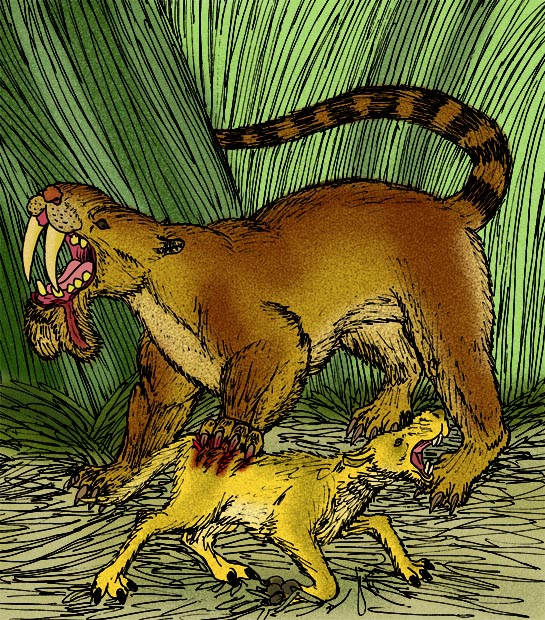
Image: File:Thylacosmilus atrox.jpg - Wikimedia Commons (CC BY-SA)
About Thylacosmilus
Thylacosmilus atrox was a remarkable prehistoric predator that roamed the terrestrial landscapes of South America during the Neogene period of the Cenozoic era, specifically living between 9 and 3 million years ago. Often colloquially and somewhat inaccurately referred to as a saber-toothed marsupial, this fascinating creature was actually a sparassodont, representing one of the most extreme examples of specialized carnivory in the fossil record. Its profound significance lies in its astonishing convergent evolution with placental saber-toothed cats, demonstrating how isolated ecosystems can produce strikingly similar anatomical adaptations in entirely distinct mammalian lineages.
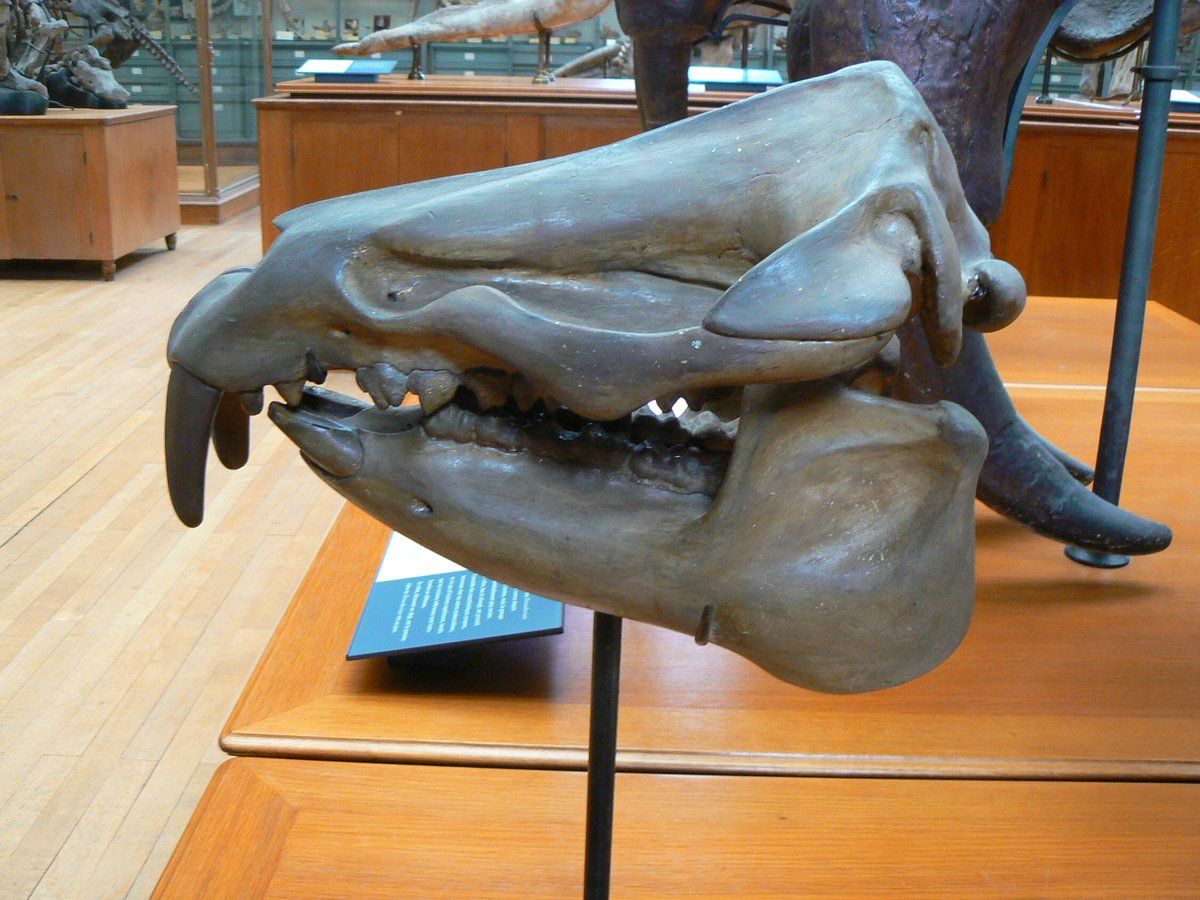
Physically, Thylacosmilus atrox was a robust and powerfully built animal, roughly comparable in size to a modern jaguar. It measured approximately 150 centimeters in length from snout to tail and is estimated to have weighed between 80 and 120 kilograms, making it one of the largest carnivorous metatherians of its time. The most defining and extraordinary feature of Thylacosmilus was its skull, which housed a pair of massive, ever-growing upper canine teeth. Unlike the saber teeth of placental machairodontines, which had closed roots and stopped growing once mature, the canines of Thylacosmilus were hypsodont, meaning they grew continuously throughout the animal's life. The roots of these enormous, blade-like teeth were so extensive that they curved upward and backward, extending over the top of the animal's braincase. To protect these elongated, fragile canines from lateral stress and breakage when the jaw was closed, Thylacosmilus evolved massive, downward-projecting bony flanges at the front of its lower jaw. These symphyseal flanges acted as a protective sheath for the saber teeth. Interestingly, Thylacosmilus lacked incisors entirely, a highly unusual trait for a mammalian carnivore, which suggests a highly specialized method of feeding. Its postcranial skeleton reveals that it was not a fast runner; it had relatively short, heavily muscled limbs and walked with a plantigrade stance, meaning its heels touched the ground like a bear rather than walking on its toes like a dog or cat. Its forelimbs were incredibly robust, equipped with semi-opposable thumbs, but it lacked the retractile claws seen in modern felines.
The paleobiology of Thylacosmilus has been the subject of intense study and revision, particularly regarding its feeding strategies and locomotion. For decades, it was assumed that Thylacosmilus hunted exactly like placental saber-toothed cats, using its powerful forelimbs to pin down prey before delivering a fatal, throat-slashing bite. However, modern biomechanical studies, including finite element analysis, have revealed that Thylacosmilus possessed a surprisingly weak bite force, much weaker than that of a modern leopard or the extinct Smilodon. Its jaw muscles were not designed for crushing bone or holding struggling prey. Instead, its skull and neck anatomy suggest a completely different mechanism for utilizing its massive teeth. Thylacosmilus had exceptionally powerful neck muscles attached to a highly modified cervical spine. Paleontologists now believe that rather than biting down with its jaw muscles, Thylacosmilus used its neck to drive its upper canines downward into the soft tissue of its prey, acting almost like a pair of biological daggers. Because it lacked incisors to scrape meat from bone, it likely specialized in consuming soft internal organs and large muscle masses. This highly specialized feeding apparatus has led to varying interpretations of its behavior. Some researchers propose it was an ambush predator that targeted specific, vulnerable areas of large, slow-moving herbivores, delivering a single massive wound and waiting for the prey to succumb to blood loss. Others have suggested it might have been a specialized scavenger, using its massive teeth to slice open the thick hides of already dead megafauna, accessing the nutrient-rich viscera that other scavengers could not reach. Its continuous tooth growth supports the idea that its teeth were subjected to significant wear, perhaps from slicing through tough hides and cartilage.
The ecological context in which Thylacosmilus evolved and thrived was unique to the isolated continent of South America during the Late Miocene and Pliocene epochs. For tens of millions of years, South America was an island continent, completely separated from North America and other landmasses. This isolation allowed for the evolution of a highly endemic and bizarre fauna. The climate during the time of Thylacosmilus was undergoing a significant transition; the global temperatures were gradually cooling, leading to the retreat of dense tropical forests and the expansion of open woodlands, savannas, and vast grasslands, particularly in regions like the Catamarca Province of Argentina. Thylacosmilus shared this changing landscape with an array of extraordinary animals. Its potential prey included heavily armored glyptodonts, giant ground sloths, and a diverse array of native South American ungulates known as notoungulates and litopterns, such as the camel-like macraucheniids and the rhinoceros-like toxodonts. In this ecosystem, Thylacosmilus occupied the niche of an apex predator or a highly specialized macropredator. It did not have to compete with placental carnivores like wolves, bears, or true cats, which had not yet reached the continent. Instead, its primary competition came from other native predators, most notably the phorusrhacids, or terror birds, which were massive, flightless, carnivorous birds that dominated the open plains. The coexistence of Thylacosmilus and terror birds suggests a complex partitioning of the predatory niches, with the fast-running birds likely hunting smaller, swifter prey, while the heavily built Thylacosmilus targeted larger, slower-moving herbivores in denser vegetation or ambushed them near water sources.
The discovery history of Thylacosmilus is a fascinating chapter in early 20th-century paleontology. The first fossils of this extraordinary animal were unearthed in 1926 by the renowned American paleontologist Elmer S. Riggs. Riggs was leading the First Marshall Field Paleontological Expedition, sponsored by the Field Museum of Natural History in Chicago. The expedition was exploring the rugged, arid terrain of the Catamarca Province in northwestern Argentina, specifically focusing on the fossil-rich deposits of the Andalhuala Formation. It was here that Riggs and his team discovered the remains of a creature unlike anything previously seen in the South American fossil record. The holotype specimen, designated FMNH P14531, consisted of a remarkably well-preserved skull and partial postcranial skeleton. The sheer size of the canine teeth and the bizarre bony flanges on the lower jaw immediately marked it as a significant find. Riggs officially described and named the animal Thylacosmilus atrox in 1933. The genus name translates to pouch saber, referencing its marsupial-like reproductive strategy and its massive teeth, while the species name atrox means cruel or terrible in Latin, a nod to its fearsome appearance. Riggs recognized that despite its superficial resemblance to saber-toothed cats, the anatomy of its skull and teeth placed it firmly within the metatherian lineage, making it a groundbreaking discovery that highlighted the incredible diversity of South America's extinct mammalian predators.
The evolutionary significance of Thylacosmilus cannot be overstated, as it provides one of the most dramatic and frequently cited examples of convergent evolution in the history of life on Earth. Convergent evolution occurs when unrelated organisms independently evolve similar traits as a result of having to adapt to similar environments or ecological niches. Thylacosmilus belonged to the order Sparassodonta, a completely extinct group of metatherian mammals. Metatherians are the broader group that includes modern marsupials and their extinct relatives. The sparassodonts diverged from the ancestors of true marsupials early in the Cenozoic era and became the dominant mammalian carnivores in South America. Despite being separated from placental mammals by over 100 million years of evolutionary history, Thylacosmilus evolved a skull and dental morphology that eerily mirrored that of the placental machairodontines, such as the famous Smilodon of North America. Both lineages independently developed elongated, blade-like upper canines, a wide gape, and modifications to the skull and neck to accommodate a specialized killing bite. However, the underlying anatomical architecture reveals their distinct evolutionary pathways. For example, while placental saber-toothed cats modified their incisors for grasping and tearing, Thylacosmilus lost its incisors entirely. Furthermore, the continuous growth of the canines in Thylacosmilus is a uniquely metatherian solution to the problem of tooth wear, contrasting with the permanent, non-growing adult teeth of placental cats. Studying Thylacosmilus allows evolutionary biologists to understand the constraints and possibilities of mammalian anatomy, demonstrating that there are limited biomechanical solutions to the problem of hunting and consuming large prey.
Despite being known to science for nearly a century, Thylacosmilus remains the subject of lively scientific debates and ongoing research. One of the most significant historical controversies surrounded its extinction. For many years, the prevailing theory was that Thylacosmilus and other native South American predators were driven to extinction by the arrival of superior placental carnivores, such as true saber-toothed cats and wild dogs, during the Great American Biotic Interchange. This interchange occurred when the Isthmus of Panama formed, connecting North and South America. However, recent fossil dating and stratigraphic revisions have largely debunked this narrative. It is now understood that Thylacosmilus went extinct around 3 million years ago, well before the arrival of Smilodon and other large North American carnivores. The current consensus is that Thylacosmilus succumbed to significant climate change during the Pliocene epoch. As the climate became cooler and drier, the environment shifted dramatically, leading to the decline of the large, slow-moving herbivores that Thylacosmilus relied upon. Another ongoing debate centers on its exact feeding behavior. While the weak bite force is well-documented, researchers like Christine Janis have proposed that Thylacosmilus might have been an obligate scavenger, using its teeth to open carcasses rather than kill live prey. This hypothesis is supported by its lack of incisors and heavily worn teeth, but it remains contested by those who argue its robust forelimbs and powerful neck were perfectly adapted for ambushing and subduing live, albeit slow, prey.
The fossil record of Thylacosmilus is relatively sparse but highly informative, primarily restricted to the Neogene deposits of southern South America. The most complete and famous specimens, including the holotype discovered by Elmer S. Riggs, originate from the Andalhuala Formation in the Catamarca Province of Argentina. These deposits date to the Late Miocene and Early Pliocene, providing a crucial window into the terrestrial ecosystems of that era. Additional, more fragmentary remains have been discovered in the Entre Rios Province of Argentina, specifically within the Ituzaingo Formation, which further expands the known geographic range of the species. The preservation quality of the Catamarca specimens is exceptional, allowing paleontologists to study the delicate structures of the skull, the internal cavities of the braincase, and the complex articulation of the jaw. However, complete postcranial skeletons are exceedingly rare, meaning that much of our understanding of its limb proportions and locomotion is pieced together from isolated bones and comparisons with other, more completely known sparassodonts. The limited number of specimens suggests that Thylacosmilus was never a highly abundant animal, which is typical for apex predators that require large territories and substantial prey populations to survive.
The cultural impact of Thylacosmilus, while perhaps not as globally ubiquitous as that of the dinosaur Tyrannosaurus rex or the true saber-toothed cat Smilodon, is nonetheless significant within the realms of paleontology, education, and popular science. The original holotype skull remains one of the most prized exhibits at the Field Museum of Natural History in Chicago, where it continues to draw the attention of researchers and the public alike. Thylacosmilus frequently appears in documentaries and books focusing on prehistoric life, often highlighted as the ultimate example of convergent evolution and the strange, isolated fauna of ancient South America. Paleoartists, from the legendary Charles R. Knight to modern masters like Mauricio Anton, have produced striking reconstructions of Thylacosmilus, bringing its bizarre, flange-jawed appearance to life. These artistic and educational representations play a crucial role in teaching the public about the diversity of evolutionary pathways and the fact that mammalian history is far more complex and bizarre than the modern fauna might suggest.
Classification
Time Period
Discovery
Location
Catamarca Province, Argentina
Formation
Andalhuala Formation
Frequently Asked Questions
What is Thylacosmilus?
Thylacosmilus atrox was a remarkable prehistoric predator that roamed the terrestrial landscapes of South America during the Neogene period of the Cenozoic era, specifically living between 9 and 3 million years ago. Often colloquially and somewhat inaccurately referred to as a saber-toothed marsupia...
When did Thylacosmilus live?
Thylacosmilus lived during the neogene period of the cenozoic era approximately 9-3 million years ago.
Where was Thylacosmilus discovered?
Fossils of Thylacosmilus were discovered in Catamarca Province, Argentina in the Andalhuala Formation.
What did Thylacosmilus eat?
Thylacosmilus was a carnivore. It lived in terrestrial habitats.
What type of fossil is Thylacosmilus?
Thylacosmilus is preserved as a body fossil. The preservation quality is good.
Related Specimens
From the cenozoic era · body fossils