Pentamerus
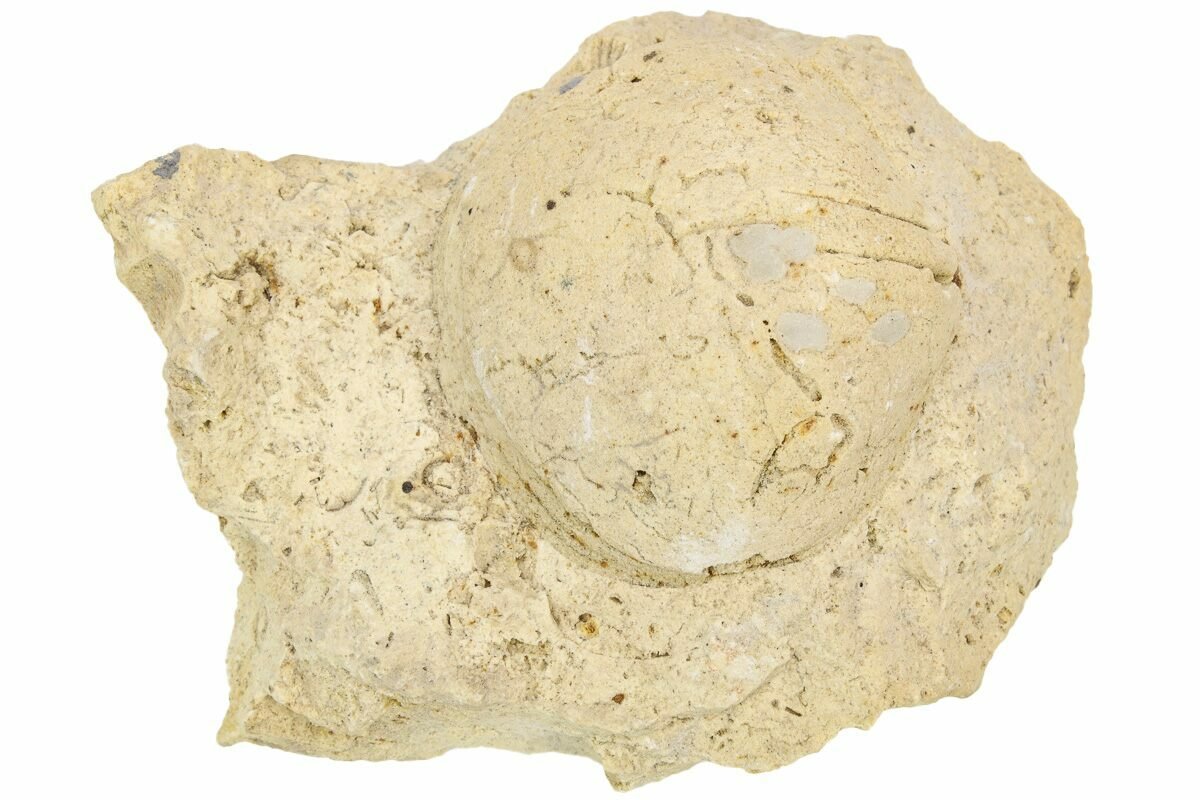
Pentamerus oblongus
Image: Image sourced via web search (Fair use / Educational)
About Pentamerus
Pentamerus is a genus of extinct brachiopod that thrived in the shallow seas of the Silurian Period, approximately 440 to 420 million years ago. As a key index fossil, its presence in rock strata provides a precise method for dating geological formations, making it an organism of immense importance to stratigraphy and paleontology. Its fossils, often found in dense accumulations, offer a detailed window into the rich marine ecosystems that flourished following the Ordovician-Silurian extinction event.
The most distinctive feature of Pentamerus oblongus is its large, biconvex, and typically smooth shell, which could reach lengths of 5 to 8 centimeters, making it a giant among many contemporary brachiopods. Its overall shape is often described as sub-pentagonal or ovate, with a pronounced curvature. The shell is composed of two unequal valves: a larger, more convex ventral (or pedicle) valve and a smaller dorsal (or brachial) valve. A prominent feature of the ventral valve is the spondylium, a large, spoon-shaped internal structure that served as an attachment site for the pedicle and adductor muscles. This internal plate is a defining characteristic of the Pentamerida order and is often visible in cross-sections of the fossil. The dorsal valve contains corresponding brachial processes that supported the lophophore, the delicate, coiled feeding organ. The shell's exterior is generally smooth, lacking the strong radial ribs (costae) seen in many other brachiopod groups, though faint growth lines may be present. When compared to modern animals, its size is roughly equivalent to a large scallop or a small clam, but its internal anatomy and filter-feeding mechanism were unique to its phylum.
Pentamerus was a sessile, benthic filter-feeder, living attached to the seafloor in shallow, well-oxygenated marine environments. It used its fleshy stalk, the pedicle, to anchor itself to hard substrates or to partially bury itself in the soft carbonate sediment with its beak (the pointed end of the shell) oriented downwards and the opening (commissure) facing upwards into the water column. This orientation allowed it to efficiently draw in water currents. Inside the shell, the complex, coiled lophophore was covered in cilia that generated these currents, trapping microscopic food particles like phytoplankton and organic detritus from the water. Its large size suggests a relatively high metabolic rate for a brachiopod and an ability to process significant volumes of water. Pentamerus was a gregarious organism, often living in dense, reef-like clusters or 'beds' that could cover vast areas of the seafloor. These aggregations, known as biostromes, likely provided mutual protection and may have influenced local currents and sediment deposition, effectively acting as ecosystem engineers. Their growth was slow, marked by the concentric lines on their shells, reflecting seasonal or environmental changes.
The Silurian world inhabited by Pentamerus was one of recovery and diversification following the major Ordovician-Silurian mass extinction. Global climates were generally warm and stable, with high sea levels creating extensive epicontinental seas across the paleocontinents of Laurentia, Baltica, and Siberia. Pentamerus thrived in these shallow, tropical to subtropical carbonate shelf environments, often forming the structural foundation of early reef ecosystems alongside tabulate and rugose corals, stromatoporoids (calcareous sponges), and crinoids (sea lilies). In this bustling ecosystem, Pentamerus occupied a low trophic level as a primary consumer. It shared its habitat with a diverse fauna including trilobites like Calymene and Dalmanites, nautiloid cephalopods, gastropods, bivalves, and early jawed fish (acanthodians). While its thick shell provided considerable defense, it was likely preyed upon by durophagous (shell-crushing) predators such as large nautiloids or early eurypterids (sea scorpions). The dense beds of Pentamerus would have created complex, three-dimensional habitats, offering shelter for smaller organisms and stabilizing the substrate for other benthic life.
The discovery and study of Pentamerus are deeply intertwined with the foundational years of geology and paleontology. The genus was first formally described by the British naturalist James Sowerby in 1813. Sowerby, a prolific illustrator and naturalist, included it in his multi-volume work, "Mineral Conchology of Great Britain." The fossils he described were collected from the Silurian-aged limestone deposits of Herefordshire, England. The name 'Pentamerus' derives from Greek, meaning 'five parts,' referring to the five-chambered appearance seen in cross-sections of the ventral valve, created by the spondylium and two sub-parallel septa. This distinctive internal morphology was crucial for its identification. The species Pentamerus oblongus became particularly famous through the work of Sir Roderick Murchison in the 1830s. Murchison used the widespread and easily identifiable Pentamerus fossils as a primary index fossil to define and correlate the strata of his newly proposed Silurian System. He recognized that specific rock layers, regardless of their composition, could be identified by the unique assemblage of fossils they contained, a cornerstone concept of biostratigraphy. No single 'type' specimen has achieved celebrity status like a dinosaur skeleton, but the countless fossils from classic localities like Wenlock Edge in Shropshire, England, are collectively iconic in the history of geology.
Pentamerus holds immense evolutionary significance as a prime example of the post-Ordovician radiation of the phylum Brachiopoda. It belongs to the order Pentamerida, a group that dominated many shallow-water marine communities during the Silurian and early Devonian periods. Their evolutionary success is marked by their large size, robust shells, and gregarious, reef-building behavior, which allowed them to exploit the ecological niches opened up by the preceding mass extinction. The evolution of the complex internal spondylium was a key innovation, providing a strong, centralized anchor for the musculature needed to operate their large, heavy shells. This structure represents a sophisticated adaptation for a sessile lifestyle in high-energy environments. While the direct lineage of Pentamerus and the entire Pentamerida order went extinct during the late Devonian extinction events, they are part of the class Rhynchonellata, which has survived to the present day. Modern rhynchonellates, though much smaller and less abundant, share the same fundamental body plan, including a bivalved shell and a lophophore, illustrating the deep evolutionary history and resilience of the brachiopod phylum.
While the fundamental classification and lifestyle of Pentamerus are well-established, scientific debate continues on finer points of its paleoecology. One area of discussion revolves around the precise function and formation of the massive Pentamerus biostromes. Some researchers argue they were true framework reefs built in high-energy, wave-agitated zones, while others suggest they were dense but unlithified 'shell beds' or 'banks' that accumulated in slightly deeper, calmer waters below the normal wave base. The debate centers on interpreting the sedimentary evidence surrounding these fossil beds. Another topic of ongoing research is the taphonomy of these accumulations—how the shells were preserved. The frequent discovery of articulated (both valves together) and life-position fossils suggests rapid burial, but the processes leading to such widespread preservation are still being refined. Recent studies using geochemical analysis of shell material are also attempting to reconstruct the specific water temperatures and chemistry of the Silurian seas in which Pentamerus lived, providing a more detailed picture of its environmental tolerances.
The fossil record of Pentamerus is exceptionally rich and geographically widespread, a testament to its abundance and ecological success during the Silurian. Fossils are considered common and are found in Silurian marine sedimentary rocks across the globe. Major localities include the classic Wenlock Limestone of England and Wales, the island of Gotland in Sweden, the Niagara Escarpment in North America (spanning from New York through Ontario to Wisconsin), and Silurian outcrops in Estonia, Norway, and the Ural Mountains of Russia. The fossils are typically preserved as calcified original shell material or as internal and external molds (steinkerns) in limestone, dolostone, and shale. Because of their gregarious nature, they are often found in dense, monospecific or paucispecific assemblages, sometimes forming entire rock layers several meters thick. The robust nature of their shells and their distinctive internal structures ensure that even fragmented remains are often identifiable, making them one of the most reliable and frequently encountered fossils of their age.
Pentamerus oblongus holds a significant place in the history of science and remains an important educational tool. As one of the first index fossils used to define a major geological period, it is featured in virtually every introductory geology and paleontology textbook. Its large size and frequent abundance make it a popular and satisfying find for amateur fossil collectors, especially in regions like the American Midwest and the Welsh Borders. Major natural history museums worldwide, including the Natural History Museum in London and the Smithsonian National Museum of Natural History, feature prominent displays of Pentamerus beds to illustrate Silurian marine life and the concept of ancient reef ecosystems. Its distinctive, five-chambered cross-section is an iconic image in stratigraphy, symbolizing the power of fossils to unlock the history of our planet.
Classification
Time Period
Discovery
Location
England, United Kingdom
Formation
Wenlock Limestone, Aymestry Limestone, and equivalent formations globally
Frequently Asked Questions
What is Pentamerus?
Pentamerus is a genus of extinct brachiopod that thrived in the shallow seas of the Silurian Period, approximately 440 to 420 million years ago. As a key index fossil, its presence in rock strata provides a precise method for dating geological formations, making it an organism of immense importance ...
When did Pentamerus live?
Pentamerus lived during the silurian period of the paleozoic era approximately 440-420 million years ago.
Where was Pentamerus discovered?
Fossils of Pentamerus were discovered in England, United Kingdom in the Wenlock Limestone, Aymestry Limestone, and equivalent formations globally.
What did Pentamerus eat?
Pentamerus was a filter-feeder. It lived in marine, reef, shallow-sea habitats.
What type of fossil is Pentamerus?
Pentamerus is preserved as a body fossil. The preservation quality is good.
Related Specimens
From the paleozoic era · body fossils