Tempskya
Tempskya wesselii
Image: Image sourced via web search (Fair use / Educational)
About Tempskya
Tempskya was a unique and enigmatic tree fern that flourished during the Cretaceous Period, approximately 120 to 90 million years ago. Its fossils, found across the Northern Hemisphere, reveal a plant with a bizarre growth habit unlike any living fern today. As an important component of Cretaceous understory floras, Tempskya provides a crucial window into the structure and evolution of terrestrial ecosystems during the age of dinosaurs.
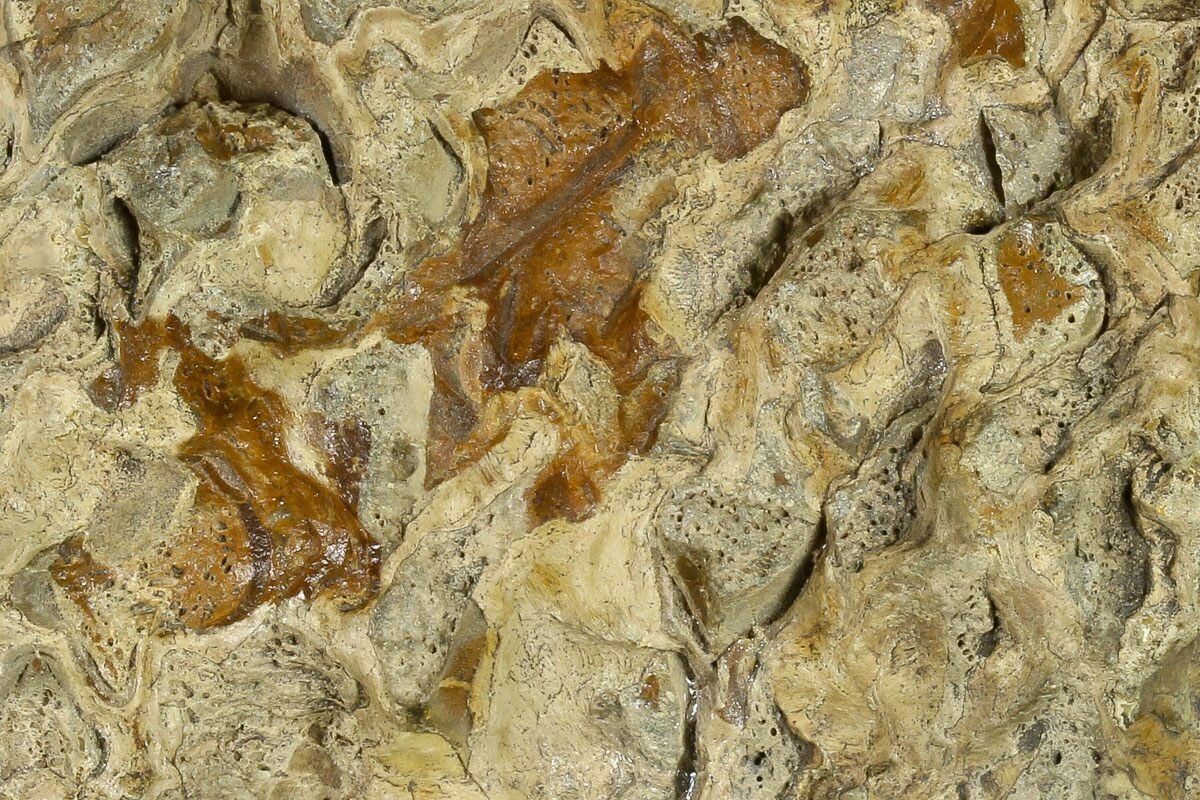
The most striking feature of Tempskya was its composite trunk, often referred to as a 'false trunk' or pseudostem. Unlike a modern tree trunk, which consists of a single, woody stem, Tempskya's trunk was an interwoven mass of hundreds of individual, small-diameter fern stems (rhizomes) bound together by a dense mat of adventitious roots. This entire structure was permineralized, typically by silica, preserving its intricate internal anatomy in remarkable detail. These false trunks could reach impressive sizes, with diameters up to 50 centimeters and estimated heights of up to 6 meters (600 cm). The individual stems within the composite trunk were typically only 5 to 10 millimeters in diameter, each possessing its own vascular tissue (a siphonostele). The collective mass of these stems and their surrounding root mantle provided the structural support necessary to achieve an arborescent, or tree-like, form. At the apex of this trunk, a crown of fronds would have unfurled, similar to modern tree ferns, though complete fronds are exceptionally rare in the fossil record. The fronds themselves were bipinnate or tripinnate, meaning they were divided into smaller leaflets multiple times, creating a delicate, lacy appearance characteristic of many ferns. The petioles, or frond stalks, were covered in fine hairs or scales, which are sometimes preserved.
As a photosynthetic organism, Tempskya's entire life strategy revolved around capturing sunlight. Its tall, tree-like form was a classic evolutionary solution to compete for light in a crowded forest understory, elevating its leafy crown above smaller shrubs and herbaceous plants. It did not hunt or consume other organisms; its 'diet' was sunlight, carbon dioxide, and water, converted into energy via photosynthesis in its fronds. The complex false trunk likely grew by the continuous upward growth and branching of the individual rhizomes at the apex, while the lower portions of the trunk became increasingly dense with supportive roots. This growth pattern is unique among vascular plants. Reproduction would have occurred via spores, produced in structures called sporangia located on the undersides of the fronds, a method typical of most ferns. These spores would have been dispersed by wind, germinating into small, independent gametophytes which would then produce the next generation of Tempskya sporophytes. Its robust, root-bound trunk suggests it was well-anchored, capable of withstanding the environmental pressures of its floodplain or swampy habitat. There is no evidence of social behavior in the way it is understood in animals, but Tempskya likely grew in dense stands or groves, forming a significant part of the local flora where conditions were favorable.
Tempskya lived in a world dominated by dinosaurs, in warm, humid, greenhouse climates. During the mid-Cretaceous, there were no polar ice caps, and sea levels were significantly higher than today, creating vast inland seas like the Western Interior Seaway in North America. Tempskya thrived in the low-lying, wet environments along the margins of these seaways, inhabiting coastal plains, river floodplains, and swampy forests. Its ecosystem was a mix of ancient and modern-looking flora. It shared its habitat with other ferns, cycads, ginkgoes, and conifers like redwoods. Critically, this was also the time when flowering plants (angiosperms) were beginning their rise to ecological dominance, though they were not yet the forest-formers they are today. Tempskya occupied the mid-canopy or understory layer of these forests. Herbivorous dinosaurs such as the armored nodosaur Sauropelta or the ornithopod Tenontosaurus, whose fossils are found in the same formations, may have fed on Tempskya's fronds, placing it as a primary producer at the base of the terrestrial food web. It competed for sunlight and soil resources with other plants, and its decomposition would have contributed vital nutrients back into the Cretaceous soil. Its presence indicates a habitat with abundant moisture and relatively stable, warm temperatures year-round.
The history of Tempskya's discovery begins in the 19th century with the expansion of paleontological exploration in the American West. The genus was first described by the German botanist Hermann von Meyer in 1845 based on European specimens. However, some of the most famous and well-studied fossils come from North America. The species Tempskya wesselii was named by Charles W. Ward in 1924, honoring Mr. F. A. Wessel of Boise, Idaho, who had collected significant specimens. Many of the best-preserved Tempskya fossils, often called 'log-ferns', were found in the Gannett Group and Wayan Formation of Idaho and Wyoming. These fossils were often discovered by ranchers and amateur collectors who noticed the unusual, patterned texture of the silicified trunks weathering out of the hillsides. One of the key figures in understanding Tempskya's anatomy was the paleobotanist Charles B. Read, who, along with his colleague G. R. Brown, published a comprehensive monograph in 1937 that detailed the internal structure of the false trunk and established a framework for classifying different species based on their anatomical variations. These early studies, based on meticulously prepared thin sections of the petrified trunks, laid the groundwork for all subsequent research on this peculiar plant.
Tempskya holds a significant place in the evolutionary history of ferns. It represents a unique and ultimately unsuccessful evolutionary experiment in achieving an arborescent habit. While other fern lineages, both ancient and modern (like the order Cyatheales), developed tree-like forms through the modification of a single, robust stem, Tempskya took a completely different path by aggregating numerous small stems and roots into a composite structure. This makes it a fascinating example of convergent evolution, where different organisms independently evolve similar solutions (in this case, a tree-like form) to similar ecological challenges. As a member of the Polypodiales, the most diverse order of modern ferns, Tempskya is related to many familiar species today, but its family, Tempskyaceae, is entirely extinct. It demonstrates the incredible morphological diversity that existed within fern lineages during the Mesozoic and highlights that the evolutionary path to 'treeness' is not monolithic. The eventual extinction of Tempskya towards the end of the Cretaceous may have been linked to changing climates and the increasing ecological dominance of faster-growing, more efficient flowering plants, which outcompeted older plant groups in many niches.
Despite decades of study, Tempskya still presents scientific puzzles. The precise classification and number of valid species remain a subject of debate. Early researchers named numerous species based on slight variations in the internal anatomy of the false trunks, such as the arrangement and size of the individual stems and vascular bundles. However, later paleobotanists, including Chester A. Arnold, argued that much of this variation could represent different growth stages or ecological adaptations within a single, widespread species. This has led to a consolidation, with many former species now considered synonyms of a few, such as T. wesselii. Another area of uncertainty is the exact appearance of the living plant's crown. Because the delicate fronds were rarely preserved attached to the trunks, reconstructions of the full plant are somewhat speculative, based on associated but unattached fossil fern foliage. The exact mechanism and rate of its composite trunk growth also remain topics of active research and modeling.
The fossil record of Tempskya is geographically widespread but temporally restricted to the Cretaceous Period. Fossils are found across the Northern Hemisphere, with notable occurrences in western North America (particularly Idaho, Wyoming, and Montana in the USA), as well as in England, France, the Czech Republic, and Russia. This distribution suggests the genus was highly successful in the warm, wet climates of Laurasia. The most commonly found fossils are sections of the permineralized false trunk. These are often so well-preserved by silica that the cellular structure of the individual stems and roots can be studied in microscopic detail using thin sections. These silicified trunks are robust and can be found as large, isolated 'logs' in sedimentary rock layers. Complete specimens showing the base and apex are extremely rare, and as mentioned, foliage is almost never found attached. The Morrison Formation is sometimes cited, but the primary North American sources are younger Cretaceous units like the Cloverly Formation and the Wayan Formation.
While not a household name like Tyrannosaurus or Triceratops, Tempskya has a notable cultural footprint within the world of geology and paleontology. Its beautifully preserved, patterned cross-sections make it a prized specimen for collectors and a popular display item in museums. Slabs of polished Tempskya, revealing the intricate mosaic of stems and roots, are often sold in rock shops and featured in lapidary art. Major natural history museums, such as the Field Museum in Chicago and the Idaho Museum of Natural History, often include specimens of Tempskya in their paleobotany exhibits to illustrate the strange and wonderful plant life of the Cretaceous. It serves as an excellent educational tool for demonstrating the concept of permineralization and showcasing an alternative evolutionary strategy for plant life.
Classification
Time Period
Discovery
Location
Wyoming, USA
Formation
Gannett Group, Wayan Formation, Cloverly Formation
Frequently Asked Questions
What is Tempskya?
Tempskya was a unique and enigmatic tree fern that flourished during the Cretaceous Period, approximately 120 to 90 million years ago. Its fossils, found across the Northern Hemisphere, reveal a plant with a bizarre growth habit unlike any living fern today. As an important component of Cretaceous u...
When did Tempskya live?
Tempskya lived during the cretaceous period of the mesozoic era approximately 120-90 million years ago.
Where was Tempskya discovered?
Fossils of Tempskya were discovered in Wyoming, USA in the Gannett Group, Wayan Formation, Cloverly Formation.
What did Tempskya eat?
Tempskya was a photosynthetic. It lived in terrestrial, floodplain, swamp habitats.
What type of fossil is Tempskya?
Tempskya is preserved as a permineralized fossil. The preservation quality is good.
Related Specimens
From the mesozoic era · permineralized fossils