Maiasaura
Maiasaura peeblesorum
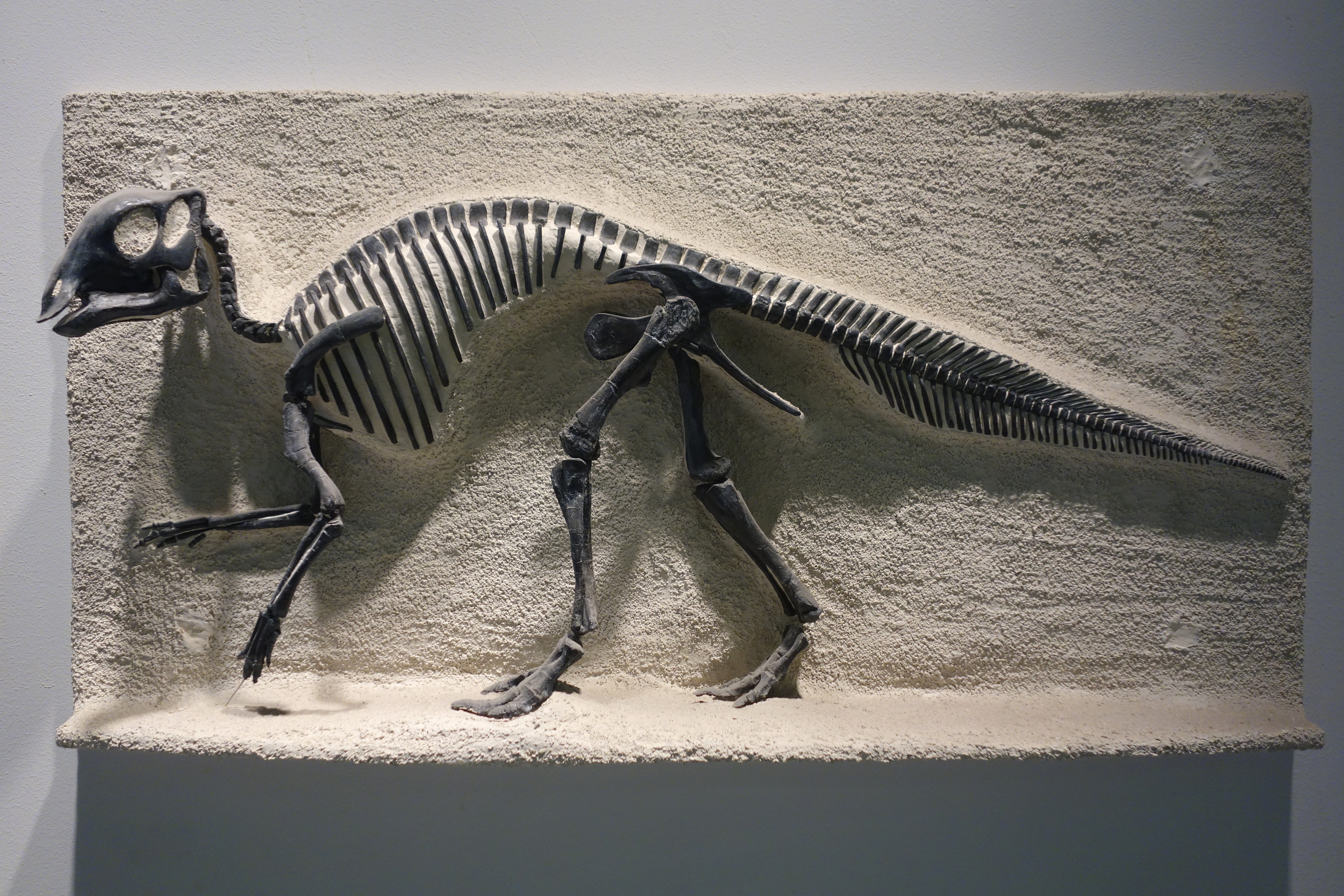
Image: File:Maiasaura peeblesorum cast - University of California Museum of Paleontology - Berkeley, CA - DSC04688.JPG - Wikimedia Commons (CC BY-SA)
About Maiasaura
Maiasaura peeblesorum, whose name translates to 'good mother lizard,' is a large hadrosaurid dinosaur that lived during the Late Cretaceous period in what is now North America. Its discovery in 1978 revolutionized the scientific understanding of dinosaur behavior, providing the first conclusive evidence of complex parental care and social nesting. Living approximately 80 to 74 million years ago, this herbivorous dinosaur inhabited the coastal plains of Montana, and its fossils, found in vast nesting grounds, offer an unparalleled glimpse into the family life of these ancient animals.
Maiasaura was a robustly built hadrosaur, reaching an impressive length of up to 9 meters (approximately 30 feet) from snout to tail and an estimated weight of around 2.5 to 4 metric tons. Its overall body plan was typical of the Hadrosauridae family, featuring a long, heavy tail that acted as a counterbalance to its bulky torso. The most distinctive feature of its skull was the broad, flattened, toothless beak, or 'duck-bill,' which was likely covered in a keratinous sheath for cropping tough vegetation. Unlike some of its more ornate relatives, such as Parasaurolophus or Corythosaurus, Maiasaura lacked a large, hollow cranial crest. Instead, it possessed a small, solid, spiky crest just in front of its eyes, which may have been used for species recognition, display, or even as a weapon in head-butting contests between rivals. Its forelimbs were shorter and more slender than its powerful hind limbs, suggesting a primarily quadrupedal posture for walking and grazing, but it was capable of rearing up and running bipedally to escape predators. The skin impressions found with some fossils indicate a pebbly, non-overlapping scale texture, similar to that seen in other hadrosaurs.
The paleobiology of Maiasaura is among the best understood of any non-avian dinosaur, thanks to the wealth of information from its nesting sites. As a herbivore, it subsisted on a diet of tough plant matter, including conifers, ferns, and flowering plants. Its specialized dental batteries, located in the cheeks, were a marvel of biological engineering. Each jaw contained hundreds of tightly packed teeth that formed a continuous grinding surface. As teeth wore down, new ones would erupt from below to replace them, ensuring a constant and efficient means of processing fibrous vegetation. Analysis of bone histology from numerous specimens, ranging from embryos to adults, has revealed a rapid growth rate. Maiasaura hatchlings were only about 40 centimeters (16 inches) long but grew to over 3 meters (10 feet) within their first year, a growth spurt comparable to that of modern birds and mammals, suggesting a high metabolic rate. This rapid development was crucial for survival in a predator-rich environment. The communal nesting behavior implies a complex social structure, with herds likely migrating to these specific colonial nesting sites year after year to lay their eggs and raise their young.
Maiasaura lived during the Campanian stage of the Late Cretaceous, a time when the Western Interior Seaway was receding, exposing a vast coastal plain in western North America. Its habitat, preserved in the Two Medicine Formation of Montana, was a seasonal, semi-arid environment characterized by upland forests and river floodplains. The climate was likely warm, with distinct wet and dry seasons that influenced the availability of food and water, possibly driving the migratory patterns of large herbivore herds. Maiasaura was a key component of this ecosystem, occupying the role of a large, low-browsing herbivore. It shared this landscape with a diverse array of other dinosaurs. Fellow herbivores included the horned ceratopsians like Einiosaurus and Achelousaurus, and the heavily armored ankylosaur Edmontonia. The primary predators in this environment were tyrannosaurids, most notably Daspletosaurus, a formidable carnivore that would have preyed on both juvenile and adult Maiasaura. Smaller predators, such as the troodontid Troodon, were a significant threat to eggs and hatchlings, making the protection afforded by parental care and communal nesting a critical survival strategy.
The discovery of Maiasaura is a landmark story in modern paleontology. In 1978, paleontologist Jack Horner and his colleague Robert Makela were exploring the Two Medicine Formation near Choteau, Montana, following a tip from local rock shop owner Marion Brandvold, who had found a collection of tiny bones. Horner and Makela investigated the site and uncovered a dinosaur nest containing the remains of 15 baby dinosaurs, each about a meter long. This initial find was soon eclipsed by the discovery of an entire nesting colony, which Horner dubbed "Egg Mountain." This site yielded not only nests and hatchlings but also eggshells, embryos, and the remains of adult individuals. The species was formally named Maiasaura peeblesorum in 1979 by Horner and Makela. The genus name, Maiasaura, means "good mother lizard," a direct reference to the evidence of parental care. The specific name, peeblesorum, honors the Peebles family, who owned the land where these groundbreaking discoveries were made. The holotype specimen, PU 22405, consists of a skull and partial skeleton, but it is the collective assemblage from Egg Mountain that truly defines the species.
From an evolutionary perspective, Maiasaura is a member of the Hadrosauridae family, specifically within the subfamily Saurolophinae (sometimes called Hadrosaurinae), which are characterized by their solid or absent cranial crests. This places it in contrast to the Lambeosaurinae, the other major hadrosaur group known for their large, hollow, and often elaborate crests. As a saurolophine, Maiasaura is closely related to other non-crested or solid-crested hadrosaurs like Edmontosaurus and Brachylophosaurus. The Hadrosauridae family itself represents one of the most successful and diverse radiations of ornithischian dinosaurs during the Late Cretaceous. Their sophisticated dental batteries and inferred complex social behaviors were key adaptations that allowed them to thrive across North America and Asia. The evidence of altricial young in Maiasaura provided a crucial link in understanding the evolution of parental care, a behavior once thought to be exclusive to birds and mammals. This discovery helped solidify the growing scientific consensus that dinosaurs were not sluggish, solitary reptiles, but active, complex animals whose behaviors have direct parallels in their living descendants, the birds.
Despite the wealth of information available, some aspects of Maiasaura's life remain subjects of scientific debate. While the evidence for parental care is overwhelming, the precise nature of that care is still discussed. For instance, it is unclear whether both parents were involved, or if care was primarily provided by the female. The function of the small, solid crest is also not fully understood; while head-butting is a popular hypothesis, supported by some pathological evidence of skull injuries in related species, other possibilities like species recognition or sexual display cannot be ruled out. Furthermore, the exact taxonomic placement of Maiasaura within the Saurolophinae has been subject to revision as new analyses and more complete specimens of related hadrosaurs are discovered. Some studies have placed it in a tribe known as Brachylophosaurini, alongside Acristavus and Brachylophosaurus, suggesting a close evolutionary relationship defined by specific skull characteristics. These ongoing discussions highlight the dynamic nature of paleontological science, where new evidence continually refines our understanding of these extinct animals.
The fossil record of Maiasaura is exceptionally rich but geographically concentrated. Virtually all known specimens have been recovered from the Two Medicine Formation in northwestern Montana. This geological formation has yielded an extraordinary number of individuals, estimated to be in the thousands, making Maiasaura one of the best-represented dinosaurs in terms of sample size. The fossils are found in bonebeds containing the disarticulated remains of entire herds, as well as the world-famous nesting sites of Egg Mountain and Egg Island. The preservation quality varies, but includes complete skeletons, skulls, skin impressions, fossilized eggs (some containing embryos), and the delicate bones of hatchlings. This remarkable fossil assemblage provides a complete ontogenetic series, allowing paleontologists to study the animal's growth and development from embryo to adult. The concentration of fossils in this specific region suggests that Maiasaura may have had a limited geographic range or that the conditions for preservation in the Two Medicine Formation were uniquely favorable for capturing these snapshots of dinosaur life.
The discovery of Maiasaura and its nesting grounds had a profound cultural impact, fundamentally changing the public perception of dinosaurs. The image of the "good mother lizard" caring for its young provided a relatable and nurturing counterpoint to the monstrous, predatory dinosaurs often depicted in popular media. This discovery was heavily featured in books, documentaries, and museum exhibits throughout the 1980s and 1990s, helping to usher in the "dinosaur renaissance." A cast of a Maiasaura nest with hatchlings is a popular and evocative display in many natural history museums, including the Museum of the Rockies in Bozeman, Montana, which holds the primary collection. In 1985, Maiasaura became one of the first dinosaurs to be sent into space, when a fossil bone fragment and eggshell were taken aboard Spacelab 2 by astronaut Loren Acton, further cementing its place in modern culture.
Classification
Time Period
Discovery
Location
Montana, USA
Formation
Two Medicine Formation
Frequently Asked Questions
What is Maiasaura?
Maiasaura peeblesorum, whose name translates to 'good mother lizard,' is a large hadrosaurid dinosaur that lived during the Late Cretaceous period in what is now North America. Its discovery in 1978 revolutionized the scientific understanding of dinosaur behavior, providing the first conclusive evid...
When did Maiasaura live?
Maiasaura lived during the cretaceous period of the mesozoic era approximately 80-74 million years ago.
Where was Maiasaura discovered?
Fossils of Maiasaura were discovered in Montana, USA in the Two Medicine Formation.
What did Maiasaura eat?
Maiasaura was a herbivore. It lived in terrestrial habitats.
What type of fossil is Maiasaura?
Maiasaura is preserved as a body fossil. The preservation quality is excellent.
Related Specimens
From the mesozoic era · body fossils