Ardipithecus ramidus
Image: Image sourced via web search (Fair use / Educational)
About Ardipithecus ramidus
Ardipithecus ramidus is a species of early hominin that lived approximately 4.4 million years ago during the early Pliocene epoch in what is now Ethiopia. Its discovery fundamentally reshaped our understanding of the last common ancestor of humans and chimpanzees, providing an unprecedented glimpse into the earliest stages of human evolution. Represented by a remarkably complete skeleton nicknamed 'Ardi,' this species presents a mosaic of primitive and derived traits that challenge long-held assumptions about how hominins first began to walk upright.
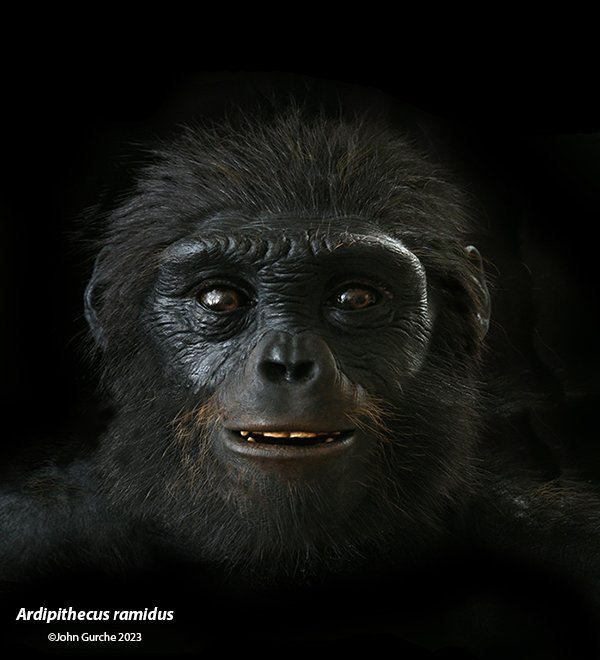
Ardipithecus ramidus was a relatively small hominin, with a body plan unlike any living primate. The most complete specimen, ARA-VP-6/500 ('Ardi'), is estimated to have stood about 120 centimeters (approximately 4 feet) tall and weighed around 50 kilograms (110 pounds). This makes her comparable in stature to a modern chimpanzee but with a significantly different build. The skull was small, with a cranial capacity of only 300 to 350 cubic centimeters, similar to that of a female chimpanzee or bonobo. The face was less prognathic (projecting) than that of modern apes, with a shorter snout and a more forward-positioned foramen magnum, the opening at the base of the skull where the spinal cord connects. This cranial base morphology is a key indicator of bipedalism. The dentition was also telling; the canine teeth were small and diamond-shaped (incisiform) in both males and females, unlike the large, sharp, dagger-like canines seen in male apes, suggesting reduced male-to-male aggression. The molar enamel was intermediate in thickness, thicker than a chimpanzee's but thinner than that of later Australopithecus species, hinting at a generalized diet. The skeleton reveals a unique combination of features for both climbing and walking. The arms were long, but the hands lacked the specialized knuckle-walking adaptations of modern African apes. Instead, the palms were short and the fingers long and curved, suitable for grasping branches. The pelvis was a revolutionary find, showing a mosaic of traits. The upper part (ilium) was short and broad like that of later hominins, providing attachment points for muscles crucial for stabilizing the trunk during upright walking. However, the lower part (ischium) was more ape-like, indicating the presence of powerful hamstring muscles essential for climbing. The foot was perhaps the most surprising element, featuring a fully opposable big toe (hallux) for grasping, a primitive trait for an arboreal lifestyle. Yet, the other four toes were rigid, and the foot contained a small bone (the os peroneum) that helped create a stiffened midfoot, acting as a propulsive lever for bipedal locomotion, a form of walking described as 'facultative bipedalism.'
Based on its unique anatomy, the paleobiology of Ardipithecus ramidus was likely complex and multifaceted. Its diet, inferred from dental morphology and enamel isotope analysis, was omnivorous and generalist. It probably consumed a wide variety of foods available in its woodland environment, including fruits, nuts, insects, small vertebrates, and tubers. The intermediate enamel thickness suggests a diet less reliant on hard, abrasive foods than later australopithecines but more varied than that of fruit-specialist chimpanzees. The small, non-dimorphic canines point towards a social structure with reduced male-to-male conflict, possibly indicating a shift towards more cooperative social dynamics, perhaps even pair-bonding, a significant departure from the competitive polygyny seen in many modern apes. Its locomotion was a unique combination of terrestrial bipedalism and arboreal clambering. On the ground, it walked upright, but its gait would have been different from ours, lacking the full striding efficiency of modern humans due to its grasping big toe and ape-like lower pelvis. In the trees, it would have been a careful climber, moving quadrupedally along the tops of branches ('above-branch palmigrade quadrupedalism') rather than swinging below them like chimpanzees or orangutans. This dual-mode locomotion suggests it was well-adapted to a life spent both in the trees, likely for foraging and safety, and on the ground, for moving between resource patches.
Ardipithecus ramidus inhabited a woodland environment, a crucial detail that overturned the 'savanna hypothesis,' which posited that bipedalism evolved as an adaptation to life on open grasslands. Fossil evidence from the Aramis site in Ethiopia, including fossilized wood, seeds, and the remains of other animals, paints a picture of a closed-canopy woodland with patches of forest. This environment was cooler and wetter than the region is today. Ardipithecus shared this habitat with a diverse array of fauna. Co-existing species included various monkeys (such as colobines), kudus, peafowl, and other forest-dwelling creatures. Potential predators would have included large carnivores of the time, such as ancestral hyenas and large cats, making the safety of the trees an important aspect of its survival strategy. As a generalist omnivore, Ardipithecus would have occupied a middle position in the food web. It was a consumer of plants and small animals but was also prey for larger predators. Its ability to exploit resources both on the forest floor and in the arboreal canopy would have given it a significant adaptive advantage in this mosaic environment, allowing it to access a broader range of food sources than more specialized primates.
The discovery of Ardipithecus ramidus is a story of decades of meticulous and patient fieldwork. The first fossil, a molar, was found in 1992 at the Aramis locality in the Middle Awash region of Ethiopia by a team led by American paleoanthropologist Tim D. White. Further discoveries followed, and in 1994, the team announced a new species, Australopithecus ramidus. However, as more material was unearthed, including the remarkably complete partial skeleton of an adult female (ARA-VP-6/500), it became clear that the organism was more primitive than any known Australopithecus. In 1995, the species was reclassified into a new genus, Ardipithecus. The excavation and preparation of the key skeleton, nicknamed 'Ardi,' was a monumental task. The bones were found crushed and fragmented in clay-rich sediments and required years of painstaking work in the laboratory to piece together. The culmination of this international effort was the 2009 publication of a special issue of the journal Science, featuring 11 detailed papers that presented Ardi and her world to the public. This publication was a landmark event in paleoanthropology, providing the most complete skeleton of any early human ancestor older than the 3.2-million-year-old 'Lucy' (Australopithecus afarensis).
The evolutionary significance of Ardipithecus ramidus cannot be overstated. It provides the best evidence we have for what the hominin lineage looked like shortly after the split from the lineage that led to modern chimpanzees and bonobos. Ardi's anatomy demonstrated that the last common ancestor was likely not a knuckle-walking, chimpanzee-like creature, as had long been assumed. Instead, Ardipithecus reveals a more generalized ancestral body plan, from which both the specialized locomotion of chimpanzees (knuckle-walking and suspension) and the specialized bipedalism of humans evolved. It is a quintessential transitional form, showcasing a mosaic of primitive ape-like features (e.g., the grasping big toe, long arms, small brain) and derived hominin features (e.g., reduced canines, aspects of the pelvis and cranial base indicating upright posture). This combination suggests that bipedalism did not evolve in a single step but emerged gradually, with early hominins retaining significant climbing abilities for a long period. Ardipithecus pushes the origins of upright walking back into a woodland context, fundamentally altering the narrative of human origins and demonstrating that our evolutionary path was more complex and less linear than previously thought.
Despite the wealth of information provided by the Ardi skeleton, the interpretation of Ardipithecus ramidus is not without scientific debate. A primary point of contention revolves around its exact place in the hominin family tree. While the discovery team, led by Tim White and C. Owen Lovejoy, argues strongly that Ardipithecus is a direct human ancestor, some researchers have questioned this. They point to its unique features, particularly the foot and lower pelvis, suggesting it might represent an extinct side branch of the ape family tree that was not directly ancestral to Australopithecus and Homo. Another debate centers on the nature of its locomotion. While the discoverers champion a model of terrestrial bipedalism combined with careful arboreal climbing, other analysts have emphasized the arboreal features, suggesting it may have been less committed to ground-dwelling bipedalism than proposed. These ongoing discussions are a healthy part of the scientific process, as researchers continue to analyze the existing fossils and await new discoveries that could further clarify the role of Ardipithecus in the grand story of human evolution.
The fossil record for Ardipithecus ramidus, while containing one spectacular skeleton, is still relatively limited. The known fossils, representing at least 36 different individuals, all come from a specific area in the Middle Awash region of Ethiopia, particularly the sites of Aramis and Gona. The preservation of the 'Ardi' skeleton is remarkable, including the skull, pelvis, hands, and feet, parts that are rarely found together for such an ancient hominin. However, many of the bones were highly fragmented and distorted, requiring extensive digital reconstruction. Other fossil finds are much more fragmentary, typically consisting of isolated teeth, jaw fragments, and postcranial bones. The concentration of fossils in this one region of Ethiopia's Afar Rift valley highlights the specific geological conditions that allowed for their preservation, but it also means our understanding of the species' geographic range is currently limited to this area. Future discoveries in other parts of Africa from the same time period are needed to determine if Ardipithecus was more widespread.
Since its public unveiling in 2009, Ardipithecus ramidus, and 'Ardi' in particular, has had a significant cultural impact. The discovery was hailed as a breakthrough of the year by major scientific publications and captured the public's imagination, featuring in numerous documentaries, magazine articles, and news reports. Ardi joined 'Lucy' as one of the most famous hominin fossils, providing a new, more ancient face for human ancestry. Museums around the world, including the Cleveland Museum of Natural History and the Smithsonian National Museum of Natural History, feature casts and reconstructions of the Ardi skeleton in their human origins exhibits. These displays are crucial for public education, visually demonstrating the complex, mosaic nature of early human evolution and challenging the simplistic, linear 'march of progress' iconography that has long dominated popular depictions of our ancestry. Ardi serves as a powerful reminder that our family tree is a rich and branching bush, full of fascinating ancestors and relatives whose stories are slowly being unearthed.
Classification
Time Period
Discovery
Location
Ethiopia
Formation
Gona deposits, Middle Awash
Frequently Asked Questions
What is Ardipithecus ramidus?
Ardipithecus ramidus is a species of early hominin that lived approximately 4.4 million years ago during the early Pliocene epoch in what is now Ethiopia. Its discovery fundamentally reshaped our understanding of the last common ancestor of humans and chimpanzees, providing an unprecedented glimpse ...
When did Ardipithecus ramidus live?
Ardipithecus ramidus lived during the neogene period of the cenozoic era approximately 4.5-4.3 million years ago.
Where was Ardipithecus ramidus discovered?
Fossils of Ardipithecus ramidus were discovered in Ethiopia in the Gona deposits, Middle Awash.
What did Ardipithecus ramidus eat?
Ardipithecus ramidus was a omnivore. It lived in terrestrial, arboreal habitats.
What type of fossil is Ardipithecus ramidus?
Ardipithecus ramidus is preserved as a body fossil. The preservation quality is good.
Related Specimens
From the cenozoic era · body fossils