Muttaburrasaurus
Muttaburrasaurus langdoni
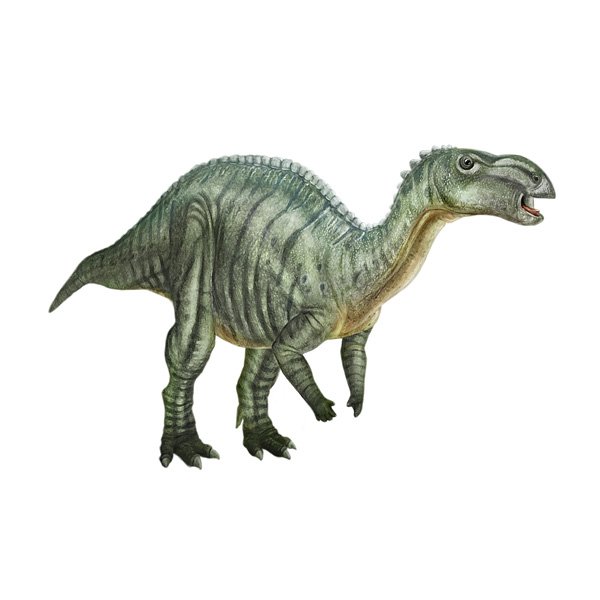
Image: Image sourced via web search (Fair use / Educational)
About Muttaburrasaurus
Muttaburrasaurus langdoni is a genus of large, herbivorous ornithopod dinosaur that lived during the Early Cretaceous period, approximately 103 to 96 million years ago, in what is now northeastern Australia. As one of the most completely known and widely recognized dinosaurs from the Australian continent, it holds immense significance in the field of paleontology for illuminating the diverse and unique dinosaur faunas that inhabited the polar and sub-polar regions of eastern Gondwana. Its discovery has provided critical insights into the evolution, morphology, and biogeography of iguanodontian dinosaurs in the Southern Hemisphere, offering a rare window into an ecosystem that was vastly different from the well-trodden fossil beds of North America and Asia.
Muttaburrasaurus was a large, robust ornithopod, with adult individuals estimated to have reached lengths of approximately 8 meters (about 26 feet) and weighing roughly 2.8 metric tons. To put this into perspective, its mass would have been comparable to that of a modern Asian elephant, though its bipedal-capable body plan was entirely different. The most distinctive anatomical feature of Muttaburrasaurus was its highly modified skull, which featured a large, hollow, bulbous bony snout. This enlarged nasal region may have supported an expanded fleshy chamber used for producing loud, resonant vocalizations, similar to the functions proposed for the crests of later hadrosaurids, or perhaps it played a role in olfactory enhancement or thermoregulation in a seasonally cold environment. Its jaws were equipped with powerful, shearing teeth that lacked the complex grinding ridges seen in more derived hadrosaurs, indicating a fundamentally different chewing mechanism. The postcranial skeleton was heavily built, with a stiffened tail supported by a network of ossified tendons that provided balance and stability. Its forelimbs were strong and ended in hoof-like claws, suggesting that while it was capable of bipedal locomotion, it likely spent a significant amount of time walking on all fours, especially when foraging for low-growing vegetation. The hind limbs were massive and pillar-like, designed to support its considerable weight during both standing and locomotion.
As a dedicated herbivore, Muttaburrasaurus possessed a diet that likely consisted of tough, fibrous vegetation such as cycads, ferns, clubmosses, and the early angiosperms that were beginning to diversify and spread during the Cretaceous period. Unlike the later duck-billed dinosaurs, which had complex dental batteries for finely grinding plant matter, Muttaburrasaurus had simpler, shearing teeth. This suggests that it relied on a powerful bite to crop and slice through tough plant material, which was then swallowed relatively whole and processed in a large, fermenting gut, possibly aided by the ingestion of gastroliths (stomach stones). Its locomotion was likely facultatively bipedal; it could rear up on its powerful hind legs to reach higher foliage or to flee rapidly from predators, but it generally moved quadrupedally while feeding and traveling long distances. The presence of the enlarged nasal cavity strongly implies complex social behaviors, potentially involving acoustic communication. These vocalizations could have been used for herd coordination, mating displays, or warning calls against approaching predators. Growth patterns inferred from the bone histology of related ornithopods suggest that Muttaburrasaurus grew rapidly during its juvenile years, reaching skeletal maturity within a decade or two. This rapid growth was a necessary evolutionary strategy to outpace the vulnerability of small size in an environment shared with large theropod predators. Its metabolism was likely intermediate, exhibiting endothermic characteristics that allowed it to maintain a high activity level and survive in the seasonally cool climates of Early Cretaceous Australia.
During the Early to mid-Cretaceous, the Australian landmass was located much further south than it is today, situated near the Antarctic Circle as part of the massive supercontinent Gondwana. The environment that Muttaburrasaurus inhabited was characterized by a cool, temperate climate with distinct seasonal variations, including prolonged periods of winter darkness and freezing temperatures. The landscape was dominated by extensive conifer forests, lush fern prairies, and meandering river systems that occasionally flooded, creating vast inland seas like the Eromanga Sea. Muttaburrasaurus shared this unique, high-latitude ecosystem with a variety of other prehistoric creatures. It coexisted with smaller, agile ornithopods like Leaellynasaura, heavily armored dinosaurs such as Minmi and Kunbarrasaurus, and large apex predators like the megaraptoran Australovenator, which would have posed a significant threat to juvenile, old, or sick individuals. The skies above were patrolled by various species of pterosaurs, while the nearby waterways teemed with plesiosaurs, ichthyosaurs, and early crocodilians. In this complex food web, Muttaburrasaurus occupied the critical niche of a large, bulk-feeding primary consumer. Its ability to process tough, fibrous vegetation allowed it to exploit abundant food sources that might have been indigestible to smaller herbivores, making it a keystone species in its habitat. The seasonal nature of the environment, with its long, dark winters, may have also driven migratory behaviors, with massive herds moving across the landscape in search of fresh feeding grounds as the seasons changed.
The discovery of Muttaburrasaurus is a landmark event in the history of Australian paleontology. The first and most significant fossils were found in 1963 by a local grazier named Doug Langdon near the small town of Muttaburra in central Queensland. Langdon stumbled upon the fossilized remains while mustering cattle along the banks of the Thomson River. Recognizing the unusual nature and potential importance of the find, he alerted authorities, leading to the excavation of the site by paleontologist Alan Bartholomai and entomologist Edward Dahms from the Queensland Museum. The recovered specimen, which included a beautifully preserved partial skull and a significant portion of the postcranial skeleton, was meticulously prepared over several years. In 1981, Bartholomai and Ralph Molnar formally described and named the dinosaur Muttaburrasaurus langdoni. The generic name honors the town of Muttaburra, while the specific epithet pays tribute to Doug Langdon for his keen observation and contribution to science. This holotype specimen (QM F6140) remains one of the most complete dinosaur skeletons ever found in Australia. Subsequent discoveries in the region, including isolated teeth and fragmentary bones from the Hughenden area, have expanded our understanding of the genus. In 1987, a second, slightly less complete skull was discovered, which helped confirm the unique anatomy of the nasal region. The story of its discovery highlights the crucial role that amateur fossil hunters and local residents play in advancing the field of paleontology.
Muttaburrasaurus occupies a fascinating and somewhat enigmatic position in the evolutionary tree of ornithischian dinosaurs. Initially, upon its formal description, it was classified within the Iguanodontidae, a family of large, widespread ornithopods known primarily from the Northern Hemisphere. However, subsequent phylogenetic analyses and the discovery of more complete material from related taxa have revealed that its evolutionary relationships are far more complex. It is now widely considered to be a member of the Rhabdodontomorpha, a clade of basal iguanodontians that were particularly successful in the Southern Hemisphere and Europe during the Cretaceous. This classification suggests that Muttaburrasaurus represents an early offshoot of the iguanodontian lineage that became isolated on the Gondwanan landmasses as the supercontinent began to break apart. Its anatomy exhibits a fascinating mosaic of primitive and derived traits; for instance, its shearing teeth are reminiscent of earlier, more basal ornithopods, while its large size and highly modified skull point towards more advanced adaptations. The presence of such a unique lineage in Australia provides critical evidence for the theory of regional endemism, indicating that the dinosaurs of Gondwana evolved along distinct, parallel pathways compared to their Laurasian counterparts. Studying Muttaburrasaurus helps paleontologists map the dispersal routes of ornithopods across the globe and understand how geographic isolation influenced the morphological evolution of dinosaurs in the lead-up to the Late Cretaceous.
The classification and paleobiology of Muttaburrasaurus have been the subjects of ongoing scientific debate and revision. One of the primary controversies revolves around its exact taxonomic placement within the ornithopod family tree. While many researchers currently support its inclusion within the Rhabdodontomorpha, others have argued that it might be more closely related to the Tenontosauridae or represent a completely unique, endemic Australian lineage of basal iguanodontians that has no close relatives elsewhere. The function of its enlarged nasal cavity also remains a topic of active discussion. While the acoustic resonance chamber hypothesis is popular and widely accepted, some paleontologists suggest it could have housed a salt gland, given the proximity of its habitat to the inland Eromanga Sea, or that it played a primary role in sexual dimorphism and visual display. Furthermore, the exact nature of its diet is debated; the lack of a grinding dental battery has led some researchers to speculate that it might have occasionally consumed animal matter, such as carrion or large insects, to supplement its diet in a nutrient-poor environment, though the overwhelming consensus remains that it was a strict herbivore. These debates highlight the dynamic nature of paleontological research and the challenges of interpreting the biology of extinct animals from fragmentary remains.
The fossil record of Muttaburrasaurus, while excellent by Australian standards, is still relatively sparse compared to the abundant remains of North American or Asian dinosaurs. The fossils are primarily found in the Mackunda Formation and the Winton Formation of Queensland, which date to the Albian and Cenomanian stages of the Cretaceous. The holotype specimen consists of a partial skull, lower jaw, cervical and dorsal vertebrae, parts of the pelvis, and elements of the fore and hind limbs. The preservation quality is generally good, though the bones are often heavily permineralized and encased in hard ironstone concretions, making preparation incredibly difficult and time-consuming. In addition to the holotype, a handful of other specimens, mostly isolated teeth, vertebrae, and a second partial skull (known as the 'Dunluce skull'), have been recovered. These fossils are typically found in deposits that represent ancient river channels and floodplains. The rarity of articulated skeletons suggests that carcasses were often scavenged or transported by water currents before burial. Despite the limited number of specimens, the quality of the cranial material has allowed for detailed biomechanical and phylogenetic studies.
Muttaburrasaurus has achieved significant cultural impact, particularly in its native Australia, where it is celebrated as a national paleontological icon. It was one of the first uniquely Australian dinosaurs to capture the public's imagination and has been featured extensively in books, documentaries, and educational materials. The town of Muttaburra proudly embraces its prehistoric heritage, featuring a large replica of the dinosaur that serves as a major tourist attraction. Casts of the Muttaburrasaurus skeleton are prominently displayed in several major institutions, including the Queensland Museum in Brisbane and the National Dinosaur Museum in Canberra. In popular culture, it gained international recognition through its appearance in the acclaimed BBC documentary series 'Walking with Dinosaurs,' which depicted it migrating across the polar forests of Cretaceous Antarctica and Australia. This exposure has cemented its status as one of the most recognizable dinosaurs from the Southern Hemisphere.
Classification
Time Period
Discovery
Location
Queensland, Australia
Formation
Mackunda Formation
Frequently Asked Questions
What is Muttaburrasaurus?
Muttaburrasaurus langdoni is a genus of large, herbivorous ornithopod dinosaur that lived during the Early Cretaceous period, approximately 103 to 96 million years ago, in what is now northeastern Australia. As one of the most completely known and widely recognized dinosaurs from the Australian cont...
When did Muttaburrasaurus live?
Muttaburrasaurus lived during the cretaceous period of the mesozoic era approximately 103-96 million years ago.
Where was Muttaburrasaurus discovered?
Fossils of Muttaburrasaurus were discovered in Queensland, Australia in the Mackunda Formation.
What did Muttaburrasaurus eat?
Muttaburrasaurus was a herbivore. It lived in terrestrial habitats.
What type of fossil is Muttaburrasaurus?
Muttaburrasaurus is preserved as a body fossil. The preservation quality is good.
Related Specimens
From the mesozoic era · body fossils