Tsintaosaurus
Tsintaosaurus spinorhinus
Image: Image sourced via web search (Fair use / Educational)
About Tsintaosaurus
Tsintaosaurus spinorhinus is a genus of hadrosaurid, or 'duck-billed' dinosaur, that inhabited what is now eastern Asia during the Late Cretaceous period, approximately 76 to 73 million years ago. Known for its distinctive, and once highly debated, cranial crest, Tsintaosaurus represents an important member of the lambeosaurine subfamily of hadrosaurs, providing key insights into the diversity, anatomy, and social dynamics of these large herbivores in the final stages of the dinosaur age. Its fossils, primarily found in the rich deposits of the Wangshi Group in Shandong, China, have fueled scientific discussion for decades regarding the structure and function of its unique head ornamentation.
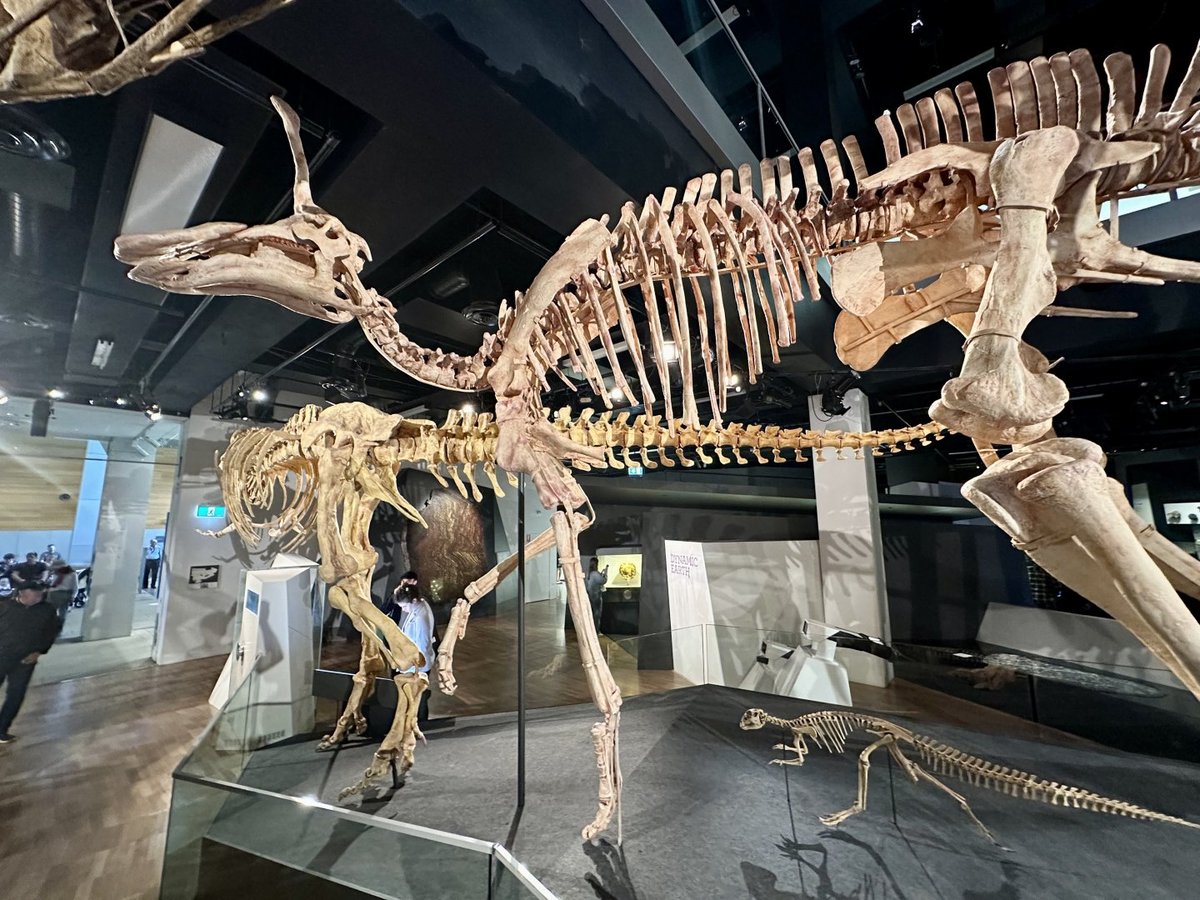
Tsintaosaurus was a large, robustly built herbivore, reaching an estimated length of 8.3 to 10 meters (approximately 27 to 33 feet) and a weight of around 2.5 to 3 metric tons. For comparison, it was roughly the size of a modern African bush elephant, though with a bipedal/quadrupedal stance. Its overall body plan was typical of hadrosaurs: a bulky torso, powerful hind limbs that supported most of its weight, shorter but strong forelimbs, and a long, stiff tail used for counterbalance. The most defining and controversial feature of Tsintaosaurus is its cranial crest. Initially, based on a single incomplete skull (specimen IVPP V725), the crest was reconstructed as a single, forward-pointing, spike-like process extending from the snout, earning it the informal nickname 'unicorn dinosaur'. This structure was thought to be a hollow tube, approximately 40 centimeters long. However, this interpretation was unique among hadrosaurs, whose crests are typically more complex, hollow, and positioned further back on the skull. The skeleton exhibits other hadrosaurid characteristics, including a specialized dental battery composed of hundreds of tightly packed, continuously replacing teeth designed for efficiently grinding tough plant material. The vertebral column was reinforced by ossified tendons, particularly along the back and tail, which provided rigidity and support for its massive frame.
As a hadrosaurid, Tsintaosaurus was a specialized herbivore. Its complex dental batteries formed a broad grinding surface capable of processing fibrous vegetation like conifers, cycads, and early flowering plants. The broad, duck-like beak at the front of its snout was toothless and likely covered in a keratinous sheath, perfect for cropping or stripping leaves and twigs from branches. It would then use its powerful cheek teeth to masticate this material thoroughly before swallowing. Tsintaosaurus was likely a facultative biped, meaning it could walk on two legs for travel but could also adopt a four-legged stance for grazing or resting. Its powerful hind legs would have enabled it to reach a respectable speed to escape predators. Inferences about its social behavior are drawn from other hadrosaur discoveries, which include evidence of large herds, nesting grounds, and parental care. The cranial crest, now understood to be part of a larger, more complex structure, likely played a significant role in social dynamics. It could have served as a visual display for species recognition and mate selection, with size and shape potentially indicating age, sex, or social status. Furthermore, if the crest contained hollow nasal passages, as is common in lambeosaurines, it would have functioned as a resonating chamber, allowing Tsintaosaurus to produce loud, distinctive calls for communication over long distances, warning of predators or coordinating herd movements.
Tsintaosaurus lived in a warm, humid, floodplain environment in what is now the Shandong Peninsula of China during the Campanian stage of the Late Cretaceous. This region was a lush coastal plain crisscrossed by rivers and dotted with lakes, supporting a rich and diverse ecosystem. The flora was dominated by conifers, ferns, and an increasing variety of angiosperms (flowering plants), providing ample food for large herbivores. Tsintaosaurus shared this habitat with a remarkable assembly of other dinosaurs. It was part of a diverse hadrosaur fauna, coexisting with the giant Shantungosaurus, one of the largest known ornithopods, and the saurolophine hadrosaur Tanius. This suggests a degree of niche partitioning, where different hadrosaur species may have specialized in feeding on different types of plants or at different heights. The primary predators in this ecosystem were large tyrannosaurids, most notably the formidable Zhuchengtyrannus magnus, a theropod comparable in size to its North American cousin, Tyrannosaurus rex. The presence of such a powerful apex predator would have placed significant evolutionary pressure on herbivores like Tsintaosaurus to develop defensive strategies, such as herding behavior and keen senses, to survive.
The discovery of Tsintaosaurus is credited to the Chinese paleontologist Yang Zhongjian (also known as C.C. Young), a foundational figure in Chinese vertebrate paleontology. The first fossils were unearthed between 1950 and 1958 in the Jingangkou locality of Laiyang County, Shandong Province, as part of extensive paleontological expeditions. The holotype specimen, IVPP V725, consists of a partial skull and postcranial skeleton. Yang officially named and described the genus in 1958. The genus name, 'Tsintaosaurus', is derived from the old romanization 'Tsingtao' for the nearby city of Qingdao, combined with the Greek 'sauros' for lizard. The species name, 'spinorhinus', means 'spine-nosed', directly referencing the initial interpretation of its unique, spike-like crest. For many years, this single, incomplete skull was the primary basis for all reconstructions, leading to its popular depiction as a dinosaur with a single horn on its snout. This unique appearance made it a curiosity among hadrosaurs, but also a subject of skepticism among paleontologists who questioned the unusual anatomy and the possibility of fossil distortion.
Within the grand evolutionary tree of dinosaurs, Tsintaosaurus is firmly placed within the family Hadrosauridae, specifically in the subfamily Lambeosaurinae. This group is distinguished by the presence of elaborate, hollow cranial crests that house elongated nasal passages. Its relatives include more famous North American genera like Corythosaurus, Lambeosaurus, and Parasaurolophus. The anatomy of Tsintaosaurus, particularly the reinterpreted crest structure, helps paleontologists understand the diversity and evolutionary pathways of these crests within Asian lambeosaurines. It demonstrates that while lambeosaurines in North America and Asia shared a common ancestor, they evolved a distinct array of crest shapes and sizes. Tsintaosaurus and its close relatives, such as Pararhabdodon and the more recently discovered Tlatolophus, form a clade known as Parasaurolophini. Studying the subtle anatomical differences between these genera allows scientists to trace their geographic dispersal and evolutionary radiation across the northern hemisphere during the Late Cretaceous. It provides a crucial data point for understanding how this successful group of herbivores adapted to different environments and diversified before the mass extinction event that ended the Mesozoic Era.
The most significant scientific debate surrounding Tsintaosaurus has always been the nature of its crest. The initial 'unicorn' reconstruction by Yang was questioned for decades. Some paleontologists, like Philippe Taquet, suggested the prominent spine was actually a nasal bone displaced from the top of the snout during fossilization. Others proposed it was part of a larger, more fragile crest that had broken away. This controversy persisted until the discovery of a second specimen (IVPP V818) and a subsequent re-examination of the holotype in 2013 by a team led by Albert Prieto-Márquez and Jonathan R. Wagner. Their analysis revealed that the 'spike' was not the complete crest but was actually the rear part of a much larger, hollow, dome-like structure that arched over the back of the skull. The spine-like process was likely the highest point of this larger, more rounded crest, which was formed primarily by the premaxilla and nasal bones. This revised interpretation brought Tsintaosaurus more in line with other lambeosaurines, resolving its anomalous anatomy and confirming its placement within the group. It transformed the animal's image from a bizarre unicorn to a more conventional, yet still unique, crested hadrosaur.
The fossil record of Tsintaosaurus is localized to the Wangshi Group formations in Shandong Province, China. This area has proven to be one of the most productive dinosaur fossil sites in the world. While not as common as its contemporary, the colossal Shantungosaurus, several partial skeletons and disarticulated bones of Tsintaosaurus have been recovered since its initial discovery. The preservation quality of these fossils is generally good, allowing for detailed anatomical study, although complete, fully articulated skeletons remain elusive. The holotype specimen, IVPP V725, which includes the famous partial skull, is the most important find. The subsequent discovery of other cranial and postcranial elements has been crucial in resolving the debate over its crest and providing a more complete picture of its skeletal anatomy. The Jingangkou bonebeds, where these fossils are found, represent a mass-death assemblage, suggesting that large numbers of dinosaurs perished in a catastrophic event, possibly a flood, which led to the accumulation and preservation of their remains.
Despite the scientific revisions to its appearance, the initial 'unicorn' image of Tsintaosaurus has secured its place in popular culture. It has been featured in numerous dinosaur books, encyclopedias, and documentaries, often highlighted for its bizarre and unique headgear. This distinctive, albeit inaccurate, reconstruction made it a memorable and easily recognizable dinosaur for generations of enthusiasts. Casts of the Tsintaosaurus skeleton, often with the traditional forward-pointing spike, are displayed in several museums worldwide, including the Paleozoological Museum of China in Beijing. Its story serves as an excellent educational tool, illustrating the self-correcting nature of science, where new discoveries and re-evaluations of old evidence can dramatically change our understanding of a prehistoric animal. The journey from 'unicorn dinosaur' to a more scientifically accurate, dome-crested hadrosaur encapsulates the dynamic process of paleontological research.
Classification
Time Period
Discovery
Location
Shandong, China
Formation
Wangshi Group (specifically the Jingangkou Formation)
Frequently Asked Questions
What is Tsintaosaurus?
Tsintaosaurus spinorhinus is a genus of hadrosaurid, or 'duck-billed' dinosaur, that inhabited what is now eastern Asia during the Late Cretaceous period, approximately 76 to 73 million years ago. Known for its distinctive, and once highly debated, cranial crest, Tsintaosaurus represents an importan...
When did Tsintaosaurus live?
Tsintaosaurus lived during the cretaceous period of the mesozoic era approximately 76-73 million years ago.
Where was Tsintaosaurus discovered?
Fossils of Tsintaosaurus were discovered in Shandong, China in the Wangshi Group (specifically the Jingangkou Formation).
What did Tsintaosaurus eat?
Tsintaosaurus was a herbivore. It lived in terrestrial habitats.
What type of fossil is Tsintaosaurus?
Tsintaosaurus is preserved as a body fossil. The preservation quality is good.
Related Specimens
From the mesozoic era · body fossils