Australopithecus africanus
Image: Image sourced via web search (Fair use / Educational)
About Australopithecus africanus
Australopithecus africanus is an extinct species of early hominin that lived in Southern Africa between approximately 3.3 and 2.1 million years ago, during the late Pliocene and early Pleistocene epochs. As one of the first australopithecines ever discovered, its fossils have provided crucial insights into the early stages of human evolution, particularly regarding the development of bipedalism and the mosaic nature of hominin anatomical changes. This species occupies a pivotal, though debated, position in the human family tree, representing a more gracile form compared to its robust contemporaries and potentially linking earlier hominins to the later genus Homo.
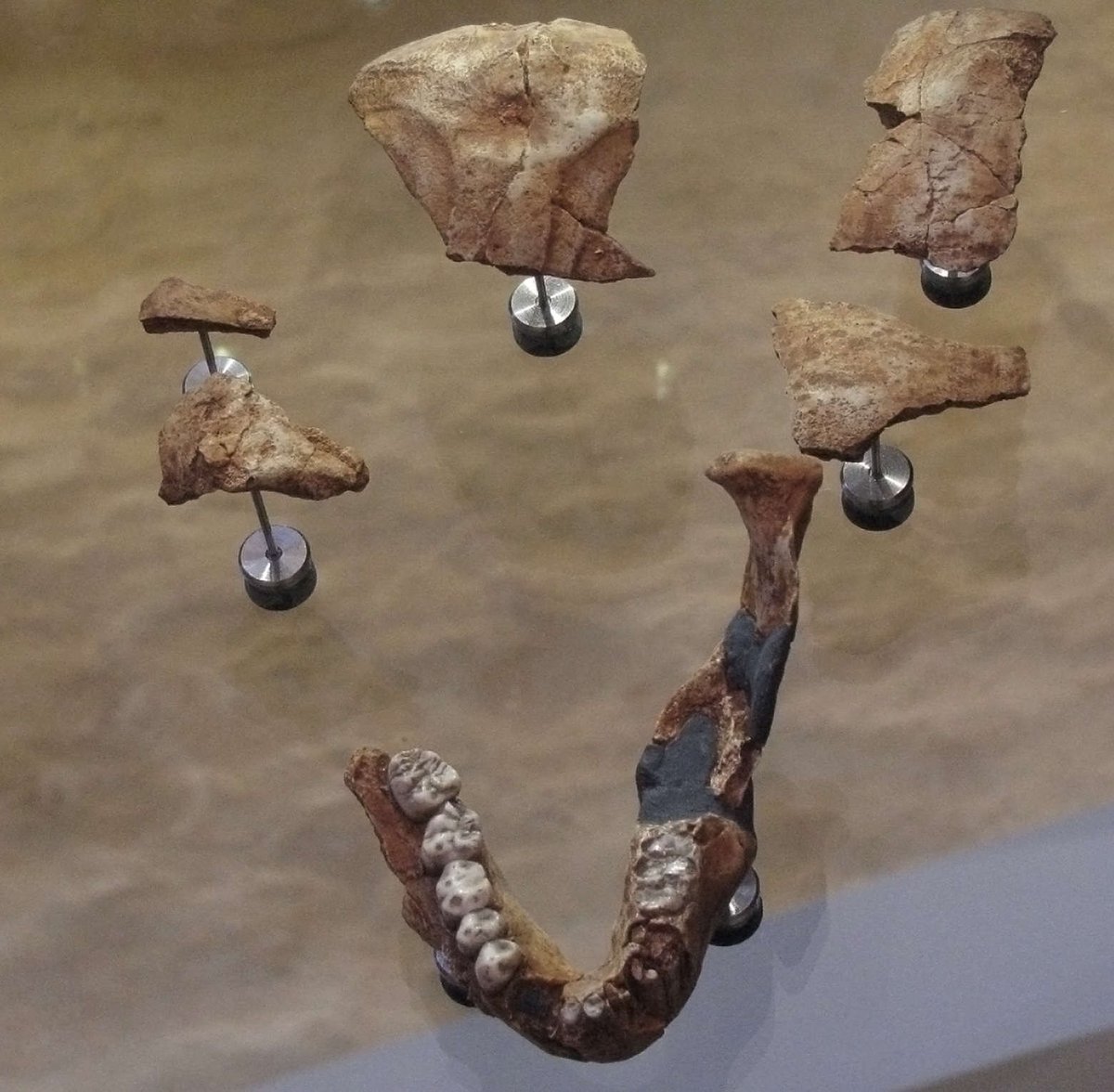
The physical anatomy of Australopithecus africanus presents a compelling mosaic of ape-like and human-like traits. Adult males stood approximately 138 cm (4 ft 6 in) tall and weighed around 41 kg (90 lb), while females were smaller, averaging 115 cm (3 ft 9 in) and 30 kg (66 lb), exhibiting significant sexual dimorphism. Their overall body plan was more robust than modern humans but more slender, or 'gracile', than the contemporary robust australopithecines like Paranthropus. The cranium was globular with a brain volume averaging between 428 and 515 cubic centimeters, larger than a chimpanzee's but only about one-third the size of a modern human's. The face was prognathic (projecting forward), but less so than in earlier species like Australopithecus afarensis. Key cranial features include a sloping forehead, prominent brow ridges, and a forward-positioned foramen magnum at the base of the skull, a definitive indicator of habitual upright posture. The dental arcade was more parabolic, like that of humans, than the U-shape of apes, with relatively small canines and incisors but large, thickly enameled molars and premolars, suggesting a diet that required powerful grinding.
The paleobiology of Australopithecus africanus reveals a versatile and adaptable hominin. Its dentition, particularly the large, flat molars with thick enamel, points to a varied, omnivorous diet. Isotopic analysis of tooth enamel suggests they consumed a wide range of foods, including fruits, nuts, seeds, roots, tubers, and likely insects and small animals. This dietary flexibility would have been advantageous in the shifting environments of Pliocene Africa. Locomotion was primarily bipedal, as confirmed by the structure of the pelvis, femur, and the position of the foramen magnum. However, certain features, such as the relatively long arms, curved finger and toe bones, and upward-oriented shoulder joints, suggest it retained significant arboreal capabilities, likely for foraging, nesting, or escaping predators. This combination of terrestrial and tree-climbing adaptations indicates a life spent both on the ground in open woodlands and within the safety of trees. Social structure is inferred to be similar to modern great apes, likely living in multi-male, multi-female groups. Growth patterns, studied from specimens like the Taung Child, suggest a developmental trajectory more akin to that of a chimpanzee than a modern human, with a faster maturation rate and shorter childhood.
Australopithecus africanus inhabited the dynamic landscapes of Pliocene-Pleistocene Southern Africa, a world undergoing significant climatic shifts. The environment was a mosaic of open woodland, gallery forests along rivers, and expanding grassy savannas, driven by global cooling and drying trends. This variable habitat would have placed a premium on adaptability. A. africanus shared this ecosystem with a diverse array of fauna, including early elephants, saber-toothed cats (like Dinofelis and Megantereon), hyenas, various antelope species, and other primates. As a relatively small hominin, it would have occupied a middle position in the food web. It was both a forager and a prey animal, vulnerable to a host of large predators. Fossil evidence, including puncture marks on the Taung Child's skull consistent with an eagle's talons and tooth marks on other specimens, confirms that predation was a significant selective pressure. Its omnivorous diet and mixed locomotor strategy were likely key adaptations for survival in this complex and dangerous ecological context, allowing it to exploit resources from both terrestrial and arboreal settings while navigating constant threats.
The discovery history of Australopithecus africanus is a landmark chapter in paleoanthropology. In 1924, quarry workers at Taung, South Africa, uncovered a small fossilized skull. It was sent to Raymond Dart, an anatomist at the University of the Witwatersrand in Johannesburg. Dart recognized it as a juvenile hominin, noting its small brain but human-like teeth and, crucially, the forward position of the foramen magnum indicating bipedalism. He named it Australopithecus africanus, meaning 'southern ape of Africa,' and published his findings in Nature in 1925. This specimen, now famously known as the 'Taung Child,' was initially met with skepticism from a scientific community that expected the earliest human ancestors to be found in Asia and to have large brains. However, subsequent discoveries by Robert Broom at the sites of Sterkfontein and Makapansgat, including the adult cranium 'Mrs. Ples' (Sts 5) in 1947 and the partial skeleton 'Little Foot' (StW 573), vindicated Dart's claims and cemented Africa as the cradle of humankind. These key specimens remain cornerstones of our understanding of the species.
Australopithecus africanus holds immense evolutionary significance as it demonstrates the complex, non-linear path of human origins. It provided the first definitive evidence that bipedalism evolved long before the significant expansion of the brain, challenging the 'brain-first' hypothesis that had dominated early 20th-century thought. Its blend of primitive (ape-like) and derived (human-like) features makes it a classic example of a transitional fossil. For many years, A. africanus was considered a direct ancestor of the genus Homo. While its precise position is still debated, many researchers place it as a close relative to the lineage that led to humans, possibly as an ancestor to either Homo or the robust australopithecines (Paranthropus), or as a sister taxon to the direct human line. The species illustrates a crucial adaptive radiation of early hominins, showcasing a successful 'gracile' body plan that thrived for over a million years before the emergence of more specialized or encephalized forms. Its existence underscores that the hominin family tree is more of a bushy, branching structure than a simple, linear progression.
Despite being one of the best-represented early hominins, Australopithecus africanus remains at the center of several scientific debates. Its exact phylogenetic relationship to other hominins is a major point of contention. Some paleoanthropologists argue it is a direct ancestor of the Homo lineage, citing features in the skull and pelvis that appear more derived than those of A. afarensis. Others propose it represents a side branch of the hominin tree that went extinct without leaving descendants, with A. afarensis being a more likely direct ancestor to Homo. The discovery of Australopithecus sediba at Malapa, South Africa, has further complicated this picture, as A. sediba shares traits with both A. africanus and early Homo. There is also ongoing discussion about the degree of its arboreality versus terrestriality, with some researchers emphasizing its climbing adaptations while others highlight the efficiency of its bipedal gait. The interpretation of its diet and social behavior also continues to be refined with new analytical techniques, such as isotopic analysis and micro-wear studies on teeth.
The fossil record of Australopithecus africanus is geographically restricted to cave sites within the 'Cradle of Humankind' UNESCO World Heritage Site in Gauteng Province, South Africa. The primary fossil-bearing localities are Sterkfontein, Makapansgat, Gladysvale, and Taung. These fossils are not found in distinct layers but rather in breccia—a rock type composed of cemented cave earth, bone fragments, and rock. Hundreds of individual specimens have been recovered, making A. africanus one of the most well-documented early hominin species. The preservation quality varies, but includes some remarkably complete remains. The record includes numerous crania (like 'Mrs. Ples'), mandibles, and postcranial elements. The most spectacular specimen is 'Little Foot' (StW 573) from Sterkfontein, an almost complete skeleton that took over two decades to fully excavate from the breccia, providing unprecedented information about the species' anatomy and proportions. This rich fossil endowment continues to yield new discoveries and deepen our understanding of this pivotal ancestor.
Australopithecus africanus, particularly through the iconic 'Taung Child' and 'Mrs. Ples' fossils, has had a significant cultural impact. These discoveries fundamentally shifted scientific and public perception of human origins to Africa. Casts and original specimens are prized exhibits in museums worldwide, including the Ditsong National Museum of Natural History in Pretoria and the Maropeng Visitor Centre at the Cradle of Humankind. The story of Raymond Dart's controversial discovery is a classic tale of scientific perseverance. As a well-understood and visually distinct early human relative, A. africanus is a staple in educational materials, documentaries, and popular science books, serving as a key character in the narrative of our own deep past and symbolizing the crucial early steps of the human journey.
Classification
Time Period
Discovery
Location
South Africa
Formation
Makapansgat Formation, Sterkfontein Formation
Frequently Asked Questions
What is Australopithecus africanus?
Australopithecus africanus is an extinct species of early hominin that lived in Southern Africa between approximately 3.3 and 2.1 million years ago, during the late Pliocene and early Pleistocene epochs. As one of the first australopithecines ever discovered, its fossils have provided crucial insigh...
When did Australopithecus africanus live?
Australopithecus africanus lived during the pliocene/pleistocene period of the cenozoic era approximately 3.3-2.1 million years ago.
Where was Australopithecus africanus discovered?
Fossils of Australopithecus africanus were discovered in South Africa in the Makapansgat Formation, Sterkfontein Formation.
What did Australopithecus africanus eat?
Australopithecus africanus was a omnivore. It lived in terrestrial (woodland, savanna) habitats.
What type of fossil is Australopithecus africanus?
Australopithecus africanus is preserved as a body fossil. The preservation quality is good.
Related Specimens
From the cenozoic era · body fossils