Sivatherium
Sivatherium giganteum
Image: Image sourced via web search (Fair use / Educational)
About Sivatherium
Sivatherium giganteum, frequently referred to as Shiva's beast, represents one of the most extraordinary and massive artiodactyls ever to walk the Earth. This extinct genus of giraffid lived from the Pliocene through the Late Pleistocene and possibly into the early Holocene epoch, spanning an approximate age of 5 million to 8,000 years ago. Geographically, its remains have been predominantly recovered from the Siwalik Hills of the Indian subcontinent, though related species within the genus ranged across Africa and other parts of Asia. As a colossal relative of the modern giraffe and okapi, Sivatherium holds immense significance in the field of paleontology because it dramatically illustrates the morphological diversity and evolutionary experimentation within the family Giraffidae. Rather than evolving the elongated neck characteristic of extant giraffes, Sivatherium evolved into a heavily built, moose-like behemoth, demonstrating an alternative evolutionary pathway for large browsing herbivores during the Neogene and Quaternary periods.
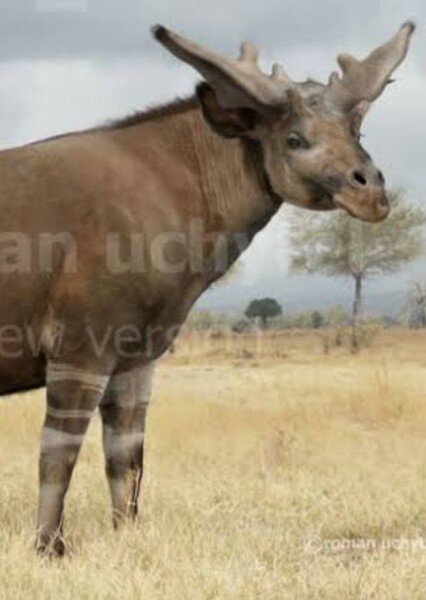
The physical description of Sivatherium giganteum paints a picture of a truly formidable creature that defies the delicate, long-necked image typically associated with giraffids. Standing approximately 2.2 to 3 meters tall at the shoulder and measuring over 3 meters in body length, this animal was built with immense robusticity. Recent volumetric mass estimations suggest that Sivatherium giganteum could have weighed between 1,200 and 1,800 kilograms, making it one of the largest known ruminants in Earth's history, rivaling or exceeding the mass of the largest modern bovines and approaching the size of a small elephant or a large rhinoceros. Its skeletal characteristics reveal a relatively short, thick neck supported by massive cervical vertebrae, which were necessary to hold up its enormous, heavy skull. The most distinctive feature of Sivatherium was its spectacular cranial ornamentation. It possessed two pairs of ossicones—horn-like structures covered in skin and hair, similar to those of modern giraffes. The posterior pair was massive, flattened, and palmate, bearing a striking resemblance to the antlers of a modern moose, while the anterior pair consisted of smaller, conical spikes situated above the eyes. The skull itself was broad and heavily constructed, with a reinforced nasal region that has led some paleontologists to infer the presence of a prehensile upper lip or even a short proboscis, similar to that of a tapir or saiga antelope. Its limbs, while shorter and much thicker than those of a modern giraffe, were still relatively long compared to other megafaunal herbivores, ending in large, cloven hooves designed to support its massive bulk over varied terrain. When compared to modern animals, Sivatherium would have looked like a bizarre chimera: possessing the body of a giant draft horse or okapi, the legs of a heavily muscled giraffe, and the head of an oversized, exotic moose.
In terms of paleobiology, Sivatherium was a dedicated herbivore, but its specific feeding strategies and ecological niche have been the subject of extensive study. Dental wear analysis and the morphology of its robust, high-crowned (hypsodont) teeth indicate that it was primarily a mixed feeder, capable of both browsing on leaves, twigs, and branches of trees and shrubs, as well as grazing on tougher grasses when necessary. The potential presence of a prehensile lip or short trunk would have been highly advantageous for stripping foliage from thorny branches, a feeding strategy observed in modern black rhinos and giraffes. Its massive size and heavy build suggest that its locomotion was likely characterized by a pacing gait, similar to modern giraffids, though it would not have been capable of high-speed running over long distances. Instead, its sheer bulk would have served as a primary defense mechanism against predators. Socially, it is inferred that Sivatherium may have lived in small herds or loose aggregations, much like modern okapis or giraffes. The spectacular palmate ossicones of the males were almost certainly used in intraspecific combat and display, likely involving head-to-head pushing or wrestling contests for mating dominance, rather than the neck-swinging blows utilized by modern giraffes. Growth patterns inferred from bone histology suggest a relatively slow maturation rate, typical of large-bodied megafauna, with a metabolism adapted to processing large volumes of low-quality forage through foregut fermentation.
The ecological context of Sivatherium giganteum places it in a dynamic and changing world. During the Pliocene and Pleistocene, the Indian subcontinent and the broader regions of Asia and Africa were experiencing significant climatic shifts, transitioning from dense, closed-canopy forests to more open woodlands, savannas, and expansive grasslands. Sivatherium thrived in these transitional mosaic environments, where it could utilize both the forest edge for browsing and the open plains for grazing. It shared its habitat with a diverse array of Pleistocene megafauna, including early elephants like Stegodon, various species of rhinoceros, giant wild cattle (aurochs), and an assortment of ancient equids and antelopes. As a megaherbivore, Sivatherium occupied a crucial position in the food web, acting as a major consumer of vegetation and a landscape architect, shaping the flora through its intensive browsing and grazing activities. While adult Sivatherium were likely immune to predation from all but the most formidable carnivores due to their immense size, juveniles, sick, or elderly individuals would have been targeted by apex predators of the time, such as saber-toothed cats (like Machairodus or Homotherium), giant hyenas, and early species of Panthera, including lions and leopards. The eventual decline of Sivatherium is closely tied to the dramatic climatic fluctuations of the Late Pleistocene, which altered the distribution of its preferred mosaic habitats, coupled with potential hunting pressures from early human populations expanding across Asia.
The discovery history of Sivatherium is a fascinating chapter in the annals of paleontology, deeply intertwined with the colonial era of scientific exploration in India. The first significant fossils of Sivatherium giganteum were discovered in the 1830s by Scottish physician and paleontologist Hugh Falconer and English engineer Proby Cautley. They unearthed these remarkable remains in the Siwalik Hills, a mountain range of the outer Himalayas that has since become world-renowned for its exceptionally rich deposits of Neogene and Quaternary vertebrate fossils. Falconer and Cautley were astounded by the massive, bizarre skull with its branching ossicones, initially struggling to classify the beast. They named it Sivatherium, meaning 'Shiva's beast,' in honor of the Hindu deity Shiva, reflecting the awe-inspiring and somewhat destructive power implied by its massive size, and 'giganteum' to denote its gigantic proportions. The original holotype specimen, a beautifully preserved skull, remains one of the most iconic fossils from the Siwalik deposits. Over the decades, further excavations in the Siwaliks and subsequent discoveries of related species in Africa (such as Sivatherium maurusium) have expanded our understanding of the genus, but the initial discoveries by Falconer and Cautley remain the foundational cornerstone of sivatheriine research.
In terms of evolutionary significance, Sivatherium occupies a crucial and fascinating branch on the tree of life. It belongs to the family Giraffidae, but it represents a distinct subfamily known as the Sivatheriinae, which diverged from the lineage leading to modern giraffes (Giraffinae) early in their evolutionary history. While the Giraffinae pursued an evolutionary strategy focused on vertical elongation—resulting in the iconic long necks and legs of the modern giraffe—the Sivatheriinae pursued a strategy of massive bulk and robusticity. Sivatherium demonstrates that the giraffid body plan was highly adaptable and capable of producing forms that converged ecologically and morphologically with large bovids and cervids. The study of Sivatherium provides invaluable insights into the evolutionary constraints and possibilities within ruminant artiodactyls. It serves as a prime example of an evolutionary dead end, a highly successful and widespread lineage that ultimately succumbed to the rapid environmental changes of the Late Quaternary. Its relationship to modern descendants is collateral rather than direct; the okapi, a forest-dwelling giraffid of Central Africa, is often considered the closest living analogue in terms of its relatively short neck and overall body proportions, though Sivatherium was vastly larger and more heavily ornamented.
Scientific debates surrounding Sivatherium have been lively and persistent since its discovery. One of the most enduring controversies involves the interpretation of its nasal morphology. The retracted nasal bones and the shape of the premaxilla have led some researchers to argue vehemently for the presence of a muscular, tapir-like trunk, which would have been used for grasping foliage. However, other paleontologists dispute this, arguing that the bone structure is more consistent with a highly mobile, prehensile upper lip, similar to that of a moose or giraffe, rather than a true proboscis. Another significant debate centers around its exact mass and biomechanics. Early estimates often exaggerated its weight, while recent 3D volumetric modeling has provided more constrained, though still massive, figures. Additionally, the exact date of its extinction remains a topic of intense discussion. While most evidence points to a Late Pleistocene extinction, some controversial archaeological findings, such as ancient rock art in the Sahara and a famous Sumerian copper ring from Kish (dating to around 2500 BCE), depict heavily built, horned animals that some have interpreted as late-surviving Sivatherium. However, mainstream paleontology generally dismisses these historical survival theories, attributing the depictions to stylized representations of other animals or misinterpretations of the artifacts.
The fossil record of Sivatherium is relatively robust for a megafaunal mammal, though it is geographically concentrated. The most famous and prolific fossil sites are located within the Siwalik Group formations in India and Pakistan, which have yielded numerous skulls, jaw fragments, and postcranial bones. The preservation quality in the Siwaliks is generally good, allowing for detailed anatomical studies. Fossils of related Sivatherium species have also been found in significant quantities across Africa, particularly in the Plio-Pleistocene deposits of East and South Africa, such as the famous hominid-bearing sites of Olduvai Gorge and the Turkana Basin. Typically, the most commonly preserved parts are the massive, dense teeth and the robust limb bones, which survive the fossilization process better than fragile elements. The spectacular skulls, complete with ossicones, are rarer but have been found in sufficient numbers to allow for comprehensive reconstructions of the animal's cranial anatomy and variations in horn morphology.
The cultural impact of Sivatherium, while perhaps not as ubiquitous as that of the woolly mammoth or Tyrannosaurus rex, is nonetheless significant within paleontology and natural history circles. It frequently appears in paleoart and documentaries focusing on the bizarre megafauna of the Pleistocene, often depicted as a towering, moose-like giant dominating the prehistoric landscape. Museums around the world, particularly the Natural History Museum in London (which houses many of Falconer and Cautley's original Siwalik specimens) and the Indian Museum in Kolkata, feature notable displays and casts of Sivatherium skulls, drawing public fascination due to their sheer size and alien appearance. Educationally, Sivatherium is frequently used as a textbook example of evolutionary divergence and the incredible morphological variety that can arise within a single taxonomic family, perfectly illustrating how the ancient relatives of familiar modern animals could take on forms that challenge our contemporary expectations of the natural world.
Classification
Time Period
Discovery
Location
India
Formation
Siwalik Group
Frequently Asked Questions
What is Sivatherium?
Sivatherium giganteum, frequently referred to as Shiva's beast, represents one of the most extraordinary and massive artiodactyls ever to walk the Earth. This extinct genus of giraffid lived from the Pliocene through the Late Pleistocene and possibly into the early Holocene epoch, spanning an approx...
When did Sivatherium live?
Sivatherium lived during the quaternary period of the cenozoic era approximately 5-0.008 million years ago.
Where was Sivatherium discovered?
Fossils of Sivatherium were discovered in India in the Siwalik Group.
What did Sivatherium eat?
Sivatherium was a herbivore. It lived in terrestrial habitats.
What type of fossil is Sivatherium?
Sivatherium is preserved as a body fossil. The preservation quality is good.
Related Specimens
From the cenozoic era · body fossils