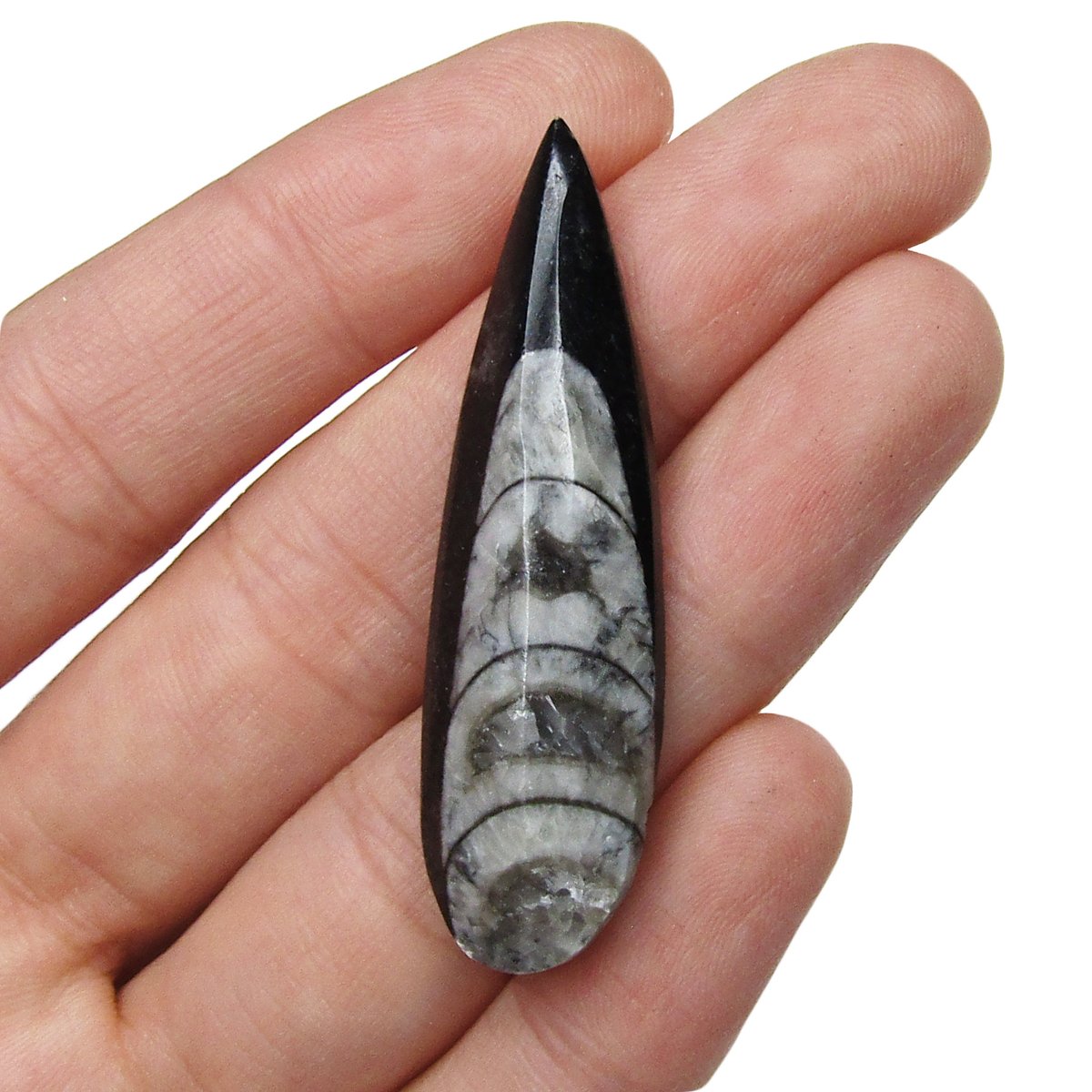
Orthoceras
Orthoceras regulare
Image: Image sourced via web search (Fair use / Educational)
About Orthoceras
Orthoceras regulare is an extinct species of nautiloid cephalopod that thrived during the Middle Ordovician period, approximately 485 to 443 million years ago. As one of the most iconic and recognizable prehistoric marine invertebrates, Orthoceras is characterized by its long, straight, conical shell, which distinguishes it from the tightly coiled shells of its modern relatives, the nautiluses. These organisms were widespread across the ancient Paleozoic oceans, particularly in the Baltic region of modern-day Europe, where their remains form massive limestone deposits. In the broader context of paleontology, Orthoceras represents a crucial stage in the evolutionary history of cephalopods, illustrating the early experimentation with buoyancy control and active predatory lifestyles in the ancient seas. Their abundant fossil record has made them invaluable index fossils for dating Ordovician marine strata and understanding the dynamics of early Paleozoic marine ecosystems.
The physical anatomy of Orthoceras regulare is dominated by its distinctive orthoconic (straight) shell, which could range in length from a modest 15 centimeters to over a meter in some related specimens, though O. regulare typically measured around 15 to 30 centimeters. The shell is divided internally into a series of chambers, known as camerae, separated by concave walls called septa. As the animal grew, it continuously secreted new shell material at the open end, moving forward and sealing off the older, smaller chambers behind it. A central tube, the siphuncle, ran through the entire length of the shell, connecting all the chambers. This siphuncle was a marvel of early biological engineering, allowing the animal to pump fluids and gases in and out of the empty chambers to regulate its buoyancy, much like a modern submarine. The exterior of the shell was generally smooth, though some specimens show faint transverse striations or growth lines. The living animal itself resided entirely within the largest, front-most chamber, known as the body chamber. While the soft tissues of Orthoceras are rarely preserved, paleontologists infer its appearance based on modern cephalopods like the nautilus and squid. It likely possessed large, well-developed eyes for hunting in the dimly lit Ordovician waters, a parrot-like beak for crushing prey, and a ring of muscular tentacles surrounding its mouth to grasp food. Unlike modern squid, it lacked suckers on its tentacles, likely relying on a firm grip or sticky secretions. The overall weight of the animal would have been relatively light in the water due to the gas-filled chambers, allowing it to maintain a neutral buoyancy despite the heavy calcium carbonate shell.
In terms of paleobiology, Orthoceras regulare was an active, free-swimming predator, occupying a significant niche in the Ordovician marine food web. Its diet likely consisted of small arthropods, trilobites, brachiopods, and other early marine invertebrates. Hunting strategies probably involved ambushing or actively pursuing prey, using its tentacles to capture and manipulate food before crushing it with its powerful beak. Locomotion was achieved through a combination of buoyancy control and jet propulsion. By expelling water forcefully through a muscular funnel or hyponome, Orthoceras could propel itself backward through the water column, a method still utilized by modern cephalopods. However, the long, straight shell would have created considerable drag, suggesting that Orthoceras was not as fast or agile as modern squid or fish. Instead, it likely cruised slowly near the seafloor or hovered in the water column, using its jet propulsion for sudden bursts of speed to escape predators or ambush prey. The growth patterns of Orthoceras, as evidenced by the sequential addition of chambers, indicate a continuous and likely rapid growth rate during its early life stages, slowing down as it reached maturity. Metabolism estimates suggest a relatively active lifestyle compared to contemporary benthic organisms, requiring a steady intake of food to fuel its swimming and growth. Social behavior is difficult to infer from the fossil record, but the massive accumulations of Orthoceras shells in certain deposits suggest they may have gathered in large numbers for mating or spawning, similar to the mass aggregations seen in some modern squid species.
The ecological context of the Middle Ordovician period was one of profound evolutionary radiation and changing global environments. The world's landmasses were largely barren, but the oceans were teeming with life during the Great Ordovician Biodiversification Event. The climate was generally warm, with high sea levels creating extensive shallow epicontinental seas that provided ideal habitats for marine invertebrates. Orthoceras regulare inhabited these shallow to moderately deep marine environments, sharing its ecosystem with a diverse array of organisms, including trilobites, graptolites, crinoids, early corals, and massive predatory eurypterids (sea scorpions). In this vibrant food web, Orthoceras occupied a mid-to-high-level predatory role. While it hunted smaller invertebrates, it was also preyed upon by larger predators, such as giant orthocones like Cameroceras, which could reach several meters in length, and the formidable eurypterids. The straight-shelled nautiloids were a dominant component of the nektonic (free-swimming) community, playing a crucial role in the transfer of energy from benthic (bottom-dwelling) prey to larger pelagic predators. The eventual decline of the orthoceratids was likely influenced by the rise of more agile predators, such as early jawed fishes, and the devastating end-Ordovician mass extinction, which drastically altered marine ecosystems and wiped out many of their contemporary species.
The discovery and naming history of Orthoceras dates back to the early days of paleontology and geology. The genus name "Orthoceras" translates to "straight horn" from the Greek words "orthos" (straight) and "keras" (horn), perfectly describing the shape of its shell. The genus was first formally described by the French zoologist Jean Guillaume Bruguière in 1789, though the fossils had been known and collected by naturalists for centuries prior. Orthoceras regulare, the type species, was established based on specimens found in the extensive limestone deposits of Sweden and the Baltic region. These deposits, often referred to as "Orthoceratite limestone" or "Orthoceratitenkalk," are famous for their dense concentrations of straight-shelled cephalopods. In the 18th and 19th centuries, these fossils were frequently polished and used as decorative stones in architecture and furniture across Europe, a practice that continues today. The sheer abundance of these fossils in the Baltic region made them some of the first prehistoric creatures to be widely recognized by the general public. Over the centuries, thousands of species were assigned to the genus Orthoceras, making it a "wastebasket taxon" for almost any straight-shelled nautiloid. It wasn't until the 20th century that paleontologists began to rigorously re-examine and reclassify these fossils, restricting the true genus Orthoceras to a specific group of Middle Ordovician species primarily found in the Baltic region.
The evolutionary significance of Orthoceras cannot be overstated, as it provides critical insights into the early evolution and diversification of cephalopods. The transition from early, bottom-dwelling mollusks with simple, cap-like shells to active, free-swimming predators like Orthoceras represents a major evolutionary leap. The development of the chambered shell and the siphuncle was a revolutionary adaptation that allowed cephalopods to conquer the water column, escaping the constraints of the seafloor. Orthoceras and its relatives demonstrate the early success of the orthoconic shell design, which dominated the Paleozoic oceans for millions of years. However, this straight shell design eventually proved to be an evolutionary dead end. As marine environments became more complex and predators like jawed fishes evolved, the long, unwieldy straight shells became a liability. This selective pressure drove the evolution of tightly coiled shells, seen in later ammonites and modern nautiluses, which offered better maneuverability and a more compact, defensible shape. Furthermore, the internal shell reduction seen in modern coleoids (squid, octopus, and cuttlefish) can be traced back through a long lineage of cephalopods that gradually internalized and reduced their shells to increase speed and agility. Thus, Orthoceras stands as a vital transitional figure, representing the peak of the straight-shelled design before the evolutionary shift toward coiling and shell internalization.
Scientific debates surrounding Orthoceras have primarily focused on its taxonomy and the mechanics of its buoyancy control. For decades, the genus Orthoceras was used as a catch-all classification for any straight-shelled nautiloid, leading to immense taxonomic confusion. Modern paleontologists have worked diligently to restrict the genus to its true members, such as Orthoceras regulare, based on specific internal shell features like the structure of the siphuncle and the septal necks. This reclassification has led to the reassignment of many famous "Orthoceras" fossils, particularly those from the Devonian of Morocco, to other genera like Michelinoceras or Arionoceras, though they are still widely sold under the Orthoceras name. Another area of debate involves the exact orientation and swimming posture of the living animal. While it was long assumed that Orthoceras swam horizontally, some biomechanical studies suggest that the weight distribution of the shell and the gas-filled chambers might have caused the animal to hang vertically in the water column, with its head pointing downward. This vertical posture would have significantly impacted its hunting strategies and ecological niche, suggesting it may have been an ambush predator that dropped down on benthic prey rather than a horizontal cruiser.
The fossil record of Orthoceras and related orthoceratids is exceptionally rich and globally distributed, though true Orthoceras regulare is primarily restricted to the Middle Ordovician deposits of the Baltic region, Sweden, and parts of Eastern Europe. The preservation quality of these fossils is often excellent, particularly in the fine-grained limestones where they are found. Typically, only the hard calcium carbonate shell is preserved, while the soft tissues decay rapidly after death. The internal chambers are frequently filled with secondary minerals like calcite, which can form beautiful crystal structures within the fossil. In some remarkable instances, the original color patterns of the shell, such as zig-zag bands or stripes, have been preserved, providing rare glimpses into the appearance of these ancient animals. The massive accumulations of these shells in certain strata, known as cephalopod limestones, suggest that the empty shells may have floated for long distances after the animal's death, driven by ocean currents before eventually sinking and accumulating in specific areas. These dense fossil beds are highly valued by commercial fossil collectors and are a staple of rock shops and museum gift stores worldwide.
The cultural impact of Orthoceras is uniquely tied to its abundance and aesthetic appeal. Because the fossils are so common and take a high polish, they have been used for centuries as decorative items, incorporated into everything from tabletops and bookends to jewelry and sculptures. This widespread commercial availability has made Orthoceras one of the most accessible and recognizable fossils for the general public, often serving as a gateway for amateur rock collectors and children to develop an interest in paleontology. Museums around the world feature spectacular slabs of Orthoceras limestone, illustrating the sheer density of life in the ancient oceans. Despite the taxonomic inaccuracies often associated with commercially sold specimens, the iconic straight-shelled nautiloid remains a powerful symbol of the Paleozoic era and a testament to the deep, fascinating history of life on Earth.
Classification
Time Period
Discovery
Location
Sweden and the Baltic region
Formation
Orthoceratite Limestone
Frequently Asked Questions
What is Orthoceras?
Orthoceras regulare is an extinct species of nautiloid cephalopod that thrived during the Middle Ordovician period, approximately 485 to 443 million years ago. As one of the most iconic and recognizable prehistoric marine invertebrates, Orthoceras is characterized by its long, straight, conical shel...
When did Orthoceras live?
Orthoceras lived during the ordovician period of the paleozoic era approximately 485-443 million years ago.
Where was Orthoceras discovered?
Fossils of Orthoceras were discovered in Sweden and the Baltic region in the Orthoceratite Limestone.
What did Orthoceras eat?
Orthoceras was a carnivore. It lived in marine habitats.
What type of fossil is Orthoceras?
Orthoceras is preserved as a body fossil. The preservation quality is excellent.
Related Specimens
From the paleozoic era · body fossils
/cc86f4a1bc00.jpg)
/bed7088e21a4.png)