Scutosaurus
Scutosaurus karpinskii
Image: Image sourced via web search (Fair use / Educational)
About Scutosaurus
Scutosaurus karpinskii represents one of the last and largest of a group of armored, herbivorous reptiles known as pareiasaurs, which thrived during the Late Permian period. This heavily-built animal inhabited the vast, semi-arid landscapes of what is now Eastern Europe approximately 260 to 252 million years ago, just before the catastrophic Permian-Triassic extinction event wiped out most life on Earth. Its name, meaning 'Shield Lizard', aptly describes its most prominent feature: a body covered in bony plates, or osteoderms, which provided a formidable defense against the apex predators of its time.
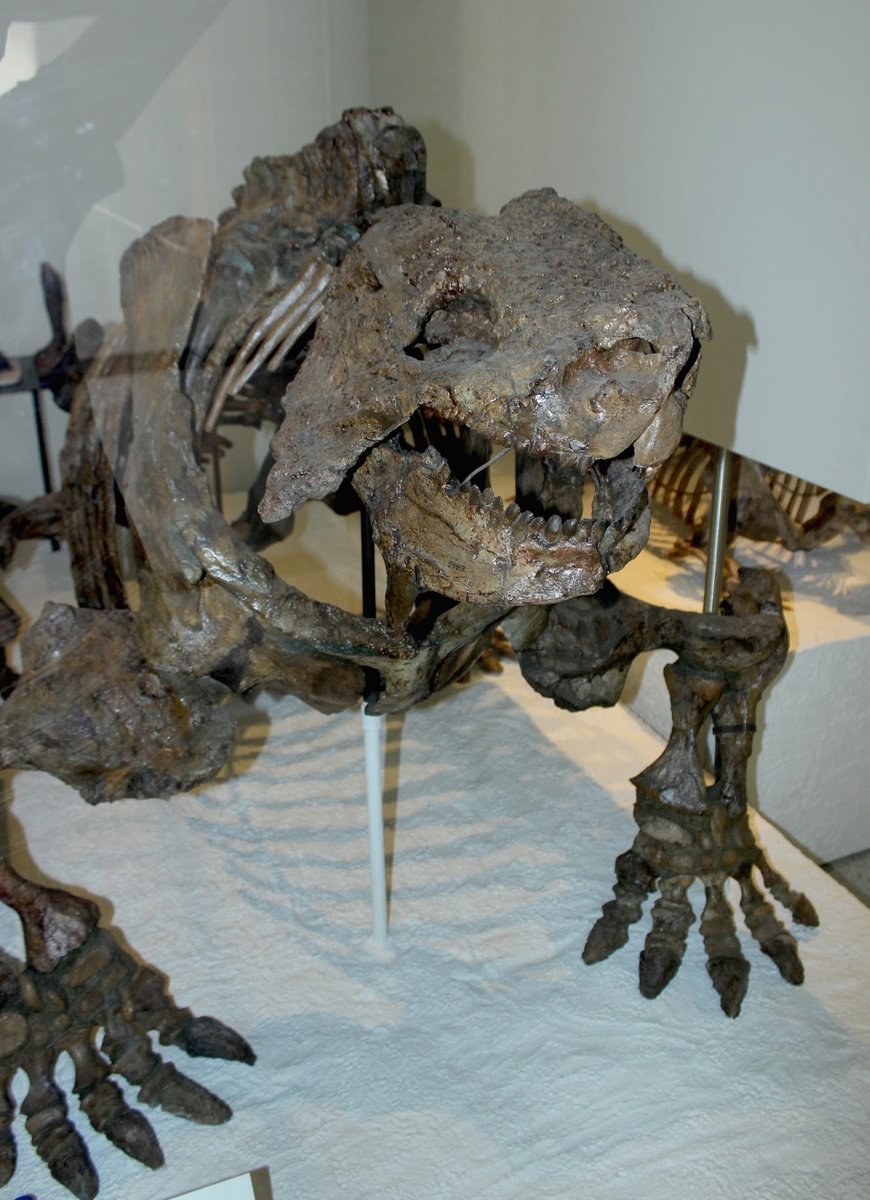
Scutosaurus was a robust and ponderous animal, reaching lengths of up to 3 meters (about 10 feet) and standing roughly 1.5 meters tall at the shoulder, comparable in size to a modern dairy cow. Weight estimates vary, but it likely tipped the scales at around 1,000 kilograms (2,200 pounds), making it one of the largest land animals of the Late Permian. Its skeleton was massively constructed to support this bulk. The limbs were short, stout, and pillar-like, sprawling slightly to the sides in a semi-erect posture, a feature common in early tetrapods. The feet were broad and short, indicating a slow, lumbering gait. The most striking aspect of Scutosaurus was its extensive armor. Its back and flanks were studded with bony scutes, or osteoderms, embedded directly into the skin, forming a protective, chainmail-like covering. The skull was also heavily ornamented and armored, broad and triangular in shape, with multiple bony knobs and flanges protruding from the cheeks and jawline. These cranial bosses, particularly the large, horn-like structures on the jugal (cheek) bones, may have been used for display, species recognition, or intraspecific combat, similar to the horns and frills of some modern reptiles and extinct ceratopsian dinosaurs. Its teeth were leaf-shaped and flattened, with serrated edges perfectly suited for shearing tough, fibrous plant material.
The paleobiology of Scutosaurus reveals an animal well-adapted to a diet of low-growing, tough vegetation. The structure of its teeth and the immense size of its barrel-shaped rib cage, which would have housed a voluminous digestive tract, strongly suggest it was a high-fiber herbivore. Like modern herbivorous mammals, it likely relied on gut fermentation to break down cellulose-rich plants such as ferns, cycads, and conifers that dominated the Permian flora. Its slow, deliberate locomotion meant it was not built for speed and could not outrun predators. Instead, it relied on its passive defense system: its thick hide and bony armor. When threatened, Scutosaurus likely hunkered down, presenting an almost impenetrable fortress of bone and tough skin to attackers. Evidence from bonebeds containing multiple individuals suggests that Scutosaurus may have been at least somewhat gregarious, possibly living in small herds. This social behavior could have offered additional protection, particularly for juveniles, through collective defense. Its metabolism was likely slower than that of modern mammals but potentially higher than that of typical modern reptiles, a condition sometimes referred to as mesothermy, allowing for sustained activity in the variable Permian climate.
Scutosaurus lived during the Wuchiapingian and Changhsingian ages of the Late Permian, a time of significant climatic and geographical change. The supercontinent of Pangea had fully assembled, creating vast interior regions with extreme continental climates characterized by hot, dry summers and cool winters. Scutosaurus inhabited the semi-arid floodplains of the Pangean interior, an ecosystem that would be almost alien to us today. It shared this environment with a diverse fauna. The apex predator was almost certainly the formidable gorgonopsid, Inostrancevia, a large, saber-toothed synapsid whose fossils are often found in the same deposits. The relationship between Scutosaurus and Inostrancevia represents a classic Permian predator-prey dynamic, with the pareiasaur's armor evolving as a direct counter to the gorgonopsid's powerful bite. Other contemporaries included various smaller reptiles, amphibians like the labyrinthodont Dvinosaurus, and other synapsids, including dicynodonts, which were also common herbivores. Scutosaurus occupied the ecological niche of a large, bulk-feeding herbivore, a role that would later be filled by sauropod dinosaurs in the Mesozoic and large ungulates in the Cenozoic.
The discovery history of Scutosaurus is rooted in early 20th-century Russian paleontology. The first fossils were unearthed in the Sokolki locality along the Northern Dvina River near Kotlas in the Arkhangelsk Oblast of European Russia. These rich fossil beds, known as the Salarevskaya Formation, were extensively excavated by the Russian paleontologist Vladimir Prokhorovich Amalitsky in the late 1890s and early 1900s. Amalitsky's expeditions yielded a treasure trove of Late Permian vertebrates, creating what is now famously known as the 'Dvina River fauna'. Among these finds were numerous complete and partial skeletons of a large, armored reptile. The animal was formally described and named Scutosaurus karpinskii in 1922 by the British paleontologist David Meredith Seares Watson, who studied the material after Amalitsky's death. The species name, 'karpinskii', honors Alexander Petrovich Karpinsky, a renowned Russian geologist and paleontologist. The holotype and many other significant specimens collected by Amalitsky are housed at the Paleontological Institute in Moscow, forming the core of our understanding of this iconic Permian animal.
Scutosaurus holds a crucial position in the evolutionary history of reptiles. It belongs to the family Pareiasauridae, a group within the larger clade Parareptilia. For a long time, pareiasaurs were thought to be the direct ancestors of modern turtles, with their broad bodies and bony scutes seen as a precursor to the turtle shell. This hypothesis, known as the 'pareiasaur-origin' theory for turtles, was popular for much of the 20th century. However, more recent anatomical and genetic studies have largely refuted this idea, placing turtle origins closer to diapsid reptiles, the group that includes lizards, snakes, and dinosaurs. Despite this, Scutosaurus remains significant as a prime example of an anapsid reptile—a group characterized by a skull lacking temporal fenestrae (openings behind the eye sockets). It represents a highly successful and specialized lineage of early herbivores that dominated terrestrial ecosystems before the rise of the dinosaurs. Its existence demonstrates the remarkable diversity of reptile forms that evolved following the Carboniferous period and highlights the evolutionary experimentation that occurred prior to the end-Permian mass extinction.
While the general understanding of Scutosaurus is well-established, some scientific debates persist. One area of discussion revolves around its exact posture and locomotion. While traditionally depicted with a classic reptilian sprawl, some biomechanical analyses suggest its limb structure could have supported a more semi-erect or 'pillar-erect' stance, allowing for more efficient movement and weight support than previously thought. This would have been advantageous for such a heavy animal. Another point of debate concerns the function of its elaborate cranial ornamentation. While defense and display are the leading theories, their precise role in social signaling and mate selection remains speculative. Furthermore, the classification of pareiasaurs themselves within the broader reptilian family tree is a subject of ongoing research, with their relationship to other anapsid groups and the enigmatic turtles continuing to be refined as new fossil evidence and analytical techniques emerge.
The fossil record of Scutosaurus is remarkably robust, making it one of the best-known pareiasaurs. The primary fossil sites are concentrated in the Permian red beds of the Arkhangelsk, Vologda, and Kirov regions of European Russia. The Sokolki Assemblage Zone of the Salarevskaya Formation, in particular, has yielded numerous skeletons, many of which are complete and articulated. This exceptional preservation has allowed for detailed anatomical studies and the creation of accurate skeletal reconstructions. The abundance of fossils, including individuals of different ages, suggests that Scutosaurus was a common and successful component of its ecosystem. These rich bonebeds provide a unique snapshot of a Late Permian community, preserving not just Scutosaurus but also its predators and other contemporaries, offering invaluable insights into the paleoecology of the period just before life's greatest crisis.
Although not as famous as dinosaurs like Tyrannosaurus or Triceratops, Scutosaurus has a notable cultural presence, particularly in media depicting prehistoric life before the Mesozoic. It is frequently featured in documentaries about the Permian period, such as the BBC's 'Walking with Monsters', where it was memorably shown battling a predatory Inostrancevia. Its impressive, tank-like appearance makes it a popular subject for museum displays. Magnificent, fully-mounted skeletons of Scutosaurus can be seen at the Paleontological Institute in Moscow and the Natural History Museum in London, captivating visitors and serving as a powerful educational tool to illustrate the strange and wonderful world that existed long before the age of dinosaurs.
Classification
Time Period
Discovery
Location
Russia
Formation
Sokolki Assemblage Zone, Salarevskaya Formation
Frequently Asked Questions
What is Scutosaurus?
Scutosaurus karpinskii represents one of the last and largest of a group of armored, herbivorous reptiles known as pareiasaurs, which thrived during the Late Permian period. This heavily-built animal inhabited the vast, semi-arid landscapes of what is now Eastern Europe approximately 260 to 252 mill...
When did Scutosaurus live?
Scutosaurus lived during the permian period of the paleozoic era approximately 260-252 million years ago.
Where was Scutosaurus discovered?
Fossils of Scutosaurus were discovered in Russia in the Sokolki Assemblage Zone, Salarevskaya Formation.
What did Scutosaurus eat?
Scutosaurus was a herbivore. It lived in terrestrial, semi-arid plains habitats.
What type of fossil is Scutosaurus?
Scutosaurus is preserved as a body fossil. The preservation quality is good.
Related Specimens
From the paleozoic era · body fossils