Dromornis
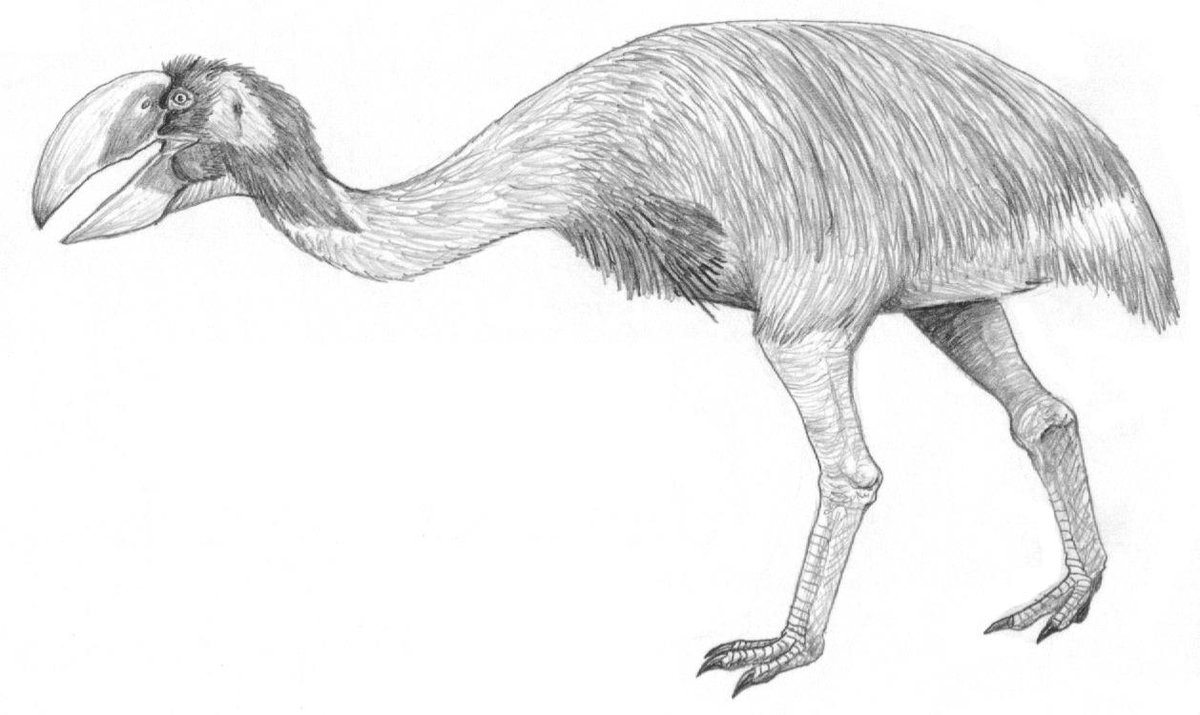
Dromornis stirtoni
Image: Image sourced via web search (Fair use / Educational)
About Dromornis
Dromornis stirtoni represents one of the largest birds known to have ever existed, a true megafaunal giant that roamed the subtropical woodlands of Australia during the Late Miocene epoch, approximately 8 to 6 million years ago. Belonging to an extinct family of flightless birds called the Dromornithidae, often colloquially known as 'mihirungs' or 'thunder birds', Dromornis stirtoni was a creature of immense proportions whose discovery has significantly shaped our understanding of avian evolution and the unique ecosystems of prehistoric Australia. Its sheer size and debated ecology make it a subject of intense paleontological interest, offering a window into a time when the continent was inhabited by a bestiary of strange and gigantic animals.
Dromornis stirtoni was a bird of staggering size, far surpassing any living avian species. Standing approximately 3 meters (9.8 feet) tall, it would have towered over a modern ostrich and rivaled the Malagasy elephant bird (Aepyornis maximus) in height, though it was considerably more robustly built. Weight estimates, derived from femoral circumference and other skeletal metrics, place it in the range of 450 to 650 kilograms (990 to 1,430 pounds), with some exceptional males possibly exceeding this, making it arguably the heaviest bird known to science. Its skeleton was a testament to this immense bulk. The legs were massive and pillar-like, with thick, powerful bones designed to support its great weight rather than for swift running. The femur was short and stout, while the tibiotarsus and tarsometatarsus were proportionally shorter and more robust than those of fast-running ratites like ostriches or emus. The feet were large, likely ending in blunt, hoof-like claws. The most distinctive feature was its enormous skull, which was deep and powerfully built, housing a massive, laterally compressed beak. This beak was disproportionately large even for the bird's size, ending in a hooked tip that initially led some researchers to suspect a carnivorous diet. The neck was relatively long and thick, connecting the large head to a broad, barrel-chested torso. Its wings were vestigial, reduced to mere nubs, rendering the bird completely and utterly flightless.
The paleobiology of Dromornis stirtoni is a subject of ongoing research and debate, particularly concerning its diet. The powerful, hooked beak initially suggested a role as a formidable predator or scavenger, capable of crushing bone. However, more detailed analyses of the skull's biomechanics, muscle attachment points, and the beak's morphology suggest a different story. The beak lacked the sharp cutting edges typical of raptors and instead seems better suited for shearing and crushing tough plant material. Isotopic analysis of its fossilized eggshells and bone collagen points towards a herbivorous diet. It is now widely believed that Dromornis was a powerful herbivore, using its massive beak to browse on tough vegetation, such as seed pods, fruits, and coarse plant stems, much like a modern-day flightless parrot on a gigantic scale. Its locomotion was ponderous; the robust, heavy-set leg structure indicates it was a walker, not a runner, plodding through the woodlands and open forests it inhabited. Fossil assemblages suggest Dromornis may have been social, possibly living in flocks. The discovery of multiple individuals of varying ages together hints at communal nesting or living arrangements. Furthermore, the species exhibited significant sexual dimorphism, with males being substantially larger and more robustly built than females, a trait often associated with complex social structures and mating competition.
Dromornis stirtoni lived in a version of Australia vastly different from today's arid continent. During the Late Miocene, the climate of central Australia was much wetter and more seasonal, supporting a mosaic of subtropical woodlands, open forests, and riparian gallery forests rather than desert. The Alcoota fossil site, where most of its remains are found, depicts a rich and diverse ecosystem centered around a series of waterholes that periodically dried up. Dromornis shared this environment with a remarkable array of other megafauna. It would have grazed alongside giant diprotodontid marsupials like Kolopsis and Plaisiodon, and faced predators such as the powerful marsupial lion, Wakaleo vanderleueri, and large terrestrial crocodiles like Baru darrowi. As a giant primary consumer, Dromornis would have played a crucial role in its ecosystem, acting as a major browser shaping the plant community. Its immense size would have made adult individuals largely immune to predation, though juveniles and eggs would have been vulnerable. Its position in the food web was that of a high-biomass herbivore, converting vast quantities of plant matter into animal protein, forming a critical link between the region's flora and its apex predators.
The discovery history of Dromornis stirtoni is centered on the Alcoota fossil site in the Northern Territory of Australia. While fragments of dromornithids had been known since the 19th century, the true scale of these birds was not realized until the rich deposits at Alcoota were systematically excavated. The site was first investigated by paleontologists from the Bureau of Mineral Resources in 1954. However, it was the subsequent expeditions led by paleontologists Ruben A. Stirton from the University of California, Berkeley, and Alan R. Telford from the Museums and Art Galleries of the Northern Territory, starting in the 1960s, that unearthed the most significant material. The sheer concentration of bones at Alcoota, representing thousands of individuals in a 'fossil-logjam', was astounding. In 1979, paleontologist Patricia Vickers-Rich formally described the species, naming it Dromornis stirtoni in honor of Ruben Stirton for his pioneering work on Australian Tertiary mammals and birds. The holotype specimen consists of a femur and other associated leg bones, but the wealth of material from Alcoota, including partial skeletons and skulls, has provided a remarkably complete picture of this giant bird, making it one of the best-understood dromornithids.
Dromornis and its relatives, the Dromornithidae, represent a unique and entirely extinct lineage of birds. For many years, their evolutionary placement was uncertain. They were initially thought to be giant ratites, related to emus and cassowaries, due to their large size and flightlessness. However, detailed anatomical studies of the skull, vertebrae, and pelvis revealed a different story. The consensus now places the Dromornithidae within the order Anseriformes, meaning their closest living relatives are, surprisingly, ducks, geese, and swans. They are considered a very early, highly specialized offshoot of the waterfowl lineage, a group known as the Galloanserae. This relationship highlights the incredible evolutionary plasticity within this avian group, demonstrating that the ancestors of modern waterfowl could give rise to terrestrial, herbivorous giants that filled ecological niches similar to those of large mammalian browsers. Dromornis stirtoni, as one of the largest and most specialized members of this family, exemplifies the peak of this unique evolutionary experiment. The dromornithids thrived in Australia for over 25 million years before finally going extinct in the Pleistocene, and their story is a crucial chapter in the evolution of modern birds.
Despite a growing consensus on its herbivorous nature and anseriform affinities, several scientific debates surrounding Dromornis stirtoni persist. The precise mechanics of its feeding strategy remain a topic of discussion. While herbivory is widely accepted, some researchers argue its powerful beak could have been used opportunistically for scavenging or cracking open large, hard-shelled fruits that no other animal could process. The degree of sexual dimorphism is also debated, with some studies suggesting the size difference between males and females was among the most extreme of any bird, while others propose the variation might represent different species or subspecies. Furthermore, the exact reasons for the extinction of the dromornithids, including Dromornis, are not fully understood. While later species like Genyornis newtoni disappeared during the Late Pleistocene megafaunal extinction event, possibly due to human activity and climate change, the earlier extinction of Dromornis stirtoni in the Late Miocene is likely linked to increasing aridity and environmental changes that transformed its woodland habitat into drier scrubland and desert, altering the vegetation it depended upon.
The fossil record of Dromornis stirtoni is almost exclusively tied to one remarkable location: the Alcoota Fossil Beds in the Waite Formation of Australia's Northern Territory. This site represents a massive concentration of vertebrate fossils, interpreted as a waterhole deposit where thousands of animals perished during a severe drought. The preservation quality is generally good, though most skeletons are disarticulated due to scavenging and water transport before final burial. Because of this concentration, a large number of Dromornis specimens are known, making it one of the most well-represented giant birds in the fossil record. Hundreds of individual bones, including skulls, vertebrae, limb bones, and pelvic girdles, have been recovered, allowing for detailed anatomical reconstructions and studies of population structure and variation. While isolated dromornithid fossils are found elsewhere in Australia, the Alcoota site remains the single most important locality for understanding Dromornis stirtoni, providing an unparalleled snapshot of this animal and its environment.
As one of the most spectacular examples of Australian megafauna, Dromornis stirtoni has captured the public imagination. It is frequently featured in museum exhibits on prehistoric life, with impressive skeletal mounts and life-sized reconstructions on display at institutions like the Museum of Central Australia in Alice Springs, close to where it was found, and the Australian Museum in Sydney. Often dubbed 'Stirton's Thunder Bird', it appears in documentaries and books about megafauna, symbolizing the unique and often bizarre evolutionary path taken by life on the isolated continent. Its story serves as a powerful educational tool, illustrating concepts of gigantism, extinction, and the dramatic environmental changes that have shaped Australia over millions of years.
Classification
Time Period
Discovery
Location
Australia
Formation
Alcoota Formation
Frequently Asked Questions
What is Dromornis?
Dromornis stirtoni represents one of the largest birds known to have ever existed, a true megafaunal giant that roamed the subtropical woodlands of Australia during the Late Miocene epoch, approximately 8 to 6 million years ago. Belonging to an extinct family of flightless birds called the Dromornit...
When did Dromornis live?
Dromornis lived during the neogene period of the cenozoic era approximately 8-6 million years ago.
Where was Dromornis discovered?
Fossils of Dromornis were discovered in Australia in the Alcoota Formation.
What did Dromornis eat?
Dromornis was a herbivore. It lived in terrestrial habitats.
What type of fossil is Dromornis?
Dromornis is preserved as a body fossil. The preservation quality is good.
Related Specimens
From the cenozoic era · body fossils