Homo ergaster
Image: Image sourced via web search (Fair use / Educational)
About Homo ergaster
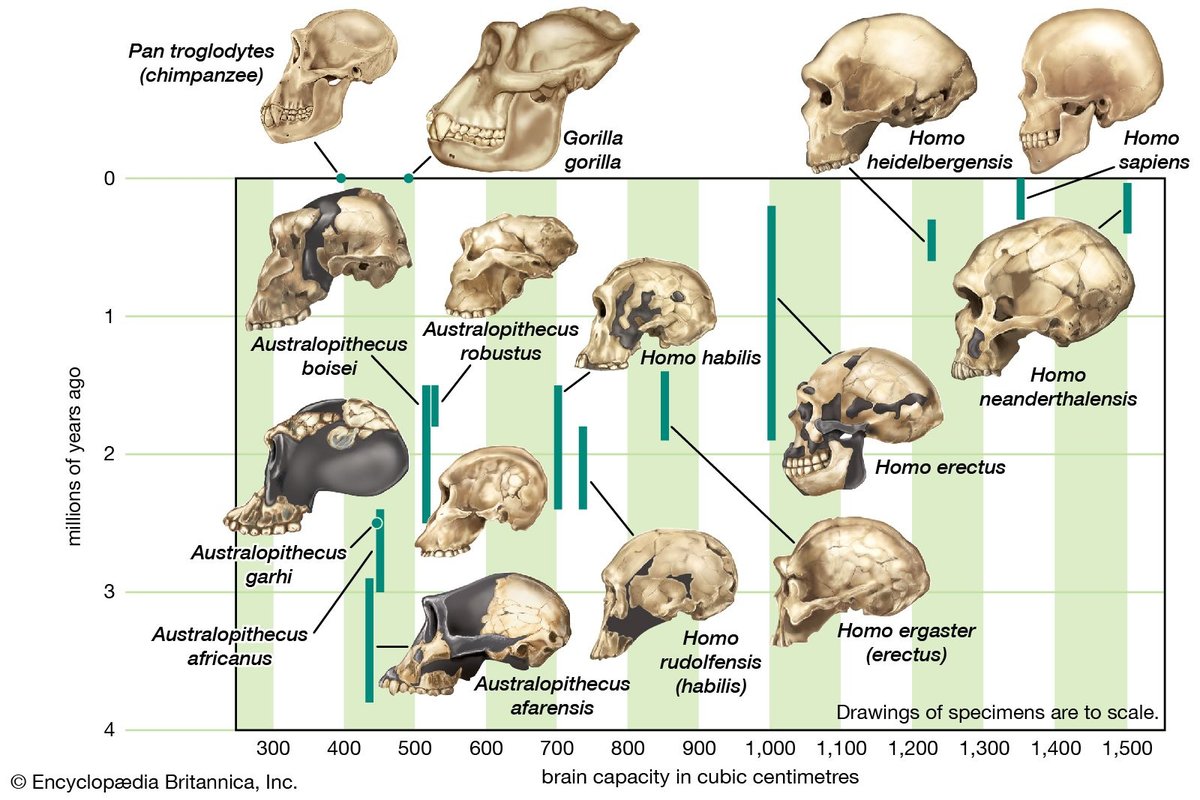
Homo ergaster, whose name translates to 'Working Man,' was an early species of the genus Homo that lived in eastern and southern Africa during the early Pleistocene epoch, approximately 1.9 to 1.4 million years ago. This hominid is of profound importance in the study of human evolution, as it represents a significant departure from earlier, more ape-like australopithecines and a clear step towards the anatomy and behavior of modern humans. Its appearance marks a pivotal transition, characterized by a larger brain, a fully modern body plan adapted for long-distance terrestrial locomotion, and the development of more sophisticated stone tool technology.
Homo ergaster exhibited a remarkably modern, human-like body plan, a stark contrast to its more primitive ancestors. Adult males stood between 160 and 185 cm (approximately 5'3" to 6'1") tall, with females being somewhat smaller, a reduction in sexual dimorphism compared to earlier hominids. Weight estimates range from 52 to 68 kg (115 to 150 lbs). The most striking feature was its postcranial skeleton, which was virtually indistinguishable from that of modern Homo sapiens. Long legs, a narrow pelvis, and a barrel-shaped chest indicate a complete adaptation to bipedalism, specifically for efficient long-distance running and walking. This is exemplified by the famous 'Turkana Boy' skeleton, which showcases these modern proportions. Cranially, H. ergaster possessed a brain volume ranging from 600 to 910 cubic centimeters, a significant increase over australopithecines but still smaller than modern humans. The skull featured a less prognathic (projecting) face, smaller molars and premolars suggesting a dietary shift, a distinct supraorbital torus (brow ridge), and a low, elongated cranial vault. Unlike later hominins, it lacked a prominent chin. Its body was likely sparsely haired, an adaptation for thermoregulation via sweating in a hot, open savanna environment.
The paleobiology of Homo ergaster reveals a species adapting to a new and challenging ecological niche. Its smaller teeth and jaw muscles, combined with evidence from stone tools, strongly suggest a diet that included a greater proportion of meat and marrow than its predecessors. This omnivorous diet was likely acquired through a combination of scavenging and active hunting of small to medium-sized game. The development of the Acheulean tool industry, characterized by large, bifacially flaked hand axes and cleavers, is often attributed to H. ergaster. These tools were more standardized and required more cognitive foresight to manufacture than the earlier Oldowan tools. Its modern physique, particularly the long legs and efficient respiratory system, would have made it an excellent endurance runner, a crucial advantage for persistence hunting on the African savanna. Socially, the increased brain size and the demands of raising dependent young likely fostered more complex social structures, including cooperative hunting and food sharing. Growth patterns, as inferred from the Turkana Boy skeleton, suggest a developmental trajectory that was faster than modern humans but slower than apes, indicating a prolonged period of childhood learning.
Homo ergaster lived during a period of significant climatic fluctuation in Africa, with expanding savannas and shrinking woodlands. This changing environment, known as the Pleistocene, presented both challenges and opportunities. The open grasslands were home to a diverse megafauna, including various species of antelope, zebra, elephants, and formidable predators like saber-toothed cats (e.g., Megantereon) and giant hyenas (e.g., Pachycrocuta). As an adept omnivore and tool-user, H. ergaster likely occupied a position as a formidable tertiary consumer, both a hunter and the hunted. It competed with other carnivores for carcasses and actively pursued its own prey. The ability to process carcasses quickly with stone tools would have been a key advantage in a landscape teeming with competitors. Its habitat was primarily the open savanna and woodland-mosaic environments of the East African Rift Valley, where access to water sources like lakes and rivers would have been critical for survival. This ecological context drove the evolution of traits like endurance running, thermoregulation, and dietary flexibility that defined the species.
The discovery history of Homo ergaster is intertwined with some of the most significant finds in paleoanthropology. The species was first proposed by Colin Groves and Vratislav Mazák in 1975 based on the mandible KNM-ER 992, discovered at Koobi Fora, Kenya. However, the most defining specimen is KNM-WT 15000, famously known as 'Turkana Boy' or 'Nariokotome Boy.' Discovered in 1984 by Kamoya Kimeu, a member of Richard Leakey's team, near Lake Turkana in Kenya, this remarkably complete skeleton of an adolescent male provided unprecedented insight into the species' anatomy and growth. Other important fossils include the cranium KNM-ER 3733, a female individual also from Koobi Fora, which helped establish the species' cranial morphology, and various remains from Swartkrans in South Africa. The initial discoveries were made in the rich fossil beds of the East African Rift Valley, a region that continues to be a focal point for research into early human origins. The naming 'ergaster' (from the Greek for 'workman') was chosen in reference to the advanced stone tools found in association with its fossils.
Homo ergaster holds a critical position in the human evolutionary tree. It is widely considered to be the direct African ancestor of later hominins, including Homo heidelbergensis, and subsequently Neanderthals and Homo sapiens. It represents the first hominin to display a suite of modern human-like traits, including a large brain, fully committed bipedalism, and a reduced gut size indicative of a high-quality diet. This combination of features suggests a major adaptive shift that set the stage for all subsequent human evolution. Crucially, H. ergaster is believed to be the first hominin species to have migrated out of Africa, around 1.8 million years ago. The populations that established themselves in Eurasia are often classified by some researchers as a separate species, Homo erectus. This 'Out of Africa' event was a momentous step, demonstrating the species' remarkable adaptability and marking the beginning of the global expansion of the genus Homo. Its innovations in tool technology and subsistence strategies were the foundation upon which later human cultural and biological evolution was built.
A central scientific debate surrounding Homo ergaster is its taxonomic relationship with the Asian species Homo erectus. Some paleoanthropologists maintain that the differences between the African (ergaster) and Asian (erectus) fossils are minor and represent regional variation within a single, widespread species, H. erectus sensu lato (in the broad sense). Proponents of this view point to the overall similarities in body plan and tool culture. Others argue that the differences, such as the thicker cranial bones and more pronounced brow ridge of Asian H. erectus, are significant enough to warrant a separate species designation. In this view, H. ergaster is the African parent species from which the Asian H. erectus lineage diverged after migrating out of Africa. This debate, often termed the 'lumpers vs. splitters' argument, continues to be fueled by new fossil discoveries and re-evaluations of existing specimens. Another area of discussion involves the extent of their cognitive abilities, including the potential for rudimentary language, inferred from the anatomy of the thoracic vertebrae and cranial endocasts.
The fossil record of Homo ergaster, while not abundant, is anchored by several key, high-quality specimens. The primary fossil sites are located in the East African Rift Valley, particularly the Koobi Fora Formation on the eastern shores of Lake Turkana in Kenya, and also in the Olduvai Gorge in Tanzania. Important remains have also been recovered from South Africa at sites like Swartkrans. The most famous and informative fossil is the Nariokotome Boy (KNM-WT 15000), which is over 80% complete and provides a detailed look at the postcranial skeleton. Cranial remains, such as KNM-ER 3733 and KNM-ER 3883, are also crucial for understanding its head and facial anatomy. While complete skeletons are exceptionally rare, the fossil record consists of numerous partial crania, mandibles, isolated teeth, and postcranial bones. The quality of preservation at sites like Koobi Fora is often good, allowing for detailed anatomical study.
Homo ergaster, particularly through the iconic Turkana Boy skeleton, has had a significant cultural impact as a powerful symbol of a key transition in human evolution. Casts and reconstructions of the Turkana Boy are prominent displays in major natural history museums worldwide, including the Smithsonian National Museum of Natural History and the Natural History Museum in London. It is a cornerstone of educational materials on human origins, featured in countless documentaries, books, and university courses. The completeness of this single fossil has allowed the public to visualize an early human ancestor with a clarity that few other fossils permit, fostering a deep public fascination with our own evolutionary journey.
Classification
Time Period
Discovery
Location
Kenya, East Africa
Formation
Koobi Fora Formation
Frequently Asked Questions
What is Homo ergaster?
Homo ergaster, whose name translates to 'Working Man,' was an early species of the genus Homo that lived in eastern and southern Africa during the early Pleistocene epoch, approximately 1.9 to 1.4 million years ago. This hominid is of profound importance in the study of human evolution, as it repres...
When did Homo ergaster live?
Homo ergaster lived during the quaternary period of the cenozoic era approximately 1.9-1.4 million years ago.
Where was Homo ergaster discovered?
Fossils of Homo ergaster were discovered in Kenya, East Africa in the Koobi Fora Formation.
What did Homo ergaster eat?
Homo ergaster was a omnivore. It lived in terrestrial habitats.
What type of fossil is Homo ergaster?
Homo ergaster is preserved as a body fossil. The preservation quality is good.
Related Specimens
From the cenozoic era · body fossils