Proterogyrinus
Proterogyrinus scheelei
Image: Image sourced via web search (Fair use / Educational)
About Proterogyrinus
Proterogyrinus scheelei represents a significant genus of early tetrapods that thrived during the Carboniferous Period, approximately 328 to 323 million years ago. As a member of the Embolomeri, a group of reptiliomorph amphibians, it occupied a crucial position in the evolutionary transition from aquatic to terrestrial life, showcasing a blend of features adapted for both environments. Its fossils, primarily unearthed in what is now North America and Scotland, provide invaluable insights into the diverse ecosystems of the Paleozoic Era's coal swamps and the adaptive radiation of vertebrates onto land.
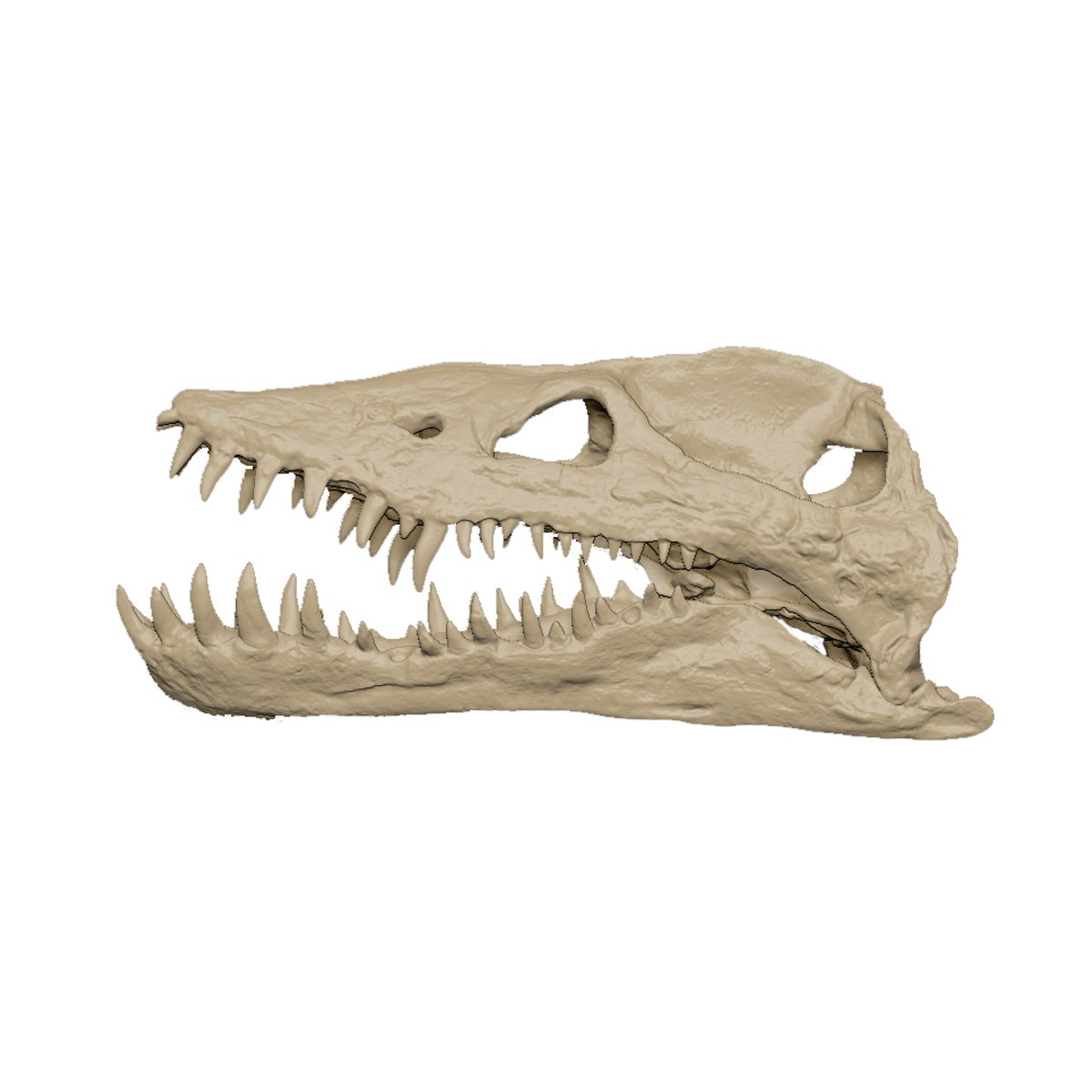
Proterogyrinus was a formidable predator, reaching an estimated body length of 2 to 2.5 meters (approximately 6.5 to 8 feet), making it one of the larger tetrapods of its time. Its physique was robust and elongated, somewhat reminiscent of a modern crocodile or a very large salamander, with a long, powerful tail that was laterally compressed and deep, indicating it was a primary tool for aquatic propulsion. The skull was relatively large, measuring around 30 centimeters in length, and possessed a distinctively tall and narrow profile. Its jaws were lined with sharp, conical teeth, including a pair of prominent fangs on the palate, characteristic of an active carnivore. The skeletal structure of Proterogyrinus reveals a fascinating mosaic of adaptations. Its limbs were well-developed and strongly built, more so than in many of its more aquatic contemporaries, suggesting a significant capacity for terrestrial locomotion. The pectoral and pelvic girdles were robust, providing strong attachment points for powerful limb muscles. Despite these terrestrial adaptations, features like the presence of lateral line canals on the skull—sensory organs for detecting water movements—confirm its strong ties to an aquatic existence. Its vertebrae were of the embolomerous type, characterized by two main cylindrical centra (an intercentrum and a pleurocentrum) of roughly equal size, which provided both strength and flexibility, ideal for the undulating swimming motions it would have employed.
The paleobiology of Proterogyrinus paints a picture of a versatile, semi-aquatic ambush predator. Its powerful jaws and sharp dentition were well-suited for capturing a variety of prey, which likely included large fish, other amphibians, and early terrestrial invertebrates found near the water's edge. It probably employed a sit-and-wait hunting strategy, lurking in the murky waters of swamps and rivers, using its lateral line system to detect the vibrations of approaching prey before launching a swift, powerful attack. The combination of a strong, paddle-like tail for swimming and robust limbs for land movement suggests a lifestyle analogous to that of modern crocodilians. Proterogyrinus could have efficiently hunted in the water and also ventured onto land to bask, move between bodies of water, or perhaps even ambush terrestrial animals that came to drink. Its relatively large size would have placed it near the top of its local food chain. Inferences about its social behavior are speculative, but like many large predators, it may have been largely solitary. Growth patterns likely involved a larval stage in the water, followed by a metamorphosis into the semi-aquatic adult form. Its metabolism was almost certainly ectothermic, or cold-blooded, relying on external heat sources to regulate its body temperature, a common trait among early tetrapods.
Proterogyrinus lived during the Viséan and Serpukhovian ages of the Mississippian subperiod of the Carboniferous. This was a time of global warmth and high humidity, characterized by the vast, continent-spanning equatorial rainforests and coal swamps that would later form the coal beds of Europe and North America. The supercontinent of Pangaea was beginning to assemble, and sea levels were relatively high. The environment was a labyrinth of rivers, deltas, and swampy wetlands choked with vegetation, including giant club mosses like Lepidodendron, towering horsetails like Calamites, and extensive seed ferns. In this lush, water-logged world, Proterogyrinus shared its habitat with a diverse array of fauna. The waters teemed with rhizodonts, massive lobe-finned fish that were themselves apex predators, as well as various sharks and acanthodians. Other amphibians, such as the smaller, more eel-like adelogyrinids and the larger temnospondyls, were also common. On land, the first amniotes—the ancestors of reptiles, birds, and mammals—were beginning to diversify, though they were still relatively small. The air was filled with giant insects, including dragonfly-like griffinflies with wingspans of up to 70 centimeters. Proterogyrinus occupied a high trophic level as a formidable predator, likely preying on medium-sized fish and other tetrapods, while potentially being prey for the truly giant rhizodonts as a juvenile.
The discovery and naming of Proterogyrinus are credited to the renowned paleontologist Alfred Sherwood Romer. Romer described the genus in 1970 based on fossils recovered from the Mauch Chunk Formation in West Virginia, USA. The holotype specimen, a well-preserved skull and partial postcranial skeleton, provided the foundational knowledge for the genus. The name Proterogyrinus translates to "early wanderer" or "early tadpole," derived from the Greek words 'proteros' (earlier) and 'gyrinos' (tadpole), reflecting its primitive nature and amphibious lifestyle. The species name, 'scheelei', honors William Scheele, the collector who discovered the initial fossils. Further important fossil material attributed to Proterogyrinus has also been found in the Dora Bone Bed of the Midland Valley in Scotland, indicating a wider geographic distribution across the supercontinent of Euramerica. These discoveries, particularly the well-preserved skulls, have been crucial for understanding the anatomy and evolutionary relationships of early reptiliomorphs. Unlike some prehistoric animals that have a single iconic specimen, the understanding of Proterogyrinus has been built from several key partial skeletons from these two primary locations, which together provide a reasonably complete picture of its anatomy.
Proterogyrinus holds a critical position in the evolutionary tree of vertebrates. As an embolomere, it belongs to the group Reptiliomorpha, which includes the ancestors of amniotes. This means it is more closely related to modern reptiles, birds, and mammals than it is to modern amphibians like frogs and salamanders (lissamphibians). It showcases a suite of characteristics that bridge the gap between earlier, more fish-like tetrapods and the fully terrestrial amniotes. Its robust limbs and girdles were more advanced than those of earlier tetrapods like Ichthyostega, indicating improved terrestrial locomotion. However, it retained primitive features such as the embolomerous vertebrae and a reliance on aquatic environments for hunting and possibly reproduction. The structure of its skull and ear region (otic notch) also shows an intermediate state. By studying Proterogyrinus and its relatives, paleontologists can trace the stepwise acquisition of traits that allowed vertebrates to conquer the land, such as stronger backbones, more efficient limbs, and changes in sensory systems. It represents a successful evolutionary experiment in a semi-aquatic lifestyle before some of its relatives, the anthracosaurs, gave rise to the first true amniotes, which developed the amniotic egg and broke the final tie to the water for reproduction.
Despite the general consensus on its evolutionary position, some scientific debates regarding Proterogyrinus and the Embolomeri persist. The precise relationships within the Embolomeri and their exact placement relative to the origin of amniotes are subjects of ongoing phylogenetic analysis, with new fossil discoveries and analytical techniques occasionally leading to revisions of the tetrapod family tree. The degree of terrestrial capability in Proterogyrinus is also a topic of discussion. While its strong limbs clearly indicate it could move on land, the extent to which it did so—whether for short forays, migration between ponds, or active hunting—is inferred from skeletal morphology and remains open to interpretation. Some researchers argue for a predominantly aquatic lifestyle with limited terrestrial activity, while others propose it was a truly amphibious animal, equally at home in both realms. Clarifying these details depends on the discovery of more complete skeletons or fossil trackways that could provide direct evidence of its locomotor habits.
The fossil record of Proterogyrinus is significant, though not exceptionally abundant. The most important specimens have been unearthed from two key localities: the Mauch Chunk Formation in Greer, West Virginia, USA, and the Dora Bone Bed near Cowdenbeath, Fife, Scotland. These sites represent coastal swamp and deltaic environments from the Carboniferous period. The fossils are typically disarticulated but often well-preserved, with skull material being particularly informative. The holotype (MCZ 1964) described by Romer is a prime example of the quality of preservation from the West Virginia site. The Scottish material has further expanded our understanding of the genus's anatomy and geographic range. While complete, articulated skeletons are unknown, the composite picture assembled from these various partial remains is considered robust. These fossil sites are crucial as they preserve a snapshot of the unique coal swamp ecosystems and the early diversification of tetrapods during a pivotal moment in Earth's history.
Proterogyrinus has not achieved the same level of mainstream fame as dinosaurs or megafauna, but it holds a significant place in paleontological circles and educational contexts. It is often featured in textbooks and museum exhibits detailing the evolution of vertebrates and the conquest of land. Its crocodile-like appearance makes it a visually compelling example of a Carboniferous predator. While direct appearances in major films are rare, it has been depicted in television documentaries about the Paleozoic Era, such as the BBC's "Walking with Monsters," where it was shown as a formidable semi-aquatic predator. Casts of its skull and skeletal reconstructions can be found in major natural history museums, including the Harvard Museum of Comparative Zoology, helping to educate the public about the fascinating and alien world of the Carboniferous period and the ancient ancestors that ultimately gave rise to all terrestrial vertebrates, including humans.
Classification
Time Period
Discovery
Location
West Virginia, USA
Formation
Mauch Chunk Formation
Frequently Asked Questions
What is Proterogyrinus?
Proterogyrinus scheelei represents a significant genus of early tetrapods that thrived during the Carboniferous Period, approximately 328 to 323 million years ago. As a member of the Embolomeri, a group of reptiliomorph amphibians, it occupied a crucial position in the evolutionary transition from a...
When did Proterogyrinus live?
Proterogyrinus lived during the carboniferous period of the paleozoic era approximately 328-323 million years ago.
Where was Proterogyrinus discovered?
Fossils of Proterogyrinus were discovered in West Virginia, USA in the Mauch Chunk Formation.
What did Proterogyrinus eat?
Proterogyrinus was a carnivore. It lived in semi-aquatic habitats.
What type of fossil is Proterogyrinus?
Proterogyrinus is preserved as a body fossil. The preservation quality is good.
Related Specimens
From the paleozoic era · body fossils