Great Auk
Pinguinus impennis
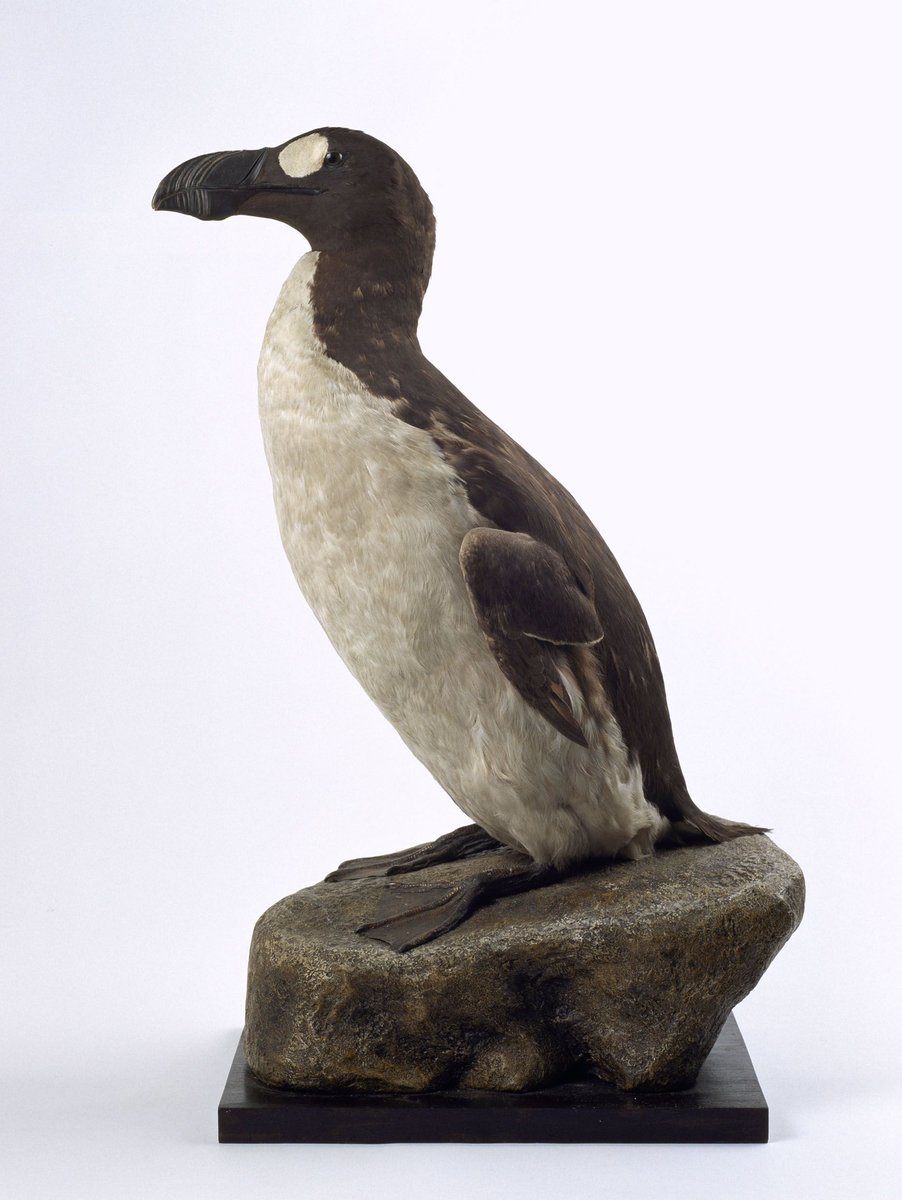
Image: Image sourced via web search (Fair use / Educational)
About Great Auk
The Great Auk (Pinguinus impennis) was a large, flightless seabird of the family Alcidae that inhabited the rocky coasts and cold offshore waters of the North Atlantic Ocean until its tragic, human-driven extinction in the mid-nineteenth century. Ranging from the shores of Canada and the northeastern United States across to Greenland, Iceland, the Faroe Islands, and the coastal regions of western Europe, this remarkable avian species represents one of the most poignant and well-documented examples of modern extinction. In the context of paleontology and archaeozoology, the Great Auk is of immense significance, as its extensive subfossil record—often found in the refuse middens of early human settlements—provides a detailed chronicle of human-wildlife interaction spanning thousands of years. The species bridges the gap between prehistoric paleontology and modern conservation biology, serving as a grim testament to the devastating impact of unregulated overexploitation by human populations on vulnerable, specialized marine fauna.
In terms of physical description, the Great Auk was a robust and imposing bird, standing approximately 75 to 85 centimeters (30 to 33 inches) tall and weighing an estimated 5 kilograms (11 pounds), making it the largest member of the alcid family. Its anatomy was highly specialized for a life spent predominantly in the water. The bird exhibited striking countershaded plumage, with a glossy black back, head, and neck, and a stark white underbelly, a coloration pattern that provided excellent camouflage against both aerial and aquatic predators. During the breeding season, the Great Auk developed a distinctive, large white patch above each eye, which faded to a white band stretching between the eyes in the winter. Its beak was particularly notable: large, heavy, and laterally compressed, featuring deep, vertical grooves that were likely used in visual displays and for securely gripping slippery prey. The wings of the Great Auk were reduced to mere flippers, measuring only about 15 centimeters in length, rendering the bird completely flightless. However, these abbreviated wings, combined with dense, heavy bones that reduced buoyancy, transformed the Great Auk into a master of underwater propulsion. Its skeletal structure, particularly the robust coracoid and sternum, supported powerful pectoral muscles necessary for 'flying' through the dense medium of water. In many ways, its physical form closely mirrored that of the unrelated penguins of the Southern Hemisphere, a classic example of convergent evolution where two distinct lineages develop similar traits in response to identical environmental pressures.
The paleobiology of the Great Auk reveals a creature exquisitely adapted to the harsh, dynamic environment of the North Atlantic. As an obligate carnivore and specialized piscivore, its diet consisted primarily of schooling fish. Isotopic analysis of subfossil bones and historical accounts suggest a preference for energy-rich species such as Atlantic menhaden, capelin, and various crustaceans. Hunting strategies involved deep, agile dives, with the bird using its powerful, paddle-like wings for propulsion and its webbed feet, set far back on its body, as a rudder for steering. While graceful and swift beneath the waves, the Great Auk was notoriously clumsy and slow-moving on land, a vulnerability that would ultimately seal its fate. Socially, the Great Auk was a highly gregarious species, congregating in massive, dense colonies during the breeding season. These colonies were restricted to a few remote, rocky islands with gently sloping shorelines, as the birds' limited terrestrial mobility prevented them from nesting on steep cliffs like their flying relatives. Growth patterns inferred from bone histology indicate a relatively rapid maturation process, though reproductive output was exceedingly low; females laid only a single, large, heavily speckled egg directly on the bare rock each year. This K-selected life history strategy, characterized by low fecundity and high parental investment, meant that the population was highly susceptible to rapid decline when faced with increased adult mortality.
The ecological context of the Great Auk places it within the rich, highly productive marine ecosystems of the Holocene North Atlantic. During its existence, the climate fluctuated through various post-glacial phases, including the Medieval Warm Period and the Little Ice Age, which likely influenced the distribution of its prey and the availability of suitable nesting sites. The Great Auk shared its habitat with a diverse array of marine life, including other alcids like the Razorbill, Atlantic Puffin, and Common Murre, as well as marine mammals such as seals, walruses, and various cetaceans. In the food web, the Great Auk occupied the role of a mid-to-top-level marine predator, exerting significant top-down pressure on local fish populations. Conversely, it was preyed upon by natural predators such as polar bears, killer whales, and white-tailed eagles. However, the most significant ecological interaction was its relationship with humans. For millennia, indigenous peoples of North America and early European coastal communities hunted the Great Auk for its meat, eggs, and feathers, incorporating the bird into their subsistence economies. The ecological balance was maintained until the advent of large-scale, commercial exploitation by European sailors and explorers, which introduced an unprecedented and unsustainable level of predation into the Great Auk's environment.
The discovery history of the Great Auk is deeply intertwined with human exploration and exploitation of the North Atlantic. The bird was well known to indigenous peoples long before European contact, as evidenced by its remains in Beothuk and Maritime Archaic middens in Newfoundland, dating back over 4,000 years. In the scientific realm, the Great Auk was formally described and named Alca impennis by the pioneering Swedish taxonomist Carl Linnaeus in 1758, in the tenth edition of his Systema Naturae. The genus was later revised to Pinguinus. The name 'penguin' was originally applied exclusively to the Great Auk by Welsh and Breton sailors (possibly derived from the Welsh 'pen gwyn', meaning white head, referring to the spots on its head), and was only later transferred to the superficially similar, but unrelated, birds of the Antarctic. The history of the Great Auk's interaction with Europeans is a grim chronicle of slaughter. Funk Island, off the coast of Newfoundland, was home to one of the largest known colonies and became a systematic slaughterhouse in the late 18th century. Sailors would drive the flightless birds up wooden planks directly into boiling cauldrons to harvest their down feathers. As populations plummeted, the bird became a highly prized rarity among wealthy European collectors and museums. The tragic culmination of this demand occurred on July 3, 1844, on the small volcanic islet of Eldey, off the coast of Iceland. A crew of fishermen, commissioned by a merchant seeking specimens for collectors, strangled the last known breeding pair and crushed their single egg underfoot, marking the definitive end of the species.
In terms of evolutionary significance, the Great Auk occupies a fascinating position within the avian tree of life. It belongs to the family Alcidae, a group of wing-propelled diving birds that includes puffins, guillemots, and murres. Phylogenetic analyses, incorporating both morphological data and ancient DNA extracted from museum specimens, have definitively shown that the Great Auk's closest living relative is the Razorbill (Alca torda). The evolutionary divergence between the flying Razorbill and the flightless Great Auk highlights a significant evolutionary trade-off: the sacrifice of aerial flight in favor of extreme specialization for underwater foraging. The Great Auk represents the only alcid to have completely lost the ability to fly in recent geological history. Furthermore, the Great Auk is a premier textbook example of convergent evolution. Despite being separated by millions of years of evolution and thousands of miles of ocean, the Great Auk of the North Atlantic and the penguins of the Southern Ocean evolved remarkably similar body plans, plumage patterns, and ecological niches. Studying the Great Auk allows evolutionary biologists to understand the biomechanical constraints of wing-propelled diving and the specific environmental conditions—such as the absence of terrestrial predators on breeding islands—that permit the evolution of flightlessness in seabirds.
Scientific debates surrounding the Great Auk continue to generate interest among paleontologists, ornithologists, and historians. One major area of ongoing research and debate concerns the exact size and distribution of the pre-exploitation population. While historical accounts describe millions of birds, some modern ecological modelers argue that the Great Auk's highly specific breeding requirements—needing remote, predator-free islands with gently sloping shores—meant that its global population was naturally constrained and perhaps more fragile than previously assumed. Another significant debate revolves around the role of climate change versus human hunting in the species' decline. While there is universal consensus that human overexploitation was the ultimate cause of extinction, some researchers suggest that environmental shifts during the Little Ice Age may have altered ocean currents and prey distribution, stressing the population and forcing them to abandon certain breeding sites, thereby concentrating them in fewer locations where they became even more vulnerable to human hunters. Additionally, the taxonomy of extinct flightless alcids, such as the prehistoric Pinguinus alfrednewtoni from the Pliocene, continues to be refined as new fossil material is discovered, helping to clarify the evolutionary timeline of the genus.
The fossil and subfossil record of the Great Auk is exceptionally rich for an extinct bird, providing a wealth of data for researchers. Remains have been discovered across a vast geographic area, ranging from as far south as Florida and northern Spain during colder climatic periods, up to the Arctic Circle. The vast majority of these remains are subfossils recovered from archaeological sites, particularly coastal shell middens, indicating the bird's long-standing importance to human diets. The preservation quality in these middens is often excellent, yielding thousands of individual bones that allow for detailed osteological and isotopic studies. In addition to subfossil bones, the Great Auk is uniquely represented by a significant number of preserved soft-tissue specimens due to its recent extinction. Currently, there are 78 mounted skins, approximately 75 intact eggs, and numerous complete skeletons housed in museum collections worldwide. Famous repositories of Great Auk remains include the Natural History Museum in London, the Royal Ontario Museum in Canada, and the Icelandic Institute of Natural History. These specimens are invaluable, providing the ancient DNA and stable isotopes necessary for modern molecular and ecological analyses.
The cultural impact of the Great Auk is profound and enduring, serving as a powerful, melancholic symbol of human-caused extinction. Its story has permeated popular culture, literature, and art, often invoked as a cautionary tale about the fragility of nature in the face of industrial exploitation. The tragic narrative of the last pair on Eldey Island resonates deeply in environmental education, illustrating the devastating consequences of the collector's paradox, where the increasing rarity of a species drives up its value, accelerating its demise. Museums around the world prominently display their Great Auk specimens, utilizing them not just as biological curiosities, but as poignant educational tools to foster conservation awareness. The legacy of the Great Auk continues to inspire modern conservation movements, reminding humanity of the irreversible permanence of extinction and the urgent need to protect the world's remaining biodiversity.
Classification
Time Period
Discovery
Location
North Atlantic coasts (Funk Island, Canada and Iceland)
Formation
Holocene coastal deposits and archaeological middens
Frequently Asked Questions
What is Great Auk?
The Great Auk (Pinguinus impennis) was a large, flightless seabird of the family Alcidae that inhabited the rocky coasts and cold offshore waters of the North Atlantic Ocean until its tragic, human-driven extinction in the mid-nineteenth century. Ranging from the shores of Canada and the northeaster...
When did Great Auk live?
Great Auk lived during the quaternary period of the cenozoic era approximately 0.005-0.0002 million years ago.
Where was Great Auk discovered?
Fossils of Great Auk were discovered in North Atlantic coasts (Funk Island, Canada and Iceland) in the Holocene coastal deposits and archaeological middens.
What did Great Auk eat?
Great Auk was a carnivore. It lived in marine habitats.
What type of fossil is Great Auk?
Great Auk is preserved as a body fossil. The preservation quality is excellent.
Related Specimens
From the cenozoic era · body fossils