Thalassomedon
Thalassomedon haningtoni
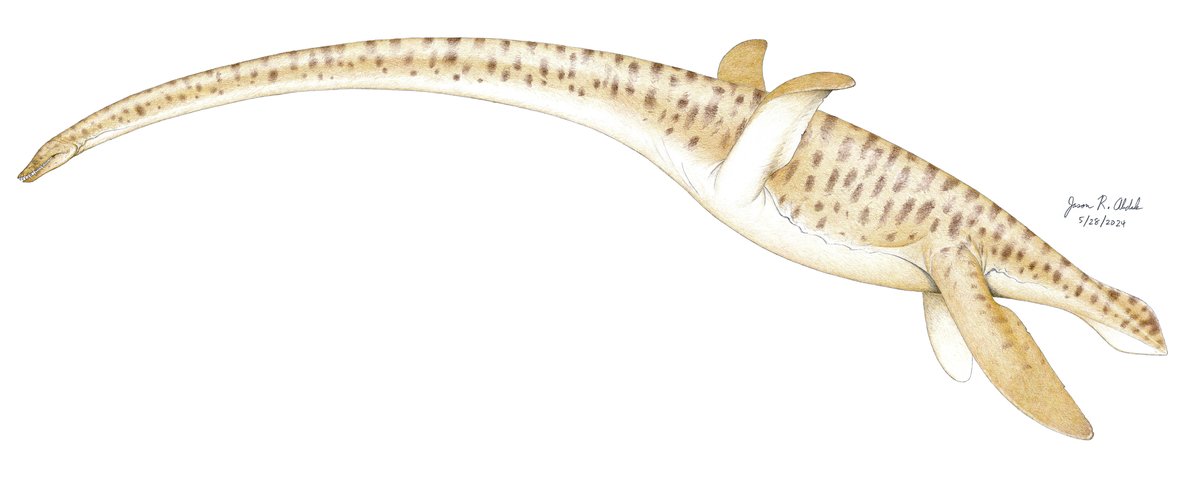
Image: Image sourced via web search (Fair use / Educational)
About Thalassomedon
Thalassomedon haningtoni was a colossal marine reptile that patrolled the ancient seas of the Late Cretaceous period, a true apex predator of its time. Its name, meaning 'Sea Lord' in Greek, aptly describes its dominant role in the Western Interior Seaway that once bisected North America. Living approximately 95 to 91 million years ago, this elasmosaurid plesiosaur is renowned for its extraordinarily long neck, which made it one of the most distinctive and formidable creatures of the Mesozoic oceans, offering paleontologists a crucial window into the structure and dynamics of prehistoric marine ecosystems.
Thalassomedon was a giant among plesiosaurs, reaching an estimated total body length of up to 12 meters (nearly 40 feet), making it comparable in size to a modern-day humpback whale or a large school bus. A significant portion of this length, nearly half, was comprised of its remarkably long and flexible neck, which contained an impressive 62 vertebrae. This anatomical feature is a hallmark of the Elasmosauridae family, but Thalassomedon's neck was particularly extreme, allowing it an incredible range of motion to strike at prey. Its skull was relatively small, measuring about 47 centimeters (18.5 inches) long, but it was armed with long, conical, interlocking teeth, each around 5 centimeters (2 inches) in length, perfectly adapted for piercing and securing slippery prey like fish and cephalopods. The body was broad, rigid, and streamlined, providing a stable platform for the powerful flippers. These four large, wing-like paddles, each potentially over 1.5 meters (5 feet) long, propelled the animal through the water with a motion akin to underwater flight, similar to how modern sea turtles and penguins swim. Its tail was relatively short and likely functioned primarily as a rudder for steering rather than for propulsion. Weight estimates for a full-grown Thalassomedon range from 5 to 10 metric tons, placing it firmly in the category of a megafaunal predator.
As an active carnivore, Thalassomedon's diet consisted primarily of the abundant marine life in the Western Interior Seaway. Its long, sharp teeth were not designed for chewing but for seizing fast-moving prey. Paleontologists believe it employed an ambush or stalking strategy, using its long neck to dart its head into schools of fish or to snatch unsuspecting ammonites and belemnites from the water column. The animal's eyes were positioned to provide good binocular vision, allowing it to accurately judge distances to its targets. Locomotion was achieved through powerful, coordinated strokes of its four flippers, likely in an alternating pattern that provided continuous and efficient thrust. This method of swimming would have allowed for both sustained cruising in search of food and rapid bursts of speed to capture prey. There is no direct fossil evidence for social behavior, but like many large marine predators today, it may have been a solitary hunter. A fascinating aspect of its biology is the presence of gastroliths, or stomach stones, found within the rib cages of some specimens. It is hypothesized that these stones were intentionally swallowed to either aid in grinding up food, act as ballast to help control buoyancy, or both, a behavior also seen in modern crocodiles and sea lions.
Thalassomedon lived during the Cenomanian and Turonian stages of the Late Cretaceous, a time of peak global temperatures and high sea levels. Its habitat was the Western Interior Seaway, a vast, shallow epicontinental sea that stretched from the Arctic Ocean to the Gulf of Mexico, dividing North America into two landmasses, Laramidia to the west and Appalachia to the east. This seaway was a vibrant and dangerous ecosystem teeming with life. Thalassomedon shared its waters with a diverse array of creatures, positioning it as a high-level predator in the food web. Its prey would have included bony fish like Xiphactinus and Enchodus, as well as numerous species of ammonites and squid. However, the 'Sea Lord' was not without its own threats. It coexisted with other large marine reptiles, including the formidable mosasaurs like Tylosaurus, which would have been a direct competitor and potential predator, especially of younger or smaller individuals. The seas were also home to giant predatory sharks such as Cretoxyrhina mantelli, the 'Ginsu Shark,' which could have posed a significant danger. The seafloor was composed of soft chalk and mud, and the water column was rich in plankton, supporting a complex food chain that ultimately sustained giants like Thalassomedon.
The discovery of Thalassomedon is a story rooted in the early days of American paleontology. The holotype specimen, designated DMNH 1588, was unearthed in 1939 by R.L. Hanington in the Graneros Shale near Pritchett, Baca County, Colorado. The fossil was remarkably complete, consisting of a skull, spinal column, and gastroliths, preserved within a limestone concretion. The task of preparing this immense fossil fell to the Denver Museum of Natural History (now the Denver Museum of Nature & Science), where it was meticulously excavated from its rock matrix. In 1943, paleontologist Samuel Welles of the University of California, Berkeley, formally described and named the creature. He coined the name Thalassomedon haningtoni, with the genus name translating to 'Sea Lord' and the species name honoring its discoverer, Hanington. This holotype remains one of the most significant elasmosaurid fossils ever found and is a centerpiece exhibit at the Denver museum. Subsequent discoveries of other Thalassomedon specimens have occurred in other states covered by the ancient seaway, including Kansas and Montana, helping to build a more complete picture of the animal's anatomy and geographic range. These finds have solidified its identity as a distinct and important genus within the plesiosaur family tree.
Thalassomedon holds a crucial position in our understanding of plesiosaur evolution, specifically within the family Elasmosauridae. This family is characterized by its members' hypertrophied necks, and Thalassomedon represents a classic, albeit early, example of this extreme anatomical specialization. It is considered a member of the Styxosaurinae, a subfamily of elasmosaurs that includes other long-necked giants like Styxosaurus and Albertonectes. By studying the anatomy of Thalassomedon and comparing it to earlier plesiosaurs from the Jurassic and Early Cretaceous, scientists can trace the evolutionary trajectory that led to these incredibly long necks. This adaptation was likely driven by selective pressures related to hunting strategies, allowing these animals to exploit food resources in a way other marine predators could not. While plesiosaurs have no direct living descendants, having gone extinct along with the non-avian dinosaurs 66 million years ago, they represent a spectacular example of reptilian adaptation to a fully marine lifestyle, paralleling the evolution of cetaceans (whales and dolphins) in the Cenozoic Era. Thalassomedon's well-preserved fossils provide vital data points for constructing the sauropterygian branch of the tree of life and understanding the dynamics of convergent evolution in marine vertebrates.
While Thalassomedon is a well-established genus, the broader classification of elasmosaurids has been a subject of ongoing scientific discussion and revision. For many years, numerous long-necked plesiosaurs were grouped under the genus Elasmosaurus, but modern phylogenetic analyses have led to a more nuanced understanding, resulting in the naming of new genera and the reclassification of old specimens. Thalassomedon itself was once considered by some to be synonymous with Styxosaurus, but detailed anatomical comparisons, particularly of the skull and pectoral girdle, have solidified its status as a distinct genus. Another area of debate concerns the function of the long neck. The traditional 'swan-like' posture, with the neck held high out of the water, is now largely dismissed as biomechanically improbable. Current consensus suggests the neck was held more horizontally, sweeping side-to-side or darting downwards to ambush prey from above. The precise function of the gastroliths also remains a topic of discussion, with the ballast versus digestion hypotheses both having strong support, and it is possible they served a dual purpose. New discoveries continue to refine our knowledge of these magnificent animals and their place in the Cretaceous seas.
The fossil record of Thalassomedon is relatively good for such a large prehistoric animal, though it is by no means common. Fossils are primarily found in geological formations that correspond to the middle of the Western Interior Seaway, such as the Carlile Shale and Graneros Shale of Colorado and Kansas, and the Greenhorn Limestone. The holotype specimen from Colorado is the most complete, providing a near-entire skeleton that has been foundational to our understanding of the species. Other partial skeletons and isolated bones have been recovered from surrounding regions, including Montana. The preservation quality is often good, as the fine-grained marine sediments of the seaway were conducive to rapid burial and fossilization, protecting the bones from scavenging and decay. The skulls are particularly rare, making the complete skull of the holotype specimen exceptionally valuable. Famous fossil sites like the Smoky Hill Chalk in Kansas, while more known for mosasaurs and the related Elasmosaurus, have also yielded remains that contribute to the broader picture of the elasmosaurid fauna of which Thalassomedon was a key member.
Although not as famous as its relative Elasmosaurus or its contemporary rivals, the mosasaurs, Thalassomedon has made a notable cultural impact. Its impressive holotype skeleton is a major attraction at the Denver Museum of Nature & Science, where its immense size and bizarre proportions captivate visitors and serve as a powerful educational tool about life in prehistoric oceans. The dramatic name 'Sea Lord' has also helped it gain some recognition in popular science books, documentaries, and online media about prehistoric life. While it may not be a household name like Tyrannosaurus rex, Thalassomedon represents a pinnacle of marine reptile evolution and stands as a testament to the incredible diversity and grandeur of life during the Age of Dinosaurs, inspiring awe and curiosity in all who learn of this ancient ruler of the Cretaceous seas.
Classification
Time Period
Discovery
Location
United States (Colorado, Kansas, Montana)
Formation
Carlile Shale, Graneros Shale, Greenhorn Limestone
Frequently Asked Questions
What is Thalassomedon?
Thalassomedon haningtoni was a colossal marine reptile that patrolled the ancient seas of the Late Cretaceous period, a true apex predator of its time. Its name, meaning 'Sea Lord' in Greek, aptly describes its dominant role in the Western Interior Seaway that once bisected North America. Living app...
When did Thalassomedon live?
Thalassomedon lived during the cretaceous period of the mesozoic era approximately 95-91 million years ago.
Where was Thalassomedon discovered?
Fossils of Thalassomedon were discovered in United States (Colorado, Kansas, Montana) in the Carlile Shale, Graneros Shale, Greenhorn Limestone.
What did Thalassomedon eat?
Thalassomedon was a carnivore. It lived in marine habitats.
What type of fossil is Thalassomedon?
Thalassomedon is preserved as a body fossil. The preservation quality is good.
Related Specimens
From the mesozoic era · body fossils