Struthiomimus
Struthiomimus altus
Image: Image sourced via web search (Fair use / Educational)
About Struthiomimus
Struthiomimus altus, whose name translates to "ostrich mimic," was a highly specialized, fleet-footed ornithomimid dinosaur that roamed the coastal plains and lush river valleys of Late Cretaceous North America, approximately 77 to 72 million years ago. As one of the most recognizable and well-represented members of the ornithomimosaur clade, this remarkable theropod has played a foundational role in our understanding of non-avian dinosaur ecology, cursorial locomotion, and the striking evolutionary convergence between ancient reptiles and modern ratites. Its abundant fossil remains, primarily recovered from the rich geological formations of western Canada, have provided paleontologists with an extraordinary window into the anatomy and paleobiology of a dinosaur that abandoned the hyper-carnivorous lifestyle of its ancestors in favor of a highly active, opportunistic, and fast-paced existence in a predator-filled world.
Struthiomimus was a medium-sized theropod, measuring approximately 4.3 meters (14 feet) in length from the tip of its beak to the end of its tail, and standing about 1.4 meters (4.6 feet) tall at the hips. Weight estimates derived from volumetric models and femoral circumference typically place the adult animal between 150 and 250 kilograms (330 to 550 pounds), making it roughly comparable in mass to a large modern ostrich, albeit significantly longer due to its tail. Its most distinctive morphological features were its striking resemblance to modern flightless birds, characterized by a small, lightly built, and highly pneumatic skull perched atop a long, slender, and exceptionally flexible neck. The jaws of Struthiomimus were entirely toothless, covered instead by a sharp, keratinous rhamphotheca (beak) that likely possessed sharp tomial edges for cropping vegetation or snapping up small prey. The large orbits (eye sockets) housed sclerotic rings, indicating large eyes and excellent visual acuity, which would have been crucial for spotting predators at a distance. The forelimbs of Struthiomimus were relatively long and slender compared to other theropods, ending in three digits tipped with long, somewhat straight claws that were not strongly curved like those of active predators. Its hind limbs were exceptionally elongated, particularly the distal elements like the tibia and the tightly bundled metatarsals, which are classic biomechanical adaptations for cursorial (running) lifestyles. The tail was stiffened by elongated prezygapophyses in the caudal vertebrae, acting as a dynamic, rigid counterbalance during high-speed maneuvers. Soft tissue inferences, supported by groundbreaking discoveries in closely related ornithomimids like Ornithomimus, strongly suggest that Struthiomimus was covered in a dense coat of pennaceous feathers. Adult individuals likely sported prominent, wing-like structures on their forelimbs, which were aerodynamically useless for flight but highly effective for intraspecific display, brooding, or rapid turning.
The paleobiology of Struthiomimus has been a subject of intense study, particularly regarding its diet, metabolic rate, and extraordinary locomotion. Originally presumed to be a strict carnivore due to its theropod lineage, modern consensus views Struthiomimus as an opportunistic omnivore or possibly a dedicated herbivore. Its toothless beak, combined with the occasional presence of gastroliths (stomach stones) found in the abdominal cavities of related taxa, suggests a diet consisting of tough plant material, seeds, fruits, insects, and perhaps small vertebrates like lizards or early mammals. The long, clawed forelimbs may have been used to hook and pull down branches, bringing high foliage within reach of its beak, a feeding strategy analogous to modern ground sloths or therizinosaurs. Locomotion was undoubtedly the defining characteristic of Struthiomimus. Biomechanical studies of its elongated hind limbs, fused metatarsals (an arctometatarsalian condition), and powerful pelvic muscle attachments indicate it was one of the fastest dinosaurs of its time. Computer simulations and trackway analyses suggest Struthiomimus was capable of reaching sustained speeds estimated between 50 to 80 kilometers per hour (30 to 50 mph). This incredible speed was its primary, and perhaps only, defense mechanism against the massive tyrannosaurid predators of its ecosystem. Socially, bonebed discoveries of related ornithomimids suggest that Struthiomimus may have exhibited gregarious behavior, moving in flocks or herds to increase collective vigilance against predators. Histological studies of their bone microstructure reveal distinct growth rings indicating a rapid growth rate, typical of endothermic (warm-blooded) animals, allowing them to reach adult size and reproductive maturity in just a few years.
During the Campanian stage of the Late Cretaceous, the environment inhabited by Struthiomimus was vastly different from the modern North American landscape. It lived on the eastern coast of Laramidia, a western island continent separated from the eastern landmass of Appalachia by the Western Interior Seaway, a shallow epicontinental sea that bisected North America. The climate was warm, temperate to subtropical, and largely free of winter frosts, supporting lush, highly diverse ecosystems characterized by coastal plains, meandering river systems, expansive swamps, and dense forests of conifers, ferns, cycads, and rapidly diversifying angiosperms (flowering plants). Struthiomimus shared its Laramidian habitat with a spectacular array of iconic dinosaurs. In the Dinosaur Park Formation of Alberta, it coexisted with massive, herd-dwelling ceratopsians like Centrosaurus and Chasmosaurus, heavily armored ankylosaurs such as Edmontonia and Euoplocephalus, and immense aggregations of hadrosaurs like Corythosaurus, Lambeosaurus, and Parasaurolophus. As a mid-sized omnivore, Struthiomimus occupied a unique ecological niche, foraging in the underbrush, along riverbanks, and in open floodplains where its speed could be utilized effectively. It was situated in the middle of the complex food web, serving as a primary food source for apex predators. The landscape was prowled by formidable tyrannosaurids, including Gorgosaurus and Daspletosaurus, which would have required stealth, ambush tactics, or cooperative hunting to capture the fleet-footed Struthiomimus. Smaller, highly agile dromaeosaurids, such as Saurornitholestes and Dromaeosaurus, may have posed a significant threat to juveniles, sick individuals, or unguarded nests, making the speed, visual acuity, and potential flocking behavior of Struthiomimus absolutely critical for its survival in this dangerous and dynamic environment.
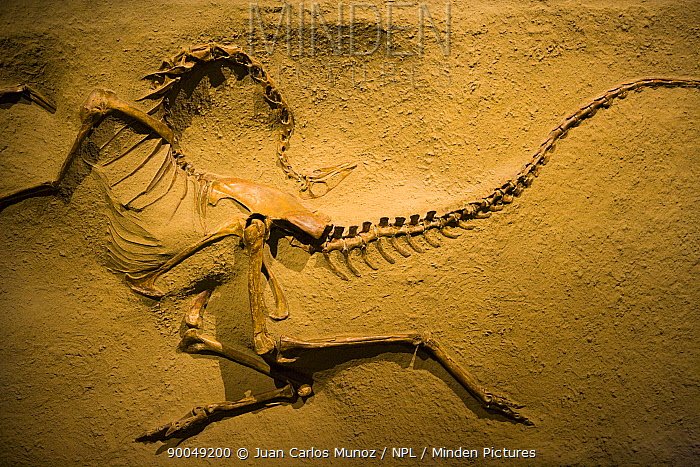
The discovery history of Struthiomimus is deeply intertwined with the early days of North American paleontology and the golden age of dinosaur hunting, though its most significant finds came slightly after the infamous "Bone Wars." The first remains attributed to this genus were discovered by the pioneering Canadian paleontologist Lawrence Lambe in 1901 in the Belly River Series (now formally known as the Dinosaur Park Formation) of Alberta, Canada. Lambe initially described these fragmentary remains as a new species of the pre-existing genus Ornithomimus, naming it Ornithomimus altus in 1902. It was not until 1917 that the eminent paleontologist Henry Fairfield Osborn, working at the American Museum of Natural History (AMNH) in New York, recognized that these fossils were morphologically distinct enough from Ornithomimus to warrant their own genus. Osborn coined the name Struthiomimus, meaning "ostrich mimic," perfectly highlighting the profound morphological similarities between this ancient reptile and modern ratites. One of the most important and famous specimens is the beautifully articulated, nearly complete skeleton AMNH 5339, discovered by the legendary fossil hunter Barnum Brown in 1914 along the Red Deer River in Alberta. This spectacular specimen, preserved in a classic "death pose" with its neck arched backward, provided the scientific community with the first comprehensive look at the skeletal anatomy of an ornithomimid, revealing the toothless beak and specialized cursorial limbs in stunning detail. Over the subsequent decades, numerous other specimens have been recovered by expeditions from the Royal Tyrrell Museum and other institutions, primarily from the rich fossil beds of Alberta, cementing Struthiomimus as one of the best-known and most thoroughly studied theropods of the Late Cretaceous period.
Struthiomimus holds a position of immense evolutionary significance within the Dinosauria, serving as a textbook example of convergent evolution and demonstrating the incredible morphological plasticity of the theropod lineage. As a member of the clade Ornithomimosauria, it belongs to the broader group of coelurosaurian theropods, the exact same evolutionary lineage that ultimately gave rise to modern birds. However, the ostrich-like body plan of Struthiomimus evolved entirely independently from that of modern flightless birds like ostriches, emus, and rheas. This striking convergence demonstrates how similar environmental pressures—specifically the need for high-speed cursorial locomotion in open environments and the shift toward an omnivorous or herbivorous diet—can lead to nearly identical morphological solutions across vast spans of geological time. The evolutionary trajectory of ornithomimosaurs shows a clear, progressive trend toward the loss of teeth and the development of a complex keratinous beak, a highly successful feature that appeared multiple times independently in different dinosaur lineages, including ceratopsians, hadrosaurs, and oviraptorosaurs. Furthermore, the inferred presence of pennaceous feathers in Struthiomimus and its close relatives provides crucial evidence that complex, branching feathers evolved long before the origin of avian flight. In these ground-dwelling dinosaurs, feathers likely served vital functions related to thermoregulation, camouflage, or elaborate sexual displays. By studying the anatomy and phylogeny of Struthiomimus, paleontologists gain invaluable insights into the step-by-step acquisition of avian traits, effectively bridging the anatomical gap between typical, heavily armed carnivorous dinosaurs and the highly derived, toothless birds of the modern era.
Despite being exceptionally well-represented in the fossil record, Struthiomimus remains the subject of several ongoing scientific debates and active research. One of the most persistent controversies surrounds the exact mechanics of its dietary preferences and feeding behavior. While the consensus strongly leans toward omnivory or herbivory, the exact method of how it processed tough plant food without teeth or a complex grinding apparatus remains debated. Some researchers, such as Makovicky et al., have previously suggested that the delicate structure of the ornithomimid beak might have been used for filter-feeding in shallow water, similar to modern flamingos or shovelers, though this view is less widely accepted today due to the terrestrial nature of most fossil sites. Another major area of debate involves its taxonomic relationship with the closely related genus Ornithomimus. The morphological differences between the two genera are subtle, primarily relating to the proportions of the forelimbs, the robustness of the skeleton, and specific features of the vertebrae. Some paleontologists have historically argued that Struthiomimus might simply represent a different growth stage, a robust morphotype, or a sexual dimorph of Ornithomimus, though most current, high-resolution phylogenetic analyses support their separation as distinct, valid genera. Additionally, the exact function of their forelimbs, which were too long for typical running balance but too weak for grasping large prey, continues to generate competing hypotheses ranging from branch-pulling to supporting large display feathers.
The fossil record of Struthiomimus is exceptionally rich and well-documented compared to many other theropod dinosaurs, providing a wealth of high-quality data for paleontological study. Fossils are predominantly found in the Late Cretaceous fluvial deposits of western North America, with the vast majority of confirmed specimens originating from the Dinosaur Park Formation in Alberta, Canada. Other significant, though sometimes fragmentary, finds have been reported from the Horseshoe Canyon Formation in Canada and potentially the Hell Creek Formation and Lance Formation in the United States, though the specific assignment of these latter, southernmost remains to Struthiomimus altus is sometimes debated by taxonomists. The preservation quality of Struthiomimus fossils is often excellent, ranging from isolated, robust limb bones to beautifully articulated, nearly complete skeletons preserved in ancient oxbow lakes and river channels. The robust hind limbs, vertebrae, and pelvic girdles are most commonly preserved due to their density, while the delicate, thin-walled, highly pneumatic skulls are significantly rarer and highly prized by researchers when found intact. The sheer abundance of these fossils in specific, well-dated stratigraphic layers allows researchers to track minor morphological changes over millions of years and provides a robust, statistically significant dataset for analyzing their population dynamics, ontogenetic growth rates, and individual variations.
Struthiomimus has enjoyed a prominent and enduring place in popular culture, museum exhibitions, and paleoart, largely due to its highly recognizable, bird-like appearance and its status as one of the fastest known dinosaurs. It frequently appears in dinosaur documentaries, children's books, and animated films as the quintessential fast-running prey animal, often dramatically depicted fleeing from massive tyrannosaurs. Notable, dynamic mounted skeletons are displayed in major educational institutions worldwide, including the American Museum of Natural History in New York and the Royal Tyrrell Museum of Palaeontology in Alberta. These striking displays captivate the public imagination, serving as highly effective educational tools that vividly illustrate the complex concepts of convergent evolution, dinosaur biomechanics, and the dynamic, active, and bird-like nature of theropod dinosaurs.
Classification
Time Period
Discovery
Location
Alberta, Canada
Formation
Dinosaur Park Formation
Frequently Asked Questions
What is Struthiomimus?
Struthiomimus altus, whose name translates to "ostrich mimic," was a highly specialized, fleet-footed ornithomimid dinosaur that roamed the coastal plains and lush river valleys of Late Cretaceous North America, approximately 77 to 72 million years ago. As one of the most recognizable and well-repre...
When did Struthiomimus live?
Struthiomimus lived during the cretaceous period of the mesozoic era approximately 77-72 million years ago.
Where was Struthiomimus discovered?
Fossils of Struthiomimus were discovered in Alberta, Canada in the Dinosaur Park Formation.
What did Struthiomimus eat?
Struthiomimus was a omnivore. It lived in terrestrial habitats.
What type of fossil is Struthiomimus?
Struthiomimus is preserved as a body fossil. The preservation quality is excellent.
Related Specimens
From the mesozoic era · body fossils