Sinosauropteryx
Sinosauropteryx prima
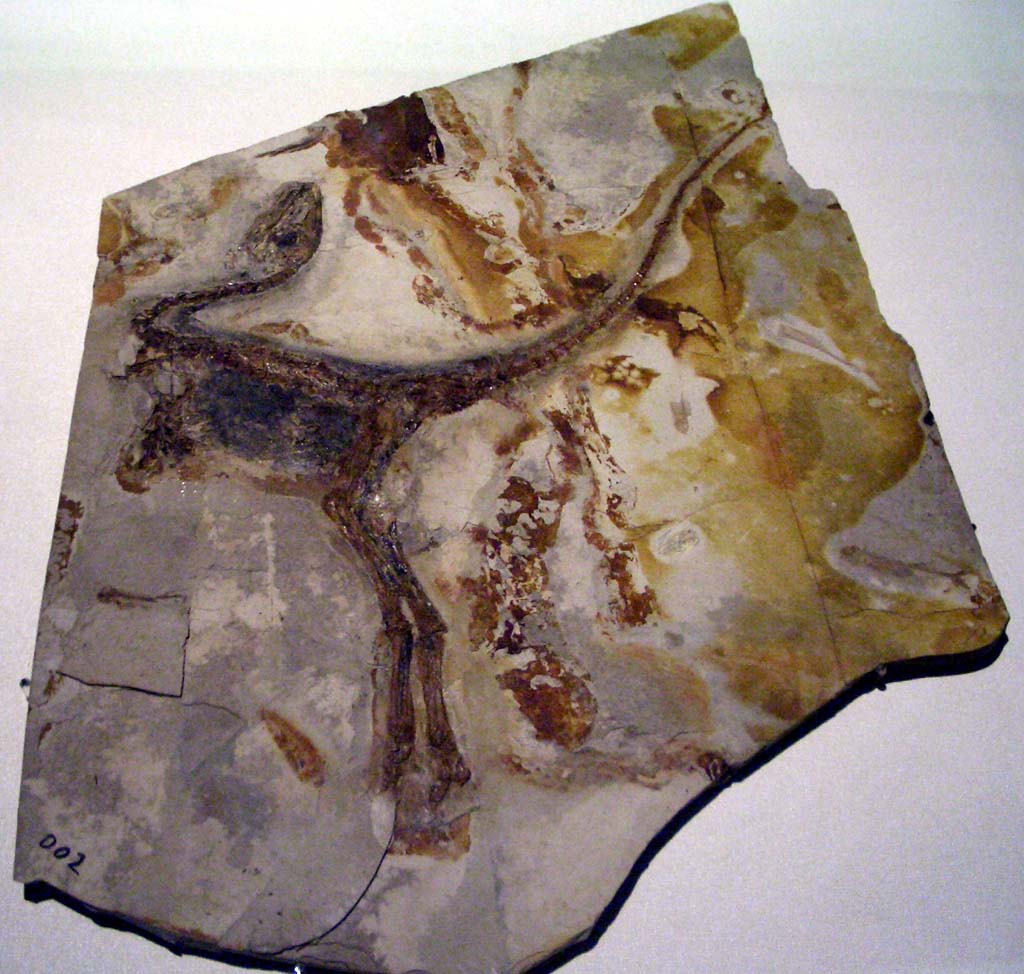
Image: File:Sinosauropteryx prima.JPG - Wikimedia Commons (CC BY-SA)
About Sinosauropteryx
Sinosauropteryx prima was a small, bipedal theropod dinosaur that inhabited the lush, volcanic landscapes of northeastern China during the Early Cretaceous period, approximately 124.6 to 122 million years ago. Its discovery in 1996 revolutionized the field of paleontology, as it provided the first direct, unequivocal fossil evidence of feathers on a non-avian dinosaur, solidifying the long-theorized evolutionary link between dinosaurs and modern birds. This turkey-sized predator, known from exquisitely preserved fossils, has since become one of the most thoroughly understood dinosaurs, offering unprecedented insights into dinosaurian anatomy, coloration, diet, and behavior.
The physical anatomy of Sinosauropteryx prima reveals a creature exquisitely adapted for a life as a swift, ground-dwelling predator. The holotype specimen, NIGP 127586, measured approximately 68 centimeters from snout to tail tip, though larger specimens, such as GMV 2124, reached a total length of 107 centimeters. A significant portion of this length, often more than half, was comprised of its remarkably long tail, which contained the highest number of vertebrae (64) of any known theropod. This tail likely served as a dynamic counterbalance, allowing for exceptional agility and rapid changes in direction while pursuing prey. Estimates of its body mass are typically in the range of 0.55 kilograms, comparable to a modern roadrunner or a small chicken. Its skull was long and low, equipped with a narrow snout filled with numerous small, sharp, and conical teeth, ideal for seizing small, fast-moving animals. The forelimbs were notably short, possessing only about 30% of the length of the hindlimbs, and terminated in three-fingered hands with sharp claws. Its hindlimbs, in contrast, were long and robust, indicating a bipedal and cursorial (running) lifestyle. The entire body, from its head down to its tail, was covered in a dense coat of simple, filamentous proto-feathers, which resembled downy fluff or bristles rather than the complex, vaned feathers of modern birds.
The paleobiology of Sinosauropteryx is known in remarkable detail thanks to the exceptional preservation of multiple specimens from the Yixian Formation. Stomach contents, preserved as distinct masses within the abdominal cavities of several fossils, provide direct evidence of its carnivorous diet. These gut contents include the partially digested remains of small vertebrates, most notably the jaws of lizards like Dalinghosaurus and the complete skeletons of early mammals such as Zhangheotherium and Sinobaatar. The presence of multiple prey items in a single individual suggests it was an opportunistic and voracious predator, capable of hunting and consuming a variety of small animals in its environment. Its long legs and agile build point to a pursuit predation strategy, chasing down prey on the forest floor. The simple, hair-like feathers, designated as 'Stage 1' feathers, were incapable of providing lift for flight and instead served primarily as insulation, a critical adaptation for maintaining a stable body temperature. This supports the hypothesis that at least some non-avian dinosaurs were warm-blooded. Furthermore, two unhatched eggs were found preserved within the body cavity of one specimen, indicating its reproductive biology. The presence of two developed eggs simultaneously suggests a paired oviduct system, a primitive trait shared with crocodiles but differing from modern birds, which typically have only one functional oviduct.
Sinosauropteryx lived within the Jehol Biota, a unique and now-famous ecosystem that thrived around a network of lakes and active volcanoes in what is now Liaoning Province, China. The climate during the Aptian age of the Early Cretaceous was temperate, with distinct warm, wet seasons and cooler, dry seasons. The landscape was dominated by conifer forests, with an understory of ferns, cycads, and early flowering plants. This environment was periodically disrupted by volcanic eruptions, which led to mass mortality events and the rapid burial of organisms in fine-grained volcanic ash and lake sediment. This process of exceptional taphonomy is responsible for the stunning preservation of the Jehol fossils, including the soft tissues of Sinosauropteryx. It shared this habitat with a diverse array of fauna, including other feathered dinosaurs like Caudipteryx and Protarchaeopteryx, early birds such as Confuciusornis, various pterosaurs, fish, insects, and small mammals. As a small carnivore, Sinosauropteryx occupied a meso-predator niche in the local food web, preying on smaller vertebrates while potentially being prey for larger theropods like Yutyrannus, which inhabited the same formation, albeit not necessarily at the exact same time or location.
The discovery of Sinosauropteryx was a watershed moment in the history of paleontology. The first specimen was unearthed in August 1996 by a local farmer, Li Yumin, in the Sihetun area of Liaoning Province, China. He sold the fossil slab to the National Geological Museum of China in Beijing. There, it was examined by paleontologists Ji Qiang and Ji Shu'an. They recognized the profound importance of the dark, filamentous impressions surrounding the skeleton and, in the same year, published their findings, naming the new genus and species Sinosauropteryx prima, meaning "first Chinese dragon wing." The announcement sent shockwaves through the scientific community, providing the "smoking gun" evidence that paleontologists like John Ostrom had long predicted would be found, cementing the dinosaur-bird connection. A second, larger specimen, GMV 2124, was described in 1997 by a team including Philip J. Currie and Chen Pei-ji. This specimen, also known as the "unnamed compsognathid" initially, further confirmed the presence of proto-feathers and contained preserved gut contents. A third specimen, NIGP 127587, was described in 2007 and contained evidence of its reproductive system. These key specimens, among others, have made Sinosauropteryx a cornerstone of modern dinosaur research.
The evolutionary significance of Sinosauropteryx cannot be overstated. As a member of the family Compsognathidae, it belongs to a group of small, coelurosaurian theropods that were relatively conservative in their body plan. Coelurosauria is the major clade of theropods that includes tyrannosaurs, ornithomimosaurs, and, most importantly, maniraptorans, the group that contains birds. The discovery of feathers on such a relatively basal coelurosaur demonstrated that these structures were not an invention of birds or their immediate ancestors, but rather appeared much earlier in theropod evolution. The simple, unbranched filaments of Sinosauropteryx represent the most primitive stage ('Stage 1') in the evolutionary development of feathers, providing a real-world example of a theoretical model proposed by Richard Prum. This finding fundamentally shifted the scientific consensus, confirming that feathers originally evolved for purposes other than flight, most likely for insulation, and were later co-opted for display and eventually for aerial locomotion. Sinosauropteryx thus serves as a crucial transitional fossil, not in the sense of being a direct ancestor to birds, but as a representative of an early stage in the evolution of the traits that would ultimately define Aves.
Despite its fame, Sinosauropteryx has been at the center of several scientific debates. Shortly after its discovery, a small group of paleontologists, notably Alan Feduccia, argued that the filamentous structures were not proto-feathers but were instead degraded collagen fibers from the skin. This "collagen hypothesis" was rigorously tested and largely refuted by subsequent chemical and structural analyses of the filaments in Sinosauropteryx and other feathered dinosaurs, which confirmed their feather-like keratinous composition and external nature. The most groundbreaking research, and a source of ongoing refinement, involves the reconstruction of its life coloration. In 2010, a team led by Fucheng Zhang and Mike Benton analyzed the fossilized impressions of its feathers under a scanning electron microscope and identified preserved melanosomes—pigment-containing organelles. By comparing the shape, size, and distribution of these fossil melanosomes to those in modern birds, they were able to infer its coloration. They concluded that Sinosauropteryx had a reddish-brown or "ginger" hue, with a distinctively banded, raccoon-like tail of alternating orange and white stripes. This research pioneered the field of paleocolor reconstruction, though the precise shades and the function of the patterns—whether for camouflage, species recognition, or display—remain active areas of study and discussion.
The fossil record of Sinosauropteryx is geographically restricted but scientifically rich. All known specimens have been recovered from the Yixian Formation, specifically from the Dawangzhangzi and Sihetun fossil beds in Liaoning Province, China. This geological formation is world-renowned for its Lagerstätte deposits, which yield fossils with an extraordinary degree of preservation, including soft tissues like feathers, skin, and internal organs. To date, at least three nearly complete and articulated skeletons have been formally described, along with several other partial specimens. The quality of these fossils is so exceptional that they preserve not only the delicate proto-feathers but also the outlines of organs and the contents of the digestive tract. This remarkable fossil record provides a uniquely comprehensive snapshot of a single dinosaur species, allowing for studies on its anatomy, diet, reproduction, and appearance that are impossible for most other extinct animals. The concentration of these fossils in a specific region highlights the unique environmental conditions that led to their preservation and has made the Jehol Biota one of the most important windows into the world of the dinosaurs.
The discovery of Sinosauropteryx had an immediate and lasting cultural impact, extending far beyond the confines of academic journals. As the first compellingly feathered non-avian dinosaur, its image became iconic, frequently appearing in museum exhibits, documentaries, and popular science books to illustrate the evolutionary origin of birds. Casts and original specimens of Sinosauropteryx are prized displays in museums worldwide, including the Paleozoological Museum of China and the National Geological Museum of China. Its depiction, particularly with its scientifically reconstructed ginger coloration and striped tail, has helped shift public perception of dinosaurs from scaly, monolithic reptiles to dynamic, bird-like animals with complex integuments and behaviors. For educators, Sinosauropteryx serves as a perfect case study for teaching core evolutionary concepts, such as transitional fossils, exaptation (the co-option of a trait for a new function), and the power of the fossil record to reveal intimate details of prehistoric life.
Classification
Time Period
Discovery
Location
Liaoning Province, China
Formation
Yixian Formation
Frequently Asked Questions
What is Sinosauropteryx?
Sinosauropteryx prima was a small, bipedal theropod dinosaur that inhabited the lush, volcanic landscapes of northeastern China during the Early Cretaceous period, approximately 124.6 to 122 million years ago. Its discovery in 1996 revolutionized the field of paleontology, as it provided the first d...
When did Sinosauropteryx live?
Sinosauropteryx lived during the cretaceous period of the mesozoic era approximately 124.6-122 million years ago.
Where was Sinosauropteryx discovered?
Fossils of Sinosauropteryx were discovered in Liaoning Province, China in the Yixian Formation.
What did Sinosauropteryx eat?
Sinosauropteryx was a carnivore. It lived in terrestrial habitats.
What type of fossil is Sinosauropteryx?
Sinosauropteryx is preserved as a impression fossil. The preservation quality is exceptional.
Related Specimens
From the mesozoic era · impression fossils