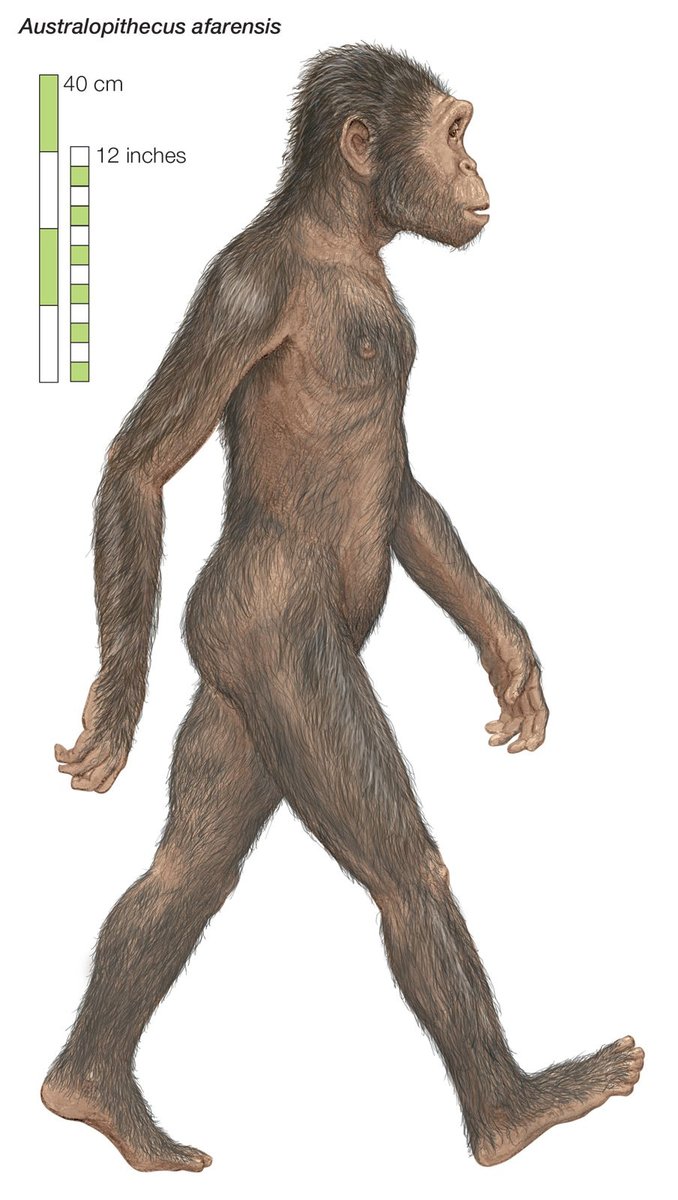
Lucy (AL 288-1)
Australopithecus afarensis
Image: Image sourced via web search (Fair use / Educational)
About Lucy (AL 288-1)
Lucy (AL 288-1) represents one of the most famous and significant hominid fossils ever discovered, belonging to the species Australopithecus afarensis. Living approximately 3.2 million years ago during the Neogene period of the Cenozoic era, this remarkable specimen was unearthed in the Afar region of Ethiopia. Lucy's discovery fundamentally transformed our understanding of human evolution by providing concrete evidence that bipedalism preceded the significant increase in brain size that characterizes the genus Homo. As a crucial transitional figure in the hominin lineage, Lucy bridges the anatomical gap between more primitive, ape-like ancestors and the later, more derived members of the human family tree. Her remarkably complete skeleton has served as the baseline for studying early hominin anatomy, biomechanics, and evolutionary adaptations for nearly half a century. The physical anatomy of Lucy and her species, Australopithecus afarensis, presents a fascinating mosaic of ape-like and human-like traits. Lucy herself was a relatively small individual, standing approximately 105 centimeters (about 3 feet 5 inches) tall and weighing an estimated 27 to 30 kilograms (60 to 65 pounds). Males of the species were significantly larger, indicating a high degree of sexual dimorphism, potentially reaching up to 150 centimeters in height and weighing around 42 kilograms. Lucy's skull was relatively small, housing a brain volume of about 380 to 430 cubic centimeters, which is roughly equivalent to that of a modern chimpanzee and about one-third the size of a modern human brain. Her facial structure featured a flat nose, a strongly projecting lower jaw (prognathism), and prominent brow ridges. However, her postcranial skeleton tells a different story. The structure of her pelvis, which was short and broad, along with the valgus angle of her femur (angling inward toward the knee), clearly indicates that she walked upright on two legs. Her arms were somewhat elongated compared to her legs, and her fingers were curved, suggesting she still retained significant adaptations for climbing trees, a trait that would have been advantageous for escaping predators or foraging. The paleobiology of Australopithecus afarensis reflects a highly adaptable species capable of exploiting diverse environments. Lucy's diet was primarily herbivorous, consisting largely of fruits, leaves, seeds, roots, and tubers, though isotopic analysis and dental microwear suggest she was an opportunistic omnivore who may have occasionally consumed insects or scavenged small amounts of meat. Her robust jaws and thick tooth enamel indicate an ability to process tough, fibrous foods, especially during times of environmental stress when softer fruits were unavailable. Locomotion was a defining characteristic of her paleobiology; Lucy was an obligate biped on the ground, utilizing a striding gait similar to modern humans, albeit perhaps slightly less efficient due to her shorter legs and wider pelvis. However, her curved phalanges and upward-oriented shoulder joints strongly imply that arboreal locomotion remained an important part of her behavioral repertoire, likely for nesting at night to avoid terrestrial predators. Socially, the high degree of sexual dimorphism observed in A. afarensis suggests a polygynous mating system, possibly similar to modern gorillas, where a single dominant male controlled a harem of females, though some researchers argue for a more multi-male, multi-female social structure akin to chimpanzees. Growth patterns inferred from dental development indicate that A. afarensis matured faster than modern humans but slower than modern apes, representing an intermediate life history strategy. During the time Lucy lived, approximately 3.2 million years ago, the Afar region of Ethiopia was a dynamic and shifting environment. The climate of the Pliocene epoch was generally warmer and wetter than today, but it was undergoing a gradual cooling and drying trend that led to the expansion of open grasslands at the expense of dense forests. Lucy's habitat was a mosaic ecosystem, featuring gallery forests along rivers and lakes, interspersed with open woodlands, bushlands, and expanding savannas. This transitional environment was perfectly suited for a creature with a mosaic anatomy like A. afarensis, allowing them to forage in the trees and travel efficiently across open ground. Lucy shared her world with a diverse array of megafauna, including extinct species of elephants, ancient rhinos, hippopotamuses, and various bovids. Predators were a constant threat, and Lucy would have had to remain vigilant against large carnivores such as saber-toothed cats, giant hyenas, and massive crocodiles that inhabited the waterways. In this complex food web, A. afarensis occupied a middle tier, acting primarily as a primary consumer of plant matter but also serving as potential prey for the apex predators of the Pliocene landscape. The discovery of Lucy is one of the most celebrated events in the history of paleoanthropology. She was found on November 24, 1974, by American paleoanthropologist Donald Johanson and graduate student Tom Gray at the site of Hadar in the Awash Valley of the Afar Triangle in Ethiopia. The team was surveying the area when Johanson spotted a proximal ulna (forearm bone) sticking out of the sediment, quickly followed by a skull bone, a femur, ribs, a pelvis, and a lower jaw. Over the next several weeks, the team meticulously excavated the site, ultimately recovering 47 out of the 207 bones that make up a complete hominin skeleton, representing about 40 percent of a single individual. This was an unprecedented level of completeness for a hominin fossil of that immense age. The specimen, officially cataloged as AL 288-1, was affectionately nicknamed Lucy after the Beatles song Lucy in the Sky with Diamonds, which was playing loudly on a tape recorder at the expedition camp during the celebratory party following the discovery. The formal naming of the species as Australopithecus afarensis occurred in 1978, authored by Johanson, Tim White, and Yves Coppens, establishing Lucy as the benchmark for this crucial early human ancestor. Lucy's evolutionary significance cannot be overstated; she provided the empirical evidence needed to resolve a long-standing debate in paleoanthropology regarding the sequence of human evolutionary milestones. Prior to her discovery, many scientists believed that a large brain was the initial defining characteristic of the hominin lineage, driving the subsequent development of bipedalism and tool use. Lucy proved the exact opposite: her fully bipedal postcranial skeleton combined with her small, ape-sized brain demonstrated conclusively that upright walking evolved millions of years before significant encephalization (brain expansion) occurred. Australopithecus afarensis is widely considered a direct ancestor to the genus Homo, or at least a very close relative to that ancestral lineage. The species exhibits a perfect suite of transitional features, retaining primitive traits in the cranium and upper limbs while displaying highly derived, human-like traits in the lower limbs and pelvis. Furthermore, the longevity and evolutionary success of A. afarensis, which persisted in the fossil record for nearly 900,000 years, highlights the effectiveness of this early bipedal adaptation. Lucy firmly anchored the human family tree in East Africa during the Pliocene, providing a morphological baseline against which all subsequent and preceding hominin discoveries are compared. Despite her iconic status, Lucy and Australopithecus afarensis remain at the center of several ongoing scientific debates. One major area of contention involves the exact nature of her locomotion. While all researchers agree she was bipedal, the debate centers on whether she walked exactly like modern humans or retained a slightly bent-hip, bent-knee gait, and to what extent she relied on arboreal climbing. Some biomechanical analyses suggest her bipedalism was highly efficient, while others argue her curved fingers and shoulder morphology indicate she spent significant time in trees. Another debate involves taxonomy and the extent of sexual dimorphism. The massive size difference between small specimens like Lucy and large specimens like the Kadanuumuu fossil has led a minority of researchers to suggest that the Hadar fossils might actually represent two distinct species rather than highly dimorphic males and females of a single species. Additionally, the exact phylogenetic relationship between A. afarensis and later hominins continues to be refined as new fossils complicate the traditional linear narrative of human evolution. The fossil record for Australopithecus afarensis is exceptionally rich compared to many other early hominin species, largely due to the prolific sites in East Africa. Fossils have been predominantly recovered from the Hadar Formation in the Afar region of Ethiopia, but significant finds have also been made at Laetoli in Tanzania and Koobi Fora in Kenya. To date, remains representing over 300 individuals have been discovered, ranging from isolated teeth and jaw fragments to relatively complete skeletons. The preservation quality varies, but the sedimentary environments of the Awash Valley, characterized by rapid burial in lacustrine and fluvial deposits, have yielded some exceptionally well-preserved specimens. Beyond Lucy (AL 288-1), other famous fossils include the First Family (AL 333), a collection of bones from at least 13 individuals who died together, providing unprecedented insights into population variation and development. Another crucial piece of the A. afarensis fossil record is the Laetoli footprints, a 27-meter-long trail of fossilized footprints preserved in volcanic ash in Tanzania, which provided undeniable trace fossil evidence of the species bipedal gait and foot anatomy. Lucy has achieved a level of cultural fame rarely seen in paleontology, becoming a global icon of human evolution. Her discovery captured the public imagination, featuring on magazine covers, in countless television documentaries, and in science curricula worldwide. The fossil's nickname made her relatable, transforming a collection of ancient bones into an approachable ambassador for our deep past. Lucy's original remains are carefully housed in a specially constructed safe at the National Museum of Ethiopia in Addis Ababa, though high-quality casts are displayed in natural history museums across the globe, continuing to educate and inspire millions about human origins.
Classification
Time Period
Discovery
Location
Hadar, Awash Valley, Ethiopia
Formation
Hadar Formation
Frequently Asked Questions
What is Lucy (AL 288-1)?
Lucy (AL 288-1) represents one of the most famous and significant hominid fossils ever discovered, belonging to the species Australopithecus afarensis. Living approximately 3.2 million years ago during the Neogene period of the Cenozoic era, this remarkable specimen was unearthed in the Afar region ...
When did Lucy (AL 288-1) live?
Lucy (AL 288-1) lived during the neogene period of the cenozoic era approximately 3.2-3.2 million years ago.
Where was Lucy (AL 288-1) discovered?
Fossils of Lucy (AL 288-1) were discovered in Hadar, Awash Valley, Ethiopia in the Hadar Formation.
What did Lucy (AL 288-1) eat?
Lucy (AL 288-1) was a omnivore. It lived in terrestrial, arboreal habitats.
What type of fossil is Lucy (AL 288-1)?
Lucy (AL 288-1) is preserved as a body fossil. The preservation quality is exceptional.
Related Specimens
From the cenozoic era · body fossils