Dodo
Raphus cucullatus
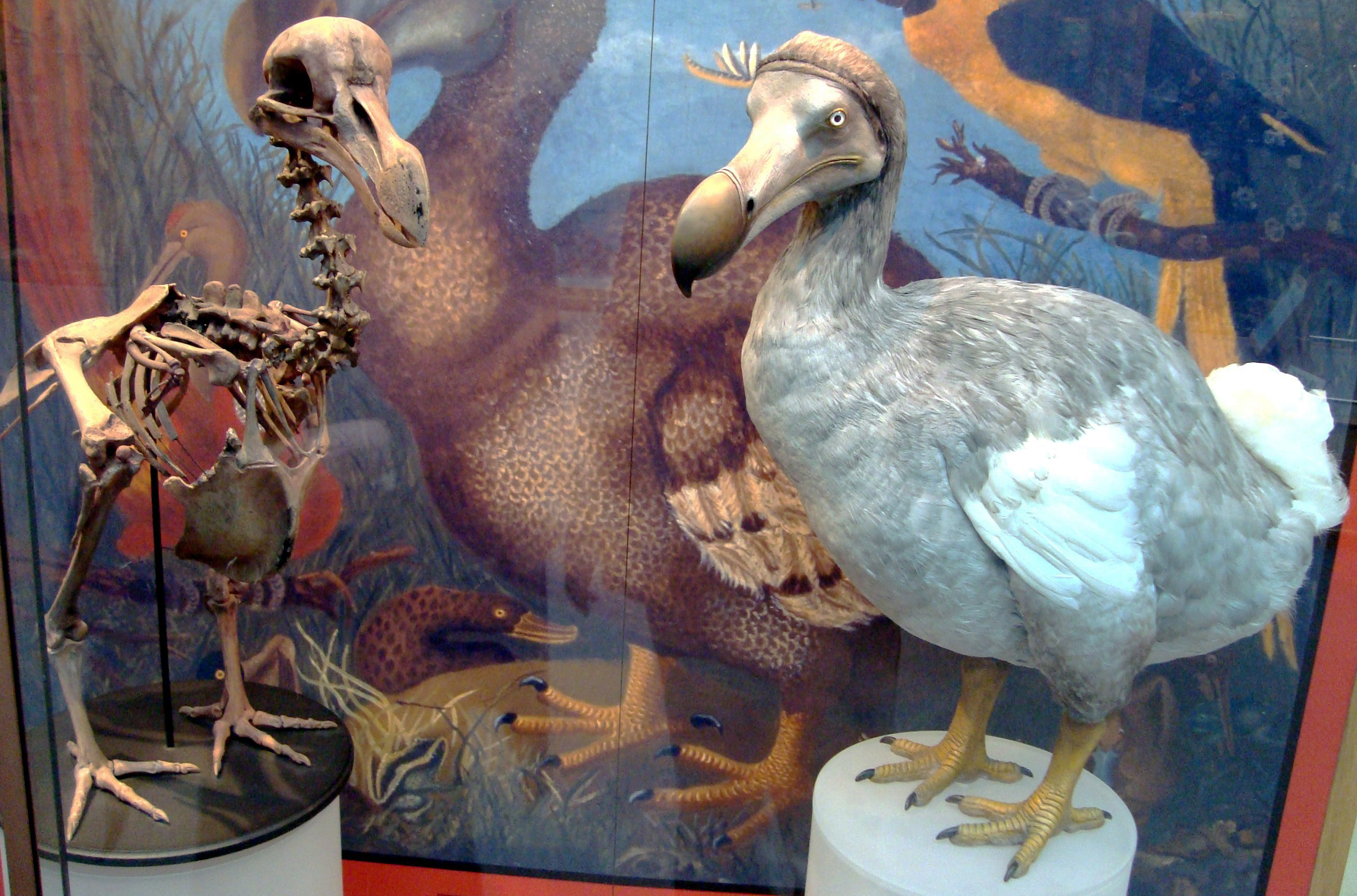
Image: Category:Taxidermied Raphus cucullatus - Wikimedia Commons (CC BY-SA)
About Dodo
The Dodo, scientifically classified as Raphus cucullatus, was a remarkable flightless bird endemic to the isolated Indian Ocean island of Mauritius during the Quaternary period, specifically existing until the late seventeenth century. Representing one of the most universally recognized and poignant examples of human-induced extinction, this highly derived member of the pigeon and dove family thrived in a predator-free environment until the arrival of European explorers. The dodo holds immense scientific and cultural significance, serving as a foundational case study in the fields of paleontology, evolutionary biology, and conservation, illustrating the extreme vulnerability of endemic island species to rapid ecological disruptions.
Standing approximately one meter tall and weighing an estimated ten to twenty kilograms, the dodo possessed a highly distinctive and robust physical anatomy that diverged significantly from its flying ancestors. Its body was heavy and ground-dwelling, supported by stout, powerful yellow legs that were well-adapted for navigating the dense, uneven terrain of the Mauritian forest floor. The most striking anatomical feature of the dodo was its massive, bulbous beak, which measured up to twenty-three centimeters in length and ended in a sharp, prominent hook. This specialized beak, which featured a naked skin patch at the base, was likely utilized for foraging, manipulating large food items, and potentially for intraspecific combat or defense. Historical accounts and contemporary paintings suggest that the dodo was covered in soft, greyish-brown plumage, with a lighter underbelly and a tuft of curly, light-colored feathers forming its tail. Its wings were drastically reduced in size, possessing primary feathers that were little more than stiff, rudimentary quills, rendering the bird entirely incapable of flight. The sternum of the dodo lacked the pronounced keel found in flying birds, a clear anatomical adaptation to its terrestrial lifestyle. While early European paintings often depicted the dodo as exceedingly fat and clumsy, modern paleontological reconstructions and biomechanical analyses of its skeletal remains suggest a much more athletic and upright posture. The perceived obesity in historical depictions may have been the result of artists painting overfed captive specimens or observing the birds during a specific seasonal cycle when they naturally accumulated fat reserves to survive the dry season. Compared to modern animals, the dodo was essentially a giant, ground-dwelling pigeon that had undergone extreme morphological changes due to the phenomenon of island gigantism, a process where isolated animals evolve larger body sizes in the absence of mammalian predators and competitors.
The paleobiology of the dodo reflects a species intimately adapted to the specific environmental rhythms of its island home. It was primarily an omnivore, with a diet heavily reliant on the abundant fallen fruits, large nuts, and seeds provided by the native Mauritian canopy. Historical records and fossil evidence indicate that the dodo regularly ingested small stones, known as gastroliths, which were retained in its muscular gizzard to help grind up and digest tough plant materials and hard-shelled nuts. In addition to plant matter, it is highly probable that the dodo opportunistically consumed small invertebrates, such as insects and terrestrial crustaceans, to supplement its protein intake. Because Mauritius lacked any significant terrestrial predators before human arrival, the dodo exhibited a profound lack of natural fear toward novel threats, a behavioral trait commonly referred to as island tameness. This lack of an anti-predator response made them incredibly docile and approachable. In terms of locomotion, biomechanical studies of the dodo's robust femur and tibiotarsus indicate that it was capable of moving with surprising agility and speed when necessary, contradicting the popular myth of a slow, lumbering creature. Growth patterns inferred from bone histology suggest that the dodo grew rapidly to reach maturity, a common trait in birds, but its reproductive strategy was likely characteristic of a K-selected species. It is believed that the dodo laid only a single egg per breeding season, which was incubated in a simple depression on the forest floor. This low reproductive rate, combined with ground-nesting behavior, was perfectly sustainable in a pristine, predator-free ecosystem but became a fatal biological vulnerability once invasive mammalian predators were introduced to the island.
During the Holocene epoch, the ecological context of Mauritius provided a unique and stable sanctuary for the dodo and a host of other highly specialized endemic species. Mauritius is a relatively young volcanic island, characterized by rugged topography and, prior to human colonization, dense, unbroken tropical forests that extended from the coastal plains to the mountainous interior. The climate was tropical, marked by distinct wet and dry seasons, and periodically subjected to severe cyclones. Within this environment, the dodo occupied a prominent position in the terrestrial food web as a primary consumer and a major ground-level frugivore. It co-existed with a bizarre and unique assemblage of endemic fauna, including the giant Mauritian tortoises of the genus Cylindraspis, the flightless broad-billed parrot, the Mauritian giant skink, and the Mauritian red rail. In the absence of large herbivorous mammals, the dodo and the giant tortoises filled the ecological niche of large terrestrial browsers and scavengers of fallen fruit. Ecologically, the dodo likely played a critical role as a seed disperser for various endemic Mauritian plants. By consuming whole fruits and passing the seeds through its digestive tract, the dodo would have facilitated the germination and geographical spread of native flora across the island. The intricate web of ecological relationships on Mauritius had evolved in complete isolation for millions of years, creating a highly specialized but exceedingly fragile ecosystem that was entirely unprepared for the sudden arrival of humans and their associated domestic and commensal animals.
The discovery history of the dodo is inextricably linked to the era of European global exploration and the expansion of maritime trade routes. The bird was first definitively documented by Dutch sailors under the command of Vice-Admiral Wybrand van Warwijck, who landed on the uninhabited island of Mauritius in 1598 during an expedition to the East Indies. The sailors, exhausted and in need of provisions, found the large, flightless birds to be an easy and abundant source of fresh meat. The Dutch initially named the bird the Walghvogel, which roughly translates to tasteless or unpalatable bird, as they found the meat tough and less desirable compared to the native pigeons and parrots, though they still consumed it in large quantities. The origin of the name dodo is heavily debated; it may derive from the Dutch word dodaars, referring to a knot of feathers on the hindquarters, or from the Portuguese word doudo, meaning foolish or crazy, reflecting the bird's lack of fear toward the sailors. Over the next few decades, Mauritius became a frequent stopover point for ships traversing the Indian Ocean. The sailors hunted the dodo relentlessly, but the most devastating blow to the species came from the animals the Europeans brought with them. Pigs, macaques, dogs, and rats were introduced to the island, where they quickly multiplied and decimated the dodo populations by preying on the vulnerable ground nests, consuming eggs and chicks. The combination of direct human hunting, habitat destruction through deforestation, and the catastrophic impact of invasive species led to a rapid population collapse. The last widely accepted sighting of a living dodo was recorded by the shipwrecked mariner Volkert Evertsz in 1662, though some statistical analyses of historical records suggest the species may have persisted in remote parts of the island until around 1690. Regardless of the exact year, less than a century after its discovery, the dodo was driven to complete extinction. The only physical remains of the dodo that survived into the modern era from living specimens were a dried head and a foot, which were part of the Tradescant collection and eventually housed at the Oxford University Museum of Natural History.
The evolutionary significance of the dodo lies in its remarkable demonstration of how extreme isolation can drive profound morphological and behavioral changes in a species. For centuries, the exact taxonomic placement of the dodo was a subject of intense speculation, with early naturalists proposing relationships to ostriches, vultures, penguins, and even albatrosses. However, modern genetic studies, notably a landmark 2002 analysis of mitochondrial DNA extracted from the Oxford specimen, definitively confirmed that the dodo was a highly derived member of the pigeon and dove family, Columbidae. The genetic evidence revealed that the dodo's closest living relative is the Nicobar pigeon, a spectacular, ground-foraging bird native to the Andaman and Nicobar Islands and the Malay Archipelago. The dodo's closest extinct relative was the Rodrigues solitaire, another large, flightless pigeon that inhabited the nearby island of Rodrigues and suffered a similar fate at the hands of human colonists. The evolutionary lineage leading to the dodo is believed to have diverged from its flying ancestors tens of millions of years ago. It is hypothesized that a flock of these ancestral pigeons was blown off course by a storm and landed on the newly formed volcanic island of Mauritius. Finding an environment rich in food resources and completely devoid of predators, the birds gradually lost the ability to fly. Flight is an extremely energy-intensive mechanism, and in the absence of a need to escape predators or migrate, natural selection favored individuals that redirected that energy into larger body size and enhanced terrestrial foraging capabilities. The dodo thus represents a spectacular example of insular evolution, showcasing transitional features such as the reduction of the pectoral girdle and the strengthening of the pelvic girdle, providing crucial insights into the mechanisms of evolutionary adaptation.
Despite its fame, the dodo has been the subject of numerous scientific debates and controversies, many of which stem from the scarcity of physical evidence and the unreliability of historical accounts. One of the most prominent debates concerns the actual physical appearance and body mass of the living bird. For centuries, the dodo was universally depicted as a grossly overweight and clumsy creature, a perception heavily influenced by the paintings of Roelant Savery and other seventeenth-century artists. However, modern paleontologists, such as Andrew Kitchener, have challenged this view, using skeletal measurements to argue that the wild dodo was much leaner and more athletic, weighing closer to ten kilograms rather than the twenty or more suggested by historical paintings. Another significant controversy revolves around the ecological relationship between the dodo and the tambalacoque tree, also known as the dodo tree. In 1977, ecologist Stanley Temple proposed that the seeds of the tambalacoque required passage through the dodo's digestive tract to germinate, and that the tree was facing extinction because its primary seed disperser was gone. While this hypothesis gained widespread popular attention as a neat ecological parable, it has been heavily criticized and largely debunked by subsequent botanical research, which demonstrated that tambalacoque seeds can germinate without dodo intervention and that other endemic species, such as giant tortoises, likely played a similar dispersal role. Furthermore, the exact timeline of the dodo's extinction remains a subject of statistical debate, with researchers like David Roberts and Andrew Solow applying probabilistic models to historical sighting records to estimate the most likely date of the final disappearance of the species.
The fossil record of the dodo is almost entirely restricted to the island of Mauritius, and for a long time, it was remarkably sparse. Following the bird's extinction, its physical remains were largely lost to history until the mid-nineteenth century. In 1865, a local schoolmaster named George Clark made a monumental discovery when he unearthed hundreds of dodo subfossils in a marshy area known as the Mare aux Songes in southeastern Mauritius. This swamp acted as a natural trap over thousands of years, preserving the bones of dodos and other endemic fauna in an anoxic environment. The Mare aux Songes remains the most important and prolific site for dodo fossils, yielding thousands of individual bones that have allowed paleontologists to reconstruct the bird's skeletal anatomy in great detail. However, the vast majority of these remains are disarticulated, meaning that nearly all museum displays of dodo skeletons are composites made from the bones of multiple individuals. The only known associated skeletons, where the bones belonged to a single individual bird, were discovered in the early twentieth century by an amateur naturalist named Etienne Thirioux, who found them in caves and ravines near Le Pouce mountain. In 2005, an international team of Mauritian and European researchers reopened excavations at the Mare aux Songes, uncovering a wealth of new, highly preserved material, including bones from juvenile dodos and associated flora and fauna, which has provided unprecedented insights into the paleoecology of the Mauritian ecosystem just prior to human arrival.
The cultural impact of the dodo is arguably greater than that of any other extinct animal, save perhaps the non-avian dinosaurs. It has become a universal symbol of extinction and human-caused ecological disaster, permanently embedded in the English language through the idiom dead as a dodo. The bird achieved global literary immortality when author Lewis Carroll featured it as a character in his 1865 classic, Alice's Adventures in Wonderland, a depiction that was directly inspired by the dodo remains housed at the Oxford University Museum of Natural History. Today, the dodo serves as a powerful educational tool and a mascot for the global conservation movement, reminding humanity of the permanent consequences of environmental exploitation and the profound fragility of the natural world.
Classification
Time Period
Discovery
Location
Mauritius
Formation
Mare aux Songes
Frequently Asked Questions
What is Dodo?
The Dodo, scientifically classified as Raphus cucullatus, was a remarkable flightless bird endemic to the isolated Indian Ocean island of Mauritius during the Quaternary period, specifically existing until the late seventeenth century. Representing one of the most universally recognized and poignant...
When did Dodo live?
Dodo lived during the quaternary period of the cenozoic era approximately 0.01-0 million years ago.
Where was Dodo discovered?
Fossils of Dodo were discovered in Mauritius in the Mare aux Songes.
What did Dodo eat?
Dodo was a omnivore. It lived in terrestrial habitats.
What type of fossil is Dodo?
Dodo is preserved as a body fossil. The preservation quality is good.
Related Specimens
From the cenozoic era · body fossils