Dunkleosteus
Dunkleosteus terrelli
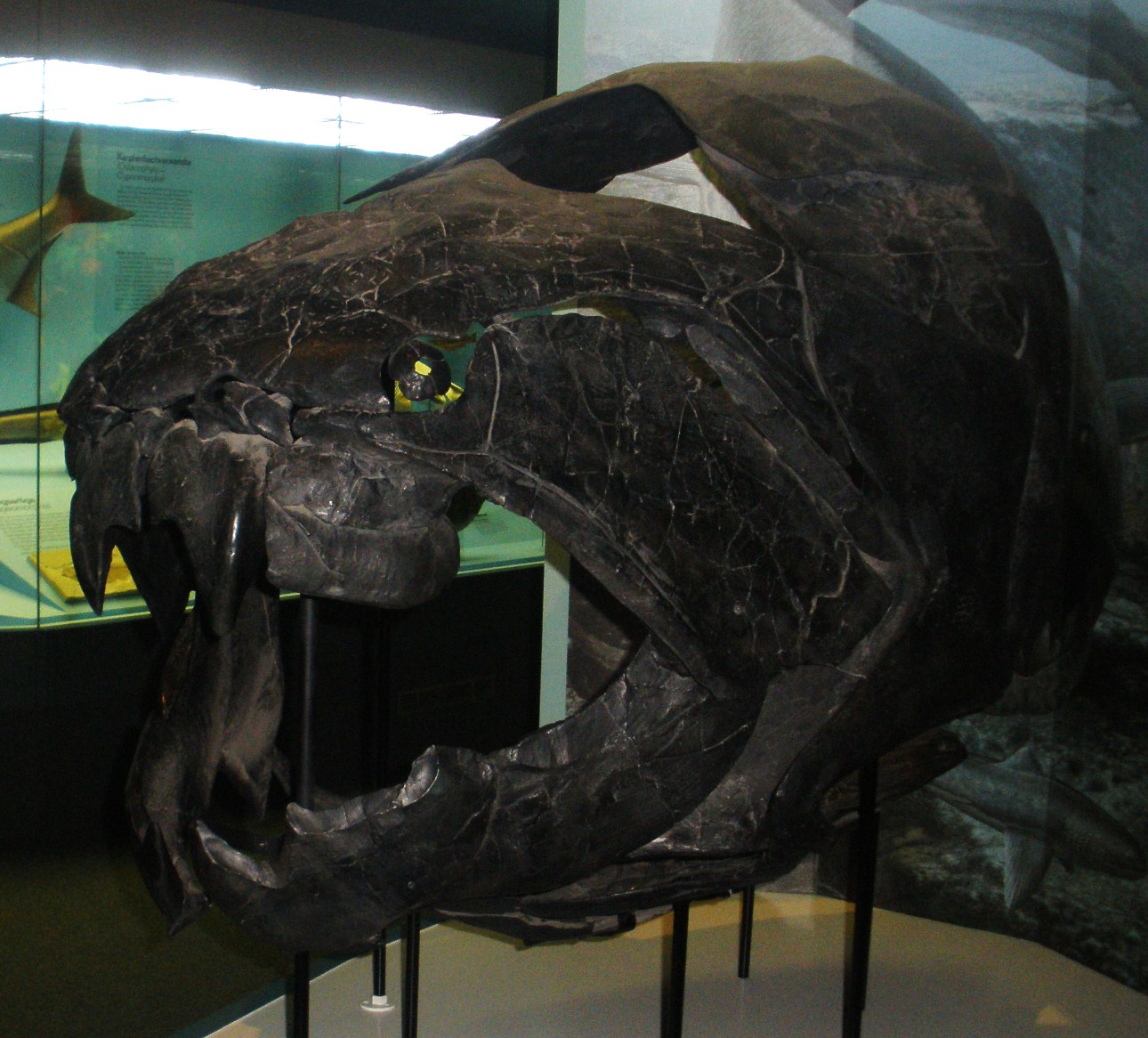
Image: File:Dunkleosteus terrelli (fossil).jpg - Wikimedia Commons (CC BY-SA)
About Dunkleosteus
Dunkleosteus terrelli was a massive, armored placoderm fish that terrorized the shallow seas of the Late Devonian period, approximately 382 to 358 million years ago. As the undisputed apex predator of its marine ecosystem, it represents the absolute pinnacle of early vertebrate gigantism and the rapid diversification of jawed fishes during a time often referred to as the Age of Fishes. Its heavily ossified skull and thoracic shields provide invaluable insights into the anatomy, feeding mechanics, and evolutionary history of early gnathostomes, or jawed vertebrates. By studying this formidable creature, paleontologists have been able to piece together the complex ecological dynamics of Paleozoic oceans and understand the evolutionary innovations that allowed early vertebrates to dominate their environments. Dunkleosteus stands as a testament to a highly successful but ultimately doomed lineage of armored fishes that left no living descendants, making its fossilized remains crucial for understanding the broader narrative of vertebrate evolution on Earth.
Dunkleosteus terrelli is renowned for its formidable physical characteristics, most notably its heavily armored head and thorax, which set it apart from almost all living marine predators. Reaching estimated lengths of up to 600 centimeters, or roughly twenty feet, and weighing an estimated one to two tons, it was one of the largest arthrodire placoderms to have ever existed. Unlike modern fishes, the anterior portion of its body was encased in a thick, bony carapace composed of interlocking plates that could be up to five centimeters thick in mature adults. This armor provided both protection against other large predators and crucial structural support for its massive jaw musculature. The posterior portion of the body, however, was cartilaginous and lacked heavy scales, which is why it is rarely preserved in the fossil record. Paleontologists reconstruct its tail and posterior body based on smaller, related arthrodires like Coccosteus, suggesting a powerful, heterocercal tail similar to that of modern pelagic sharks. This tail structure would have provided the necessary thrust to propel its massive bulk through the water. The most distinctive feature of Dunkleosteus was its lack of true teeth. Instead, it possessed two pairs of massive, self-sharpening bony plates, known as gnathal plates, that extended from its jaws to form a devastating, beak-like structure. As the animal opened and closed its mouth, these plates rubbed against one another, maintaining a razor-sharp edge capable of shearing through bone and armor. The skull itself was highly kinetic, featuring a unique four-bar linkage mechanism in the jaw joints that allowed the upper jaw to lift simultaneously as the lower jaw dropped, a mechanical marvel of the Devonian seas.
The paleobiology of Dunkleosteus terrelli reveals a highly specialized and devastatingly effective apex predator equipped with some of the most extreme feeding adaptations in vertebrate history. Biomechanical studies, notably those conducted by researchers such as Philip Anderson and Mark Westneat in 2006, indicate that its jaw could open in a mere fraction of a second, approximately one-fiftieth of a second. This rapid expansion of the buccal cavity created a powerful suction force, drawing water and unsuspecting prey directly into its gaping maw. Once the prey was inside, the jaw snapped shut with an immense bite force, estimated to be as high as 6000 Newtons at the tip of the fangs and over 7400 Newtons at the blade edge. This bite force is comparable to that of modern crocodilians and large predatory dinosaurs like Tyrannosaurus rex, making it one of the most powerful bites in the history of the animal kingdom. This extraordinary mechanical advantage allowed Dunkleosteus to shear through the thick dermal armor of other placoderms, large arthropods, ammonites, and early sharks. Fossilized boluses, or regurgitated pellets, found in association with Dunkleosteus remains contain partially digested, chewed bones of other fishes, including smaller members of its own species. This provides direct evidence of its carnivorous and potentially cannibalistic diet, indicating that it would consume anything it could fit into its mouth. The rapid growth patterns of Dunkleosteus have been studied through bone histology, revealing that it grew quickly during its juvenile stages to reach a size refuge from other predators, before its growth slowed significantly in adulthood. The heavy anterior armor suggests that while it was capable of bursts of high speed to ambush prey, it was likely not a sustained pursuit predator, relying instead on stealth, suction, and overwhelming bite force to secure its meals.
During the Late Devonian period, Dunkleosteus terrelli inhabited the shallow, subtropical epicontinental seas that covered much of what is now North America. The specific environment represented by the Cleveland Shale formation in Ohio was a stratified marine basin with a well-oxygenated upper water column and an anoxic, or oxygen-depleted, bottom layer. This unique hydrological setup was crucial for the exceptional preservation of its fossils, as the lack of oxygen at the sea floor prevented scavengers and bacteria from destroying the remains. The climate of the Late Devonian was generally warm, promoting a rich and diverse marine ecosystem that supported complex food webs. Dunkleosteus occupied the very top of this food web, acting as the ultimate apex predator and playing a crucial role in controlling the populations of other marine organisms. It coexisted with a wide array of marine life, including early chondrichthyans like the primitive shark Cladoselache, which likely served as both a competitor for smaller prey and a food source for adult Dunkleosteus. The waters were also teeming with other placoderms, such as the massive, bottom-dwelling Titanichthys, which, despite its large size, was a filter feeder and potentially fell victim to the shearing jaws of Dunkleosteus. Acanthodians, or spiny sharks, and early ray-finned fishes were abundant, providing a steady food source for the diverse predatory guilds of the time. The presence of Dunkleosteus in this ecosystem highlights the evolutionary arms race of the Devonian, where the development of heavy dermal armor in potential prey species was met with the evolution of increasingly powerful crushing and shearing jaw mechanics in apex predators.
The discovery history of Dunkleosteus terrelli is deeply intertwined with the early days of North American vertebrate paleontology and the exploration of the continent's ancient geology. The first major fossils of this formidable predator were discovered in the late nineteenth century, specifically in 1867, along the shores of Lake Erie in the Cleveland Shale formation of Ohio, USA. The initial discoveries were made by Jay Terrell, an amateur paleontologist and local hotel owner, who uncovered the massive, fossilized bony plates weathering out of the dark shale cliffs. Terrell brought these findings to the attention of the scientific community, and the type species was eventually named in his honor to recognize his contributions to paleontology. Originally, the specimens were classified under the genus Dinichthys, meaning terrible fish, by the prominent paleontologist John Strong Newberry in 1873. For decades, the fossils were known as Dinichthys terrelli, and the name became synonymous with Devonian marine terror. However, as more complete specimens were discovered and the anatomical differences between various arthrodires became clearer, it was recognized that the Cleveland Shale specimens represented a distinct genus separate from the original Dinichthys type specimens. In 1956, the paleontologist Jean-Pierre Lehman established the new genus Dunkleosteus to accommodate these fossils. The genus name honors David Dunkle, a highly respected former curator of vertebrate paleontology at the Cleveland Museum of Natural History, who made significant contributions to the study of Devonian fishes. The Cleveland Museum of Natural History remains the premier repository for Dunkleosteus fossils, housing the famous specimen CMNH 5768, which features a nearly complete, beautifully preserved skull that has become the iconic representation of the species worldwide.
The evolutionary significance of Dunkleosteus terrelli cannot be overstated, as it represents the absolute peak of placoderm evolution and a critical juncture in the history of vertebrate life. Placoderms were among the earliest jawed vertebrates, or gnathostomes, and their emergence marked a pivotal moment in evolutionary biology. Before the evolution of jaws, vertebrates were limited to filter-feeding or scavenging as jawless agnathans, restricted in their ecological roles and dietary options. The development of articulated jaws, derived from modified gill arches, allowed early fishes to actively pursue, capture, and process a much wider variety of prey, leading to a massive radiation of forms during the Devonian period. Dunkleosteus exemplifies the extreme specialization possible within this new anatomical paradigm. Its highly modified jaw structure, lacking true teeth but utilizing self-sharpening bony plates, demonstrates an alternative evolutionary pathway to the dentition seen in modern sharks and bony fishes. Despite their incredible success, global distribution, and immense diversity, the placoderms, including the mighty Dunkleosteus, were an ultimately doomed class of animals. They went entirely extinct during the end-Devonian mass extinction events, approximately 358 million years ago, leaving no living descendants. The exact causes of this extinction are still debated but likely involved severe fluctuations in global climate, widespread ocean anoxia, and rapid sea-level changes associated with the Kellwasser and Hangenberg events. The demise of the placoderms cleared the ecological stage for the subsequent rise and diversification of chondrichthyans and osteichthyans, the cartilaginous and bony fishes that dominate the world's oceans today. Thus, Dunkleosteus stands as a magnificent evolutionary dead end, a testament to a bygone era of armored leviathans.
Throughout its history of study, Dunkleosteus terrelli has been the subject of several scientific debates, most notably concerning its maximum size, body proportions, and exact taxonomic placement within the arthrodire family tree. For many years, popular literature and even some scientific publications cited lengths of up to ten meters for the largest individuals, based on linear extrapolations from the massive skull plates compared to modern fishes. However, more recent and rigorous morphometric analyses, such as those published by researcher Russell Engelman in 2023, have challenged these colossal estimates. By comparing the proportions of the skull to the complete body fossils of smaller, closely related arthrodires like Coccosteus, researchers now suggest that Dunkleosteus was likely much shorter and more robustly built than previously thought, with maximum lengths closer to four or five meters. This shorter, stockier build would have made it a more powerful, albeit less elongated, swimmer, fundamentally changing our understanding of its locomotion and pursuit capabilities. Additionally, the taxonomy of the family Dunkleosteidae has undergone numerous revisions over the decades. Paleontologists continually debate the phylogenetic relationships between Dunkleosteus and other giant arthrodires found globally, such as those from the Gogo Formation in Australia or the Devonian deposits of Morocco. The exact boundaries of the genus and the number of valid species remain active areas of research, as new discoveries and advanced imaging techniques prompt re-evaluations of historical specimens.
The fossil record of Dunkleosteus terrelli is heavily biased toward the preservation of its massive, heavily ossified anterior armor, while the cartilaginous post-cranial skeleton is almost entirely absent from the geological record. Despite this taphonomic limitation, the quality of preservation in the skull and thoracic shields is often exceptional, particularly in the Cleveland Shale of Ohio. The anoxic bottom waters of this Late Devonian basin prevented scavengers from disturbing the carcasses and inhibited bacterial decay, allowing the bony plates to fossilize in incredible three-dimensional detail. While Ohio remains the most famous and prolific locality for Dunkleosteus terrelli, fossils attributed to the broader genus Dunkleosteus have a surprisingly broad geographic distribution. Remains have been discovered in Devonian strata across North America, Europe, and northern Africa, specifically in regions like the Anti-Atlas mountains of Morocco, Poland, and Belgium. This widespread distribution indicates that Dunkleosteus and its close relatives were highly successful, pelagic predators capable of traversing vast oceanic distances and adapting to various marine environments. The abundance of specimens, ranging from small juveniles to massive, heavily scarred adults, provides paleontologists with a rare opportunity to study the ontogeny, or growth and development, of a Paleozoic apex predator in remarkable detail.
Beyond the realm of academic paleontology, Dunkleosteus terrelli has made a profound cultural impact, capturing the public imagination as a quintessential prehistoric sea monster. Its terrifying, toothless grin and heavily armored visage make it a popular subject in nature documentaries, paleontology books, and video games, where it is often featured as the ultimate terror of the ancient oceans. Casts of the iconic Cleveland Museum of Natural History skull are displayed in natural history museums worldwide, serving as powerful educational tools to teach the public about the Devonian period, the evolution of jaws, and the harsh reality of mass extinction. Dunkleosteus stands as a visceral reminder of the deep history of our planet, inspiring awe and curiosity about the bizarre, magnificent creatures that once ruled its waters long before the first dinosaurs walked the earth.
Classification
Time Period
Discovery
Location
Ohio, USA
Formation
Cleveland Shale
Frequently Asked Questions
What is Dunkleosteus?
Dunkleosteus terrelli was a massive, armored placoderm fish that terrorized the shallow seas of the Late Devonian period, approximately 382 to 358 million years ago. As the undisputed apex predator of its marine ecosystem, it represents the absolute pinnacle of early vertebrate gigantism and the rap...
When did Dunkleosteus live?
Dunkleosteus lived during the devonian period of the paleozoic era approximately 382-358 million years ago.
Where was Dunkleosteus discovered?
Fossils of Dunkleosteus were discovered in Ohio, USA in the Cleveland Shale.
What did Dunkleosteus eat?
Dunkleosteus was a carnivore. It lived in marine habitats.
What type of fossil is Dunkleosteus?
Dunkleosteus is preserved as a permineralized fossil. The preservation quality is excellent.
Related Specimens
From the paleozoic era · permineralized fossils