Herrerasaurus
Herrerasaurus ischigualastensis
Image: File:Herrerasaurus ischigualastensis.jpg - Wikimedia Commons (CC BY-SA)
About Herrerasaurus
Herrerasaurus ischigualastensis represents one of the earliest and most primitive known dinosaurs, roaming the terrestrial landscapes of the Late Triassic period approximately 231.4 million years ago. Discovered in the fossil-rich Ischigualasto Formation of San Juan Province, Argentina, this ancient predator provides a critical window into the dawn of dinosaur evolution. As a basal member of the dinosaur family tree, Herrerasaurus offers invaluable insights into the anatomical and ecological foundations that allowed dinosaurs to eventually dominate the Mesozoic Era. By studying this remarkable creature, paleontologists can trace the initial evolutionary radiation of dinosaurs, demonstrating how these early predators adapted to their environments long before they achieved global dominance in the Jurassic and Cretaceous periods.
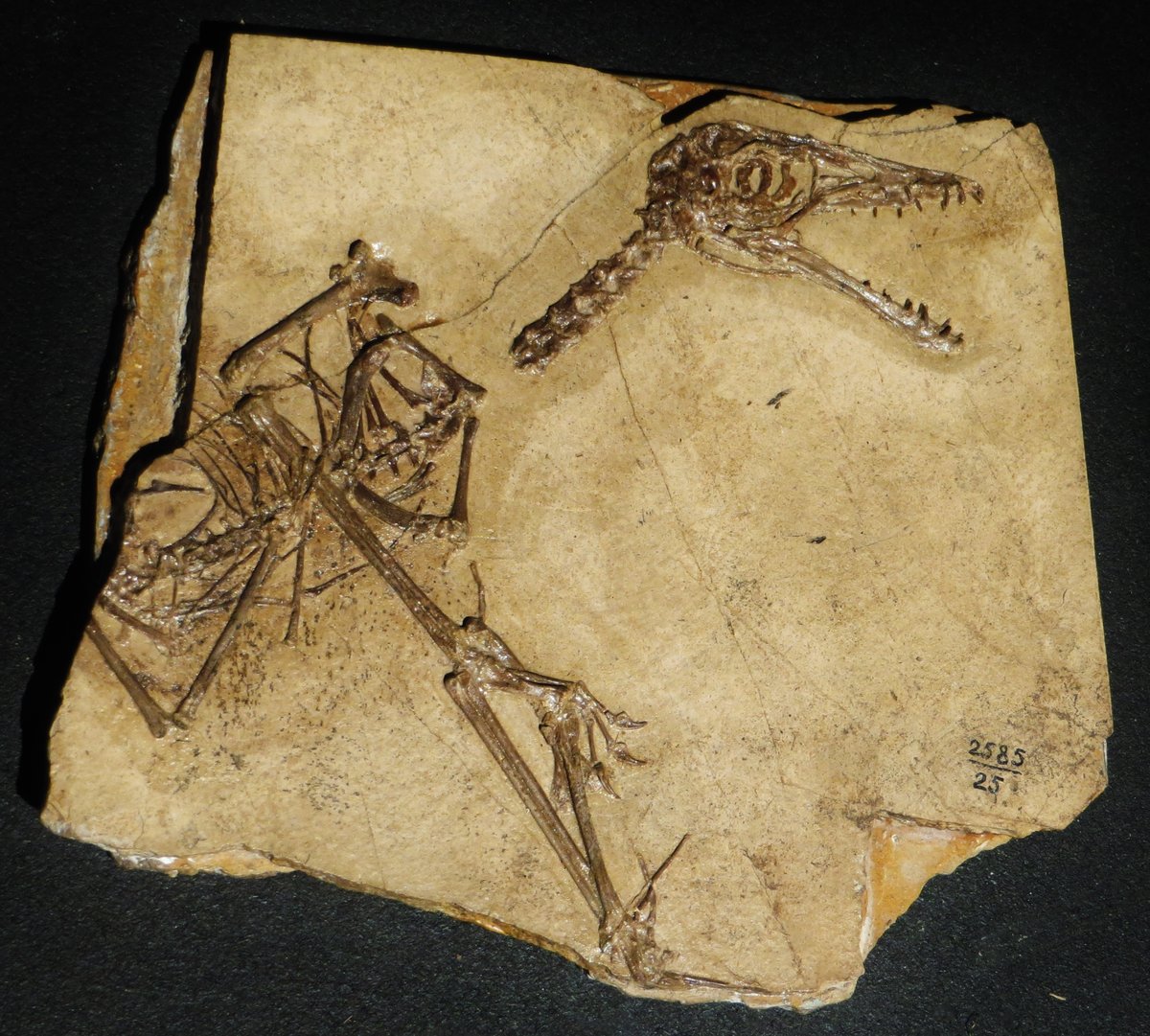
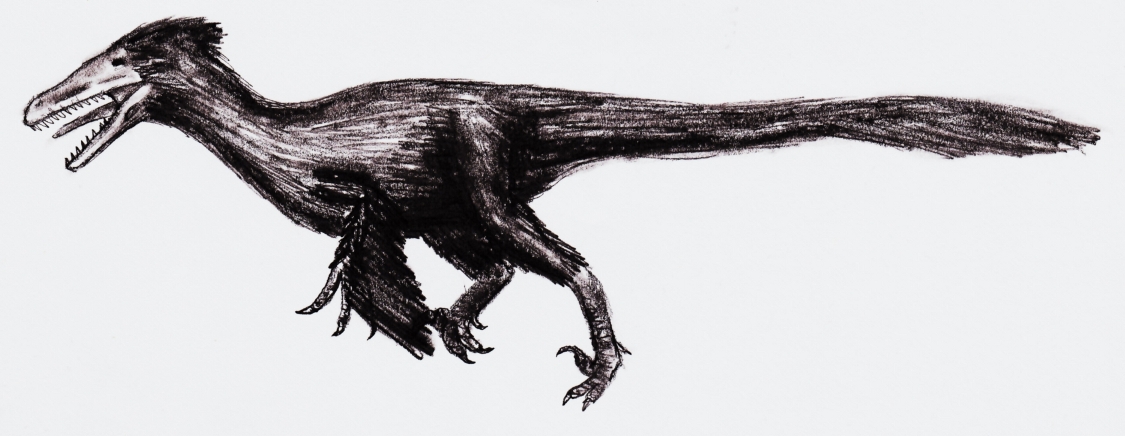
Measuring roughly 4.5 to 6 meters in length and weighing an estimated 250 to 350 kilograms, Herrerasaurus was a formidable bipedal predator for its time, dwarfing many of its contemporaries. Its anatomy was a fascinating mosaic of primitive and advanced traits. The skull of Herrerasaurus was long, narrow, and heavily built, measuring up to 56 centimeters in length in the largest adult specimens. It lacked the extensive weight-saving fenestrae seen in later theropods, making its cranium relatively robust and solid. The jaws were lined with large, serrated, recurved teeth designed for slicing through flesh and bone. A highly distinctive feature of Herrerasaurus was its specialized sliding lower jaw joint, an intramandibular hinge that allowed the mandible to flex and grasp struggling prey with a vice-like grip. The postcranial skeleton was equally specialized. Its forelimbs were relatively short, being less than half the length of its hindlimbs, but they were powerfully built. The hands possessed five digits, but only the first three ended in large, curved, sharp claws used for grasping and subduing prey; the fourth and fifth digits were reduced and clawless stubs. The hindlimbs were long and muscular, indicating a strong capacity for running. The foot had a fully developed ankle joint that allowed for an upright, digitigrade stance, a hallmark of dinosaurian locomotion. The tail was stiffened by overlapping vertebral projections, acting as a dynamic counterbalance during rapid pursuit. In comparison to modern animals, its build might loosely resemble a heavily scaled, long-tailed flightless bird crossed with a crocodilian, though such analogies fall short of capturing its unique early dinosaurian morphology.
As an obligate carnivore, Herrerasaurus employed a combination of speed, agility, and specialized anatomical tools to secure its diet. Its long, muscular hind legs suggest it was an active pursuit predator capable of short, rapid bursts of speed to run down prey across the Triassic floodplains. Once within striking distance, Herrerasaurus likely used its strong, clawed forelimbs to grapple with victims, while its flexible lower jaw and serrated teeth delivered fatal, slicing bites. The sliding intramandibular joint would have absorbed the shock of a struggling victim, preventing jaw fractures during violent encounters. Bone histological studies conducted on Herrerasaurus remains have revealed fascinating insights into its growth patterns and metabolism. Cross-sections of its long bones show highly vascularized fibrolamellar bone tissue, indicating a rapid growth rate comparable to later dinosaurs and modern mammals, rather than the slower growth typical of contemporary reptiles. This suggests that Herrerasaurus possessed an elevated metabolic rate, possibly an early form of endothermy or mesothermy, which would have fueled its active, predatory lifestyle. Lines of arrested growth within the bones also indicate that its growth was somewhat seasonal, likely responding to the environmental fluctuations of its habitat. Behaviorally, while there is no direct evidence of pack hunting, the abundance of specimens in certain areas suggests they were at least common components of their ecosystem, solitary hunters patrolling vast territories to sustain their high energy requirements.
During the Carnian age of the Late Triassic, approximately 231.4 million years ago, the landmasses of Earth were locked together in the supercontinent of Pangaea. The Ischigualasto Formation of Argentina, where Herrerasaurus resided, was a seasonally dry, volcanically active floodplain characterized by distinct wet and dry seasons. The landscape was dominated by extensive riparian forests of ferns, horsetails, and towering conifers, interspersed with more open, arid floodplains. In this dynamic environment, Herrerasaurus occupied the role of an apex or mid-level carnivore. It shared its habitat with a diverse array of early archosaurs, synapsids, and other prehistoric creatures. Its primary prey likely included medium-sized herbivores such as the abundant rhynchosaurs, notably Hyperodapedon, and herbivorous cynodonts like Exaeretodon. It also coexisted with other early dinosaurs, such as the smaller, agile predator Eoraptor and the early ornithischian Pisanosaurus. However, Herrerasaurus was not the absolute undisputed ruler of its domain; it had to compete with, and potentially avoid, massive non-dinosaurian predators like the giant rauisuchian Saurosuchus, a quadrupedal apex predator that could reach lengths of over seven meters. The presence of Herrerasaurus in this ecosystem highlights a transitional phase in Earths history, where early dinosaurs were beginning to assert themselves in ecological niches still largely dominated by older lineages of crurotarsan archosaurs and therapsids.
The story of the discovery of Herrerasaurus is as compelling as the animal itself. The first fossil remains were uncovered in 1959 by Victorino Herrera, an Andean goat herder who noticed unusual bones weathering out of the rock in the remote, arid badlands of the Ischigualasto Provincial Park in San Juan Province, Argentina. Herrera brought these findings to the attention of Argentine paleontologist Osvaldo Reig, who recognized their immense scientific value. In 1963, Reig formally described and named the type species Herrerasaurus ischigualastensis, honoring both the observant goat herder and the geological formation where it was found. For decades, Herrerasaurus remained an enigmatic creature known only from fragmentary remains, leading to widespread speculation about its appearance and evolutionary relationships. This changed dramatically in 1988 when a team led by American paleontologist Paul Sereno conducted extensive expeditions in the Ischigualasto Formation. Sereno and his team discovered a nearly complete, articulated skeleton of Herrerasaurus, along with several other partial specimens and a pristine skull. These spectacular finds, published in the early 1990s, provided the first comprehensive look at the anatomy of this early dinosaur. The new material allowed researchers to reconstruct the animal with unprecedented accuracy, resolving many long-standing questions about its morphology and firmly establishing the Ischigualasto Formation as one of the most important Late Triassic fossil sites in the world.
Herrerasaurus holds a place of paramount importance in the study of dinosaur evolution, serving as a crucial reference point near the very base of the dinosaur family tree. Its anatomy is a textbook example of a transitional mosaic, exhibiting a blend of primitive archosaurian characteristics and derived dinosaurian traits. Primitive features include the presence of only two sacral vertebrae, a relatively unspecialized hip structure compared to later dinosaurs, and a completely enclosed acetabulum, or hip socket, which is only partially open unlike the fully open sockets of more advanced dinosaurs. Conversely, it possesses key derived traits that firmly place it within Dinosauria, such as the upright, parasagittal stance, the reduction of digits on the hands and feet, and specific modifications in the ankle joint. For decades, paleontologists have debated its exact phylogenetic placement. Some early analyses suggested it was a basal theropod, representing the earliest radiation of the lineage that would eventually lead to Tyrannosaurus and modern birds. Others argued it was a basal saurischian, predating the split between theropods and the long-necked sauropodomorphs. Still, other researchers have proposed that Herrerasaurus and its close relatives, the Herrerasauridae, might fall entirely outside the core group of true dinosaurs, representing a sister clade of dinosauriformes that evolved parallel traits. Regardless of its exact placement, Herrerasaurus is universally recognized as a vital proxy for the ancestral dinosaur condition, illustrating the anatomical blueprint from which all subsequent dinosaur diversity arose.
The taxonomic classification of Herrerasaurus has been the subject of intense and ongoing scientific debate since its discovery. The core of the controversy lies in its contradictory anatomical features. When Paul Sereno described the complete skull and skeleton in the early 1990s, he argued forcefully that Herrerasaurus was an early theropod, pointing to its bipedalism, carnivorous adaptations, and specific features of the hands and skull. However, subsequent cladistic analyses by other paleontologists, such as Max Langer and Michael Benton, have frequently recovered Herrerasaurus as a basal saurischian, branching off before the theropod-sauropodomorph split. The debate was further complicated in 2017 by a controversial study led by Matthew Baron, which proposed a radical reorganization of the dinosaur family tree, grouping theropods with ornithischians into a new clade called Ornithoscelida. In this revised tree, Herrerasaurus and its kin were placed as basal sauropodomorphs, a hypothesis that sparked vigorous pushback and re-analysis from the broader paleontological community. Beyond taxonomy, debates also exist regarding its paleobiology. While the sliding jaw joint is widely accepted as an adaptation for grasping prey, some biomechanical experts argue about the exact range of motion and the bite force it could generate. Additionally, the extent to which Herrerasaurus was endothermic remains a topic of active research, with some scientists arguing that its growth rings suggest a more intermediate, mesothermic physiology rather than the full endothermy seen in modern birds.
The fossil record of Herrerasaurus is remarkably robust for an animal of its antiquity, though it is geographically restricted. All known specimens of Herrerasaurus ischigualastensis have been recovered from the Ischigualasto Formation in northwestern Argentina, a region often referred to as the Valley of the Moon due to its stark, otherworldly landscapes. To date, paleontologists have unearthed dozens of specimens, ranging from isolated bones and teeth to nearly complete, articulated skeletons. The preservation quality of these fossils is often exceptional, a result of the rapid burial in the volcanic ash and fluvial sediments of the ancient Triassic floodplain. The most famous and scientifically significant of these is the nearly complete skeleton discovered by Paul Sereno in 1988, which includes an intact skull, a rarity for early dinosaurs whose delicate cranial bones are easily crushed or scattered. Other important sites within the formation have yielded juvenile specimens, providing crucial data on the ontogeny and growth trajectories of the species. The concentration of Herrerasaurus fossils in this specific geological window makes the Ischigualasto Formation an unparalleled laboratory for studying the dawn of the dinosaur era, though the lack of Herrerasaurus fossils elsewhere suggests it may have been an endemic species restricted to the southern regions of Pangaea.
Despite being less famous than later giants like Tyrannosaurus or Triceratops, Herrerasaurus has made a significant mark on popular culture and science education. It is frequently featured in museum exhibits around the world as the quintessential early dinosaur, with skeletal mounts and life-sized reconstructions prominently displayed in institutions such as the Field Museum in Chicago and the Bernardino Rivadavia Natural Sciences Argentine Museum in Buenos Aires. In popular media, Herrerasaurus has appeared in various dinosaur documentaries, video games, and numerous educational books, where it is often depicted as a swift, cunning predator of the Triassic. Its cultural importance lies primarily in its educational value, serving as a tangible, accessible example of evolutionary transitions and the deep, complex history of life on Earth.
Classification
Time Period
Discovery
Location
San Juan Province, Argentina
Formation
Ischigualasto Formation
Frequently Asked Questions
What is Herrerasaurus?
Herrerasaurus ischigualastensis represents one of the earliest and most primitive known dinosaurs, roaming the terrestrial landscapes of the Late Triassic period approximately 231.4 million years ago. Discovered in the fossil-rich Ischigualasto Formation of San Juan Province, Argentina, this ancient...
When did Herrerasaurus live?
Herrerasaurus lived during the triassic period of the mesozoic era approximately 231.4 million years ago.
Where was Herrerasaurus discovered?
Fossils of Herrerasaurus were discovered in San Juan Province, Argentina in the Ischigualasto Formation.
What did Herrerasaurus eat?
Herrerasaurus was a carnivore. It lived in terrestrial habitats.
What type of fossil is Herrerasaurus?
Herrerasaurus is preserved as a permineralized fossil. The preservation quality is excellent.
Related Specimens
From the mesozoic era · permineralized fossils