Homo erectus
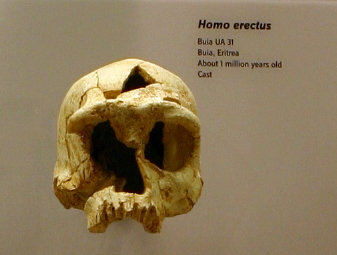
Image: Category:Homo erectus fossils - Wikimedia Commons (CC BY-SA)
About Homo erectus
*Homo erectus*, meaning 'upright man,' is an extinct species of archaic human that represents a pivotal chapter in the story of our own origins. Living from approximately 2 million to as recently as 110,000 years ago, this remarkably successful and long-lived hominin was the first of our ancestors to exhibit a truly modern human-like body plan and to expand its range beyond the confines of the African continent. Its tenure on Earth, spanning the vast majority of the Pleistocene epoch, witnessed profound developments in technology, social behavior, and cognitive ability, laying the essential groundwork for the subsequent evolution of *Homo sapiens*.
The anatomy of *Homo erectus* marks a significant departure from earlier, more ape-like hominins such as the australopithecines. Possessing a body plan strikingly similar to that of modern humans, they stood between 145 and 185 centimeters (approximately 4 feet 9 inches to 6 feet 1 inch) tall and weighed an estimated 40 to 68 kilograms (88 to 150 pounds). This physique was characterized by relatively long legs and shorter arms in proportion to the torso, a clear adaptation for a fully terrestrial, bipedal lifestyle and a definitive move away from the arboreal adaptations of their predecessors. This efficient striding gait would have been crucial for traversing the vast, open landscapes they came to inhabit. The skull, while more robust than that of *Homo sapiens*, showed significant advancements. It featured a long, low cranial vault with a prominent brow ridge (supraorbital torus), a receding forehead, and lacked a distinct chin. The cranial capacity of *Homo erectus* was a key area of evolutionary change, ranging from about 600 cubic centimeters in early specimens to over 1,100 cubic centimeters in later individuals, overlapping with the lower range of modern humans. This brain size, averaging around 900 cubic centimeters, was substantially larger than that of earlier hominins like *Homo habilis* and reflects the increasing cognitive complexity of the species.
The paleobiology of *Homo erectus* reveals a highly adaptable and resourceful omnivore. Their dentition, smaller than that of australopithecines, suggests a diet that included a greater proportion of higher-quality foods, such as meat and marrow, which would have been necessary to fuel their larger, more metabolically expensive brains. Isotopic analysis and archaeological evidence from kill sites confirm that they were active hunters and scavengers, capable of processing large animal carcasses. This dietary shift was facilitated by a revolutionary technological advance: the Acheulean tool industry. Beginning around 1.76 million years ago, *Homo erectus* began crafting sophisticated bifacial tools, most notably the characteristic teardrop-shaped hand axe. These implements were standardized, required significant foresight and skill to produce, and served as versatile multi-tools for butchering animals, woodworking, and digging for tubers. Perhaps the most profound behavioral leap was the controlled use of fire. Evidence from sites like Wonderwerk Cave in South Africa and Gesher Benot Ya'aqov in Israel suggests that by at least 1 million years ago, *Homo erectus* was harnessing fire for warmth, protection from predators, and cooking. Cooking food would have unlocked more nutrients, reduced chewing time, and killed pathogens, potentially acting as a powerful selective pressure for further brain growth and social cohesion around a central hearth. Growth patterns, inferred from the remarkably complete 'Turkana Boy' skeleton, suggest a developmental trajectory intermediate between that of apes and modern humans, reaching maturity faster than *Homo sapiens* but slower than chimpanzees.
*Homo erectus* emerged and thrived during the Pleistocene, an epoch characterized by dramatic climatic fluctuations, including cycles of glacial advances and retreats. As the first truly global hominin, it demonstrated an unprecedented ability to adapt to a wide array of environments, from the tropical savannas of Africa to the temperate woodlands of Eurasia and the humid forests of Southeast Asia. In Africa, they would have shared the landscape with a diverse megafauna, including saber-toothed cats, giant hyenas, and various species of elephants and antelope, positioning themselves as formidable mid-level predators and expert scavengers. As they migrated into Eurasia, they encountered new ecological challenges and different sets of fauna, such as woolly mammoths, cave bears, and deer. Their success in these varied habitats underscores their behavioral flexibility and technological prowess. The ability to create effective tools, control fire, and likely engage in cooperative hunting and food-sharing allowed them to occupy a new and influential niche as a highly adaptable, wide-ranging carnivore-omnivore, fundamentally altering the ecological dynamics of every new environment they entered.
The discovery of *Homo erectus* is a cornerstone of paleoanthropology, beginning in the late 19th century with the determined efforts of Dutch anatomist Eugène Dubois. Inspired by the evolutionary theories of Darwin and Haeckel, Dubois specifically traveled to Southeast Asia in search of a "missing link." In 1891, his team unearthed a fossilized skullcap along the Solo River at Trinil, on the Indonesian island of Java. The following year, a femur was found nearby that was strikingly modern in its anatomy, indicating an upright posture. Convinced he had found an ancient human ancestor, Dubois named the species *Pithecanthropus erectus*, or 'upright ape-man.' His discovery, now known as 'Java Man,' was initially met with skepticism by the scientific community. However, subsequent discoveries in the 1920s and 1930s at Zhoukoudian, China, of similar fossils dubbed *Sinanthropus pekinensis* ('Peking Man'), bolstered the case for this widespread archaic human. Later, a wealth of fossils from Africa, including the iconic 'Turkana Boy' (KNM-WT 15000) discovered in 1984 by Kamoya Kimeu of the Richard Leakey team, solidified the species' place in our lineage and led to the consolidation of these various finds under the single taxonomic designation *Homo erectus*.
In the grand narrative of human evolution, *Homo erectus* occupies a crucial, transitional position. It is widely considered a direct descendant of an earlier species of *Homo*, such as *Homo habilis*, and represents the evolutionary branch from which later, larger-brained hominins, including *Homo heidelbergensis* and ultimately *Homo sapiens*, arose. This species embodies the emergence of the modern human bauplan—the long-legged, fully terrestrial body—and the beginnings of the complex feedback loop between diet, technology, and brain expansion. The migration of *Homo erectus* out of Africa, known as the first major hominin dispersal, was a landmark event. It demonstrated a new level of cognitive and cultural adaptability, requiring the navigation of unfamiliar landscapes, the exploitation of novel food sources, and the endurance of different climatic conditions. This expansion set the stage for the global presence of the genus *Homo*. The species' remarkable longevity, persisting for nearly two million years, stands as a testament to its evolutionary success and its foundational role in shaping the trajectory that would eventually lead to us.
Despite its well-established importance, *Homo erectus* remains the subject of significant scientific debate, primarily concerning its taxonomy. Some paleoanthropologists advocate for a more "split" classification, arguing that the anatomical differences between the early African fossils and the later Asian fossils are significant enough to warrant separate species designations. In this scheme, the African specimens are often assigned to the species *Homo ergaster* ('working man'), with *Homo erectus* being reserved for the Asian populations. Proponents of this view suggest *H. ergaster* was the direct ancestor of later hominins, while Asian *H. erectus* represented a distinct, and ultimately terminal, evolutionary side-branch. Others maintain a "lumped" perspective, viewing the variation across Africa and Asia as intraspecific regional differences within a single, widespread, and polymorphic species, *Homo erectus sensu lato* (in the broad sense). Debates also continue regarding the extent of their cognitive abilities, including the potential for symbolic thought or rudimentary language, for which direct evidence remains elusive.
The fossil record for *Homo erectus* is one of the most extensive for any extinct hominin, with remains discovered across three continents. Major fossil sites are concentrated in East and South Africa (e.g., Olduvai Gorge in Tanzania, Koobi Fora in Kenya), Western Asia (Dmanisi, Georgia), and East and Southeast Asia (Zhoukoudian in China, the Sangiran and Trinil sites in Java, Indonesia). The Dmanisi fossils, dated to around 1.8 million years ago, provide the earliest definitive evidence of hominins outside of Africa. The quality of preservation varies widely, from isolated teeth and skull fragments to remarkably complete skeletons like the 'Turkana Boy,' which has provided unparalleled insights into the species' growth, development, and locomotion. The sheer geographic and temporal breadth of the fossil evidence allows researchers to track the species' evolution over a vast timescale and across diverse ecological settings, making it a cornerstone for understanding human origins.
The profound significance of *Homo erectus* has cemented its place in public consciousness and scientific education. Specimens like 'Turkana Boy' and reconstructions of 'Peking Man' are iconic displays in natural history museums worldwide, serving as powerful visual representations of a deep human past. The species is a staple of documentaries, popular science books, and educational curricula that explore human evolution. Its story—one of innovation, migration, and endurance—captures the imagination and provides a tangible link to the ancient ancestors who first mastered fire, perfected stone tools, and took the first human steps onto the global stage.
Classification
Time Period
Discovery
Location
Java, Indonesia
Formation
Trinil Formation
Frequently Asked Questions
What is Homo erectus?
*Homo erectus*, meaning 'upright man,' is an extinct species of archaic human that represents a pivotal chapter in the story of our own origins. Living from approximately 2 million to as recently as 110,000 years ago, this remarkably successful and long-lived hominin was the first of our ancestors t...
When did Homo erectus live?
Homo erectus lived during the quaternary period of the cenozoic era approximately 2.0-0.1 million years ago.
Where was Homo erectus discovered?
Fossils of Homo erectus were discovered in Java, Indonesia in the Trinil Formation.
What did Homo erectus eat?
Homo erectus was a omnivore. It lived in terrestrial habitats.
What type of fossil is Homo erectus?
Homo erectus is preserved as a body fossil. The preservation quality is good.
Related Specimens
From the cenozoic era · body fossils