Laetoli Footprints
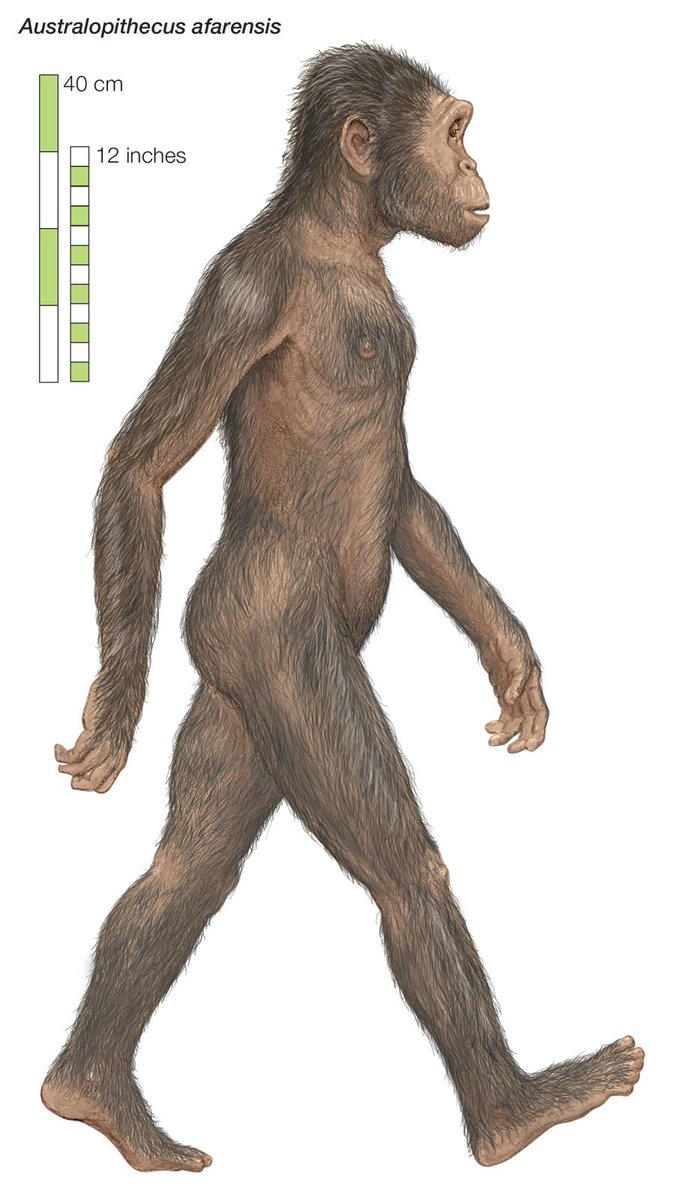
Australopithecus afarensis
Image: Image sourced via web search (Fair use / Educational)
About Laetoli Footprints
The Laetoli Footprints are a series of remarkably preserved hominid footprints discovered in northern Tanzania, providing indisputable evidence of early human ancestors walking fully upright 3.66 million years ago. These trace fossils, attributed to the species Australopithecus afarensis, offer a rare and evocative snapshot of a moment in deep time, capturing the locomotion and social behavior of our distant relatives. Their discovery fundamentally altered our understanding of human evolution, proving that bipedalism was a well-established trait long before the evolution of large brains and tool use.
Australopithecus afarensis, the species credited with making the Laetoli Footprints, was a small-bodied, sexually dimorphic hominid. Males stood approximately 150 cm (4 ft 11 in) tall and weighed around 42 kg (93 lb), while the smaller females averaged about 105 cm (3 ft 5 in) in height and 29 kg (64 lb) in weight. Their anatomy was a mosaic of ape-like and human-like features. They possessed a small brain, with a cranial capacity of about 380–430 cubic centimeters, comparable to that of a modern chimpanzee. Their faces were prognathic, featuring a projecting lower jaw, and they had prominent brow ridges above the eyes. The dental arcade was more rectangular than the parabolic shape seen in modern humans, and their canines were larger, though significantly reduced compared to other apes. However, their post-cranial skeleton reveals a creature well-adapted for upright walking. The pelvis was short and broad, similar to a human's, providing stability for bipedal locomotion. The femur angled inward toward the knee, positioning the feet directly under the body's center of gravity, a key adaptation for efficient walking. While their feet had a pronounced arch and a non-divergent big toe aligned with the other toes—hallmarks of a bipedal gait—they also retained some arboreal adaptations, such as long, curved fingers and toes and a more upward-oriented shoulder joint, suggesting they still spent some time in trees.
The paleobiology of Australopithecus afarensis, as illuminated by the Laetoli tracks and skeletal remains like 'Lucy', points to a versatile and adaptable species. Their locomotion was primarily terrestrial and bipedal, a conclusion cemented by the footprints' clear heel-strike, arch, and toe-off pattern, which is functionally identical to modern human walking. This efficient gait would have been advantageous in the expanding savanna-woodland environments of Pliocene Africa, allowing them to travel longer distances between food patches and carry resources. Their diet was omnivorous and varied, consisting of fruits, nuts, seeds, roots, and likely insects and small vertebrates. Microwear analysis of their teeth suggests they consumed a mix of soft and hard, brittle foods. There is no direct evidence of tool manufacture, but it is plausible they used simple, unmodified tools like sticks or stones. The Laetoli tracks themselves provide a compelling glimpse into social behavior. The primary trackway, Site G, was made by at least three individuals walking in the same direction at the same time. The size differences in the prints suggest they may have been a small social group, possibly a male, a female, and a juvenile, walking together. This implies a degree of social cohesion and group travel, which would have offered protection and facilitated foraging activities in a landscape populated by formidable predators.
The world of Australopithecus afarensis 3.66 million years ago was a mosaic of habitats, shifting from denser woodlands to more open grasslands. The climate of the Pliocene was generally warmer and wetter than today, but with increasing aridity that drove the expansion of savannas. The Laetoli area in Tanzania was a dynamic volcanic landscape. The footprints were preserved in a layer of fine volcanic ash from the nearby Sadiman volcano, which was moistened by a light rain, creating a cement-like consistency that captured the impressions before being buried by subsequent ash falls. This environment supported a rich and diverse fauna. A. afarensis shared this landscape with a wide array of animals, including early elephants (Deinotherium), three-toed horses (Hipparion), saber-toothed cats (Megantereon), hyenas, giraffes, rhinos, and numerous antelope species. As a small hominid, A. afarensis would have occupied a middle position in the food web. They were foragers and opportunistic omnivores, but also potential prey for the large carnivores of the time. Their bipedalism and social structure would have been critical adaptations for navigating this dangerous and competitive ecosystem, allowing them to spot predators from a distance and move efficiently across open terrain.
The discovery of the Laetoli Footprints is a landmark event in the history of paleoanthropology. The initial finds were made in 1976 by paleontologist Andrew Hill, a member of Mary Leakey's expedition team at Laetoli, Tanzania. He stumbled upon animal tracks preserved in the hardened volcanic tuff. It was not until 1978 that Paul Abell, another team member, discovered the now-famous hominid trackway at a site designated 'Site G'. Mary Leakey immediately recognized their profound importance. The team, including geologist Richard Hay, meticulously excavated the 27-meter (88-foot) long trail, revealing the prints of three individuals. The clarity of the prints was astonishing, showing the anatomical details of the foot in motion. The discovery was announced in 1979 and caused a global sensation. It provided the first direct, unequivocal evidence that hominids were fully bipedal millions of years before the emergence of the genus Homo. The prints were attributed to Australopithecus afarensis, the same species as the famous 'Lucy' skeleton (AL 288-1), which had been discovered in Ethiopia just four years earlier by Donald Johanson. The combination of Lucy's skeleton and the Laetoli footprints provided a powerful, complementary picture of this crucial human ancestor.
The evolutionary significance of the Laetoli Footprints cannot be overstated. They provided definitive proof that bipedalism was one of the earliest and most fundamental adaptations in the human lineage, preceding the dramatic encephalization (brain growth) and sophisticated tool-making that would later define the genus Homo. For decades, scientists had debated whether bipedalism evolved before or after large brains. The Laetoli tracks, dated to 3.66 million years ago and made by a hominid with an ape-sized brain, settled this debate decisively. The footprints demonstrated a modern, efficient striding gait, refuting earlier ideas that early hominids walked with a bent-hip, bent-knee shuffle. This adaptation likely freed the hands for carrying food, tools, and infants, a critical step that may have driven subsequent evolutionary changes. Australopithecus afarensis occupies a pivotal position in the human family tree, widely considered a direct ancestor of later australopithecines and the genus Homo, including our own species, Homo sapiens. The Laetoli evidence anchors our understanding of this transition, showing that the foundation of what it means to be human was laid, quite literally, one step at a time on the ancient African savanna.
Despite their clarity, the Laetoli Footprints have been the subject of scientific debate. While the consensus attributes the tracks to Australopithecus afarensis, a minority of researchers have proposed other candidates, such as an unknown hominid species or even an early member of the genus Homo, though the latter lacks fossil evidence from that time period. Another major debate revolves around the interpretation of the Site G trackway. Mary Leakey initially interpreted the prints as being made by two individuals, one of whom stepped in the tracks of the other. Later analysis by Russell Tuttle and others concluded it was three individuals. More recently, a 2016 study proposed that the size variation in the prints indicated a group with one large male and several smaller females, suggesting a polygynous social structure similar to gorillas. In 2022, the discovery of a separate set of footprints at nearby Site S, initially thought to be from a bear, were re-analyzed and attributed to a different A. afarensis individual, further expanding our knowledge of locomotor variation within the species.
The fossil record for the Laetoli Footprints is unique, as it is a trace fossil site rather than a collection of skeletal remains. The primary fossils are the trackways themselves, preserved in the Upper Laetolil Beds in northern Tanzania. The main trackway at Site G is the most famous, but over a dozen other hominid prints have been identified in the area, along with thousands of tracks from other animals. The preservation is exceptional due to the unique geological circumstances: a fall of fine-grained volcanic ash, a light rainfall to create a mud-like consistency, and a rapid burial by another ash layer that protected the prints from erosion. This sequence created a natural mold of the footfalls. After their excavation, the original tracks were re-buried under a protective layer of sand and stone to preserve them from weathering. High-quality casts and 3D digital models are now the primary resources for scientific study. Skeletal remains of Australopithecus afarensis, the likely track-maker, are found at Laetoli and other East African sites, most notably Hadar in Ethiopia.
The Laetoli Footprints have had a profound cultural impact, capturing the public imagination in a way few other fossils have. They represent a tangible, relatable link to our distant past—not just bones, but the record of a family or social group on a journey. This evocative power has made them a centerpiece in museum exhibits on human evolution worldwide. Replicas of the trackway are prominently displayed at the American Museum of Natural History in New York, the Smithsonian National Museum of Natural History in Washington D.C., and the Natural History Museum in London. The footprints are frequently featured in documentaries, books, and educational materials, serving as a powerful symbol of the deep origins of humanity and the long evolutionary path that led to modern humans. They are a poignant reminder that our most basic mode of locomotion connects us directly to ancestors who walked the African plains nearly four million years ago.
Classification
Time Period
Discovery
Location
Tanzania
Formation
Laetoli Beds (Upper Laetolil Beds)
Frequently Asked Questions
What is Laetoli Footprints?
The Laetoli Footprints are a series of remarkably preserved hominid footprints discovered in northern Tanzania, providing indisputable evidence of early human ancestors walking fully upright 3.66 million years ago. These trace fossils, attributed to the species Australopithecus afarensis, offer a ra...
When did Laetoli Footprints live?
Laetoli Footprints lived during the neogene period of the cenozoic era approximately 3.7-3.6 million years ago.
Where was Laetoli Footprints discovered?
Fossils of Laetoli Footprints were discovered in Tanzania in the Laetoli Beds (Upper Laetolil Beds).
What did Laetoli Footprints eat?
Laetoli Footprints was a omnivore. It lived in terrestrial (woodland-savanna) habitats.
What type of fossil is Laetoli Footprints?
Laetoli Footprints is preserved as a trace fossil. The preservation quality is exceptional.
Related Specimens
From the cenozoic era · trace fossils
/bed7088e21a4.png)