Marrella
Marrella splendens
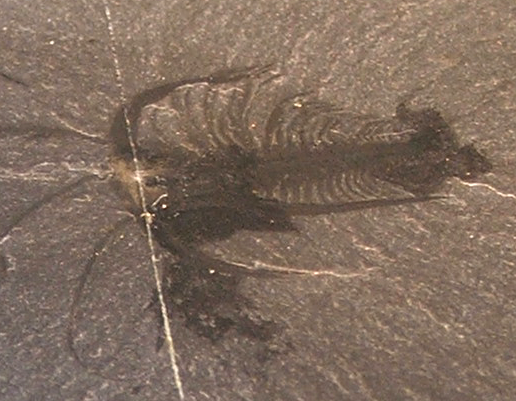
Image: File:Marrella (fossil).png - Wikimedia Commons (CC BY-SA)
About Marrella
Marrella splendens is an extinct species of small, highly distinctive basal arthropod that thrived during the Middle Cambrian period, approximately 505 million years ago. It holds a monumental place in the annals of paleontology as the most abundant fossil ever recovered from the world-renowned Burgess Shale formation in British Columbia, Canada. As a quintessential representative of the Cambrian Explosion, Marrella provides an extraordinary window into a time when complex multicellular life was undergoing a rapid and unprecedented diversification, resulting in bizarre body plans that challenge our modern understanding of animal morphology.
Physically, Marrella was a diminutive creature, with adult specimens typically measuring between 2 and 2.5 centimeters in length, making it roughly the size of a modern thumbnail. Despite its small stature, its anatomy was incredibly complex and visually striking. The most prominent feature of Marrella was its distinctive head shield, which was adorned with two pairs of long, robust, backward-curving spikes or spines. One pair extended outward and backward from the sides of the head, while the other pair swept dramatically upward and backward over the main body, likely providing both protection from predators and stabilization in the water column. Beneath this elaborate head shield, Marrella possessed two distinct pairs of antennae. The first pair was remarkably long, slender, and highly flexible, consisting of over thirty individual segments; these were undoubtedly sensory organs used to probe the environment for chemical and tactile cues. The second pair of antennae was stouter, paddle-like, and densely covered in fine setae, or bristles. The main trunk of the organism consisted of 24 to 26 cylindrical body segments, each of which grew progressively smaller toward the posterior end, terminating in a tiny, button-like telson. Attached to each of these body segments was a pair of biramous, or two-branched, appendages. In a configuration typical of early arthropods, the lower branch formed a jointed walking leg used for navigating the sea floor, while the upper branch consisted of a delicate, feathery gill structure used for respiration. Unlike modern crabs or shrimp, Marrella lacked calcified armor, possessing instead a relatively thin, unmineralized exoskeleton that would have made it lightweight but vulnerable.
In terms of paleobiology, Marrella is generally interpreted as a benthic, or bottom-dwelling, marine organism that made its living as an active scavenger and detritivore. Its primary habitat was the soft, muddy substrate of the shallow Cambrian seas. The creature's feeding strategy likely relied heavily on its specialized second pair of antennae. Paleontologists hypothesize that Marrella used these stout, bristle-covered appendages to sweep the uppermost layer of the sediment, gathering microscopic organic particles, decaying matter, and perhaps tiny, soft-bodied organisms. The setae would have acted like a sieve, trapping food particles and directing them backward toward the mouth, which was located on the underside of the head. Locomotion was achieved primarily through the coordinated movement of its numerous jointed walking legs, allowing it to scuttle across the ocean floor in a manner vaguely reminiscent of modern isopods or centipedes. However, the presence of the large, feathery gill branches and the hydrodynamic shape of its sweeping head spines suggest that Marrella was also capable of short bursts of swimming. By undulating its body and beating its gill flaps, it could likely lift itself into the water column to escape predators or relocate to more resource-rich feeding grounds. Like all arthropods, Marrella grew by molting its rigid exoskeleton. Fossil evidence indicates a continuous growth pattern, with juveniles possessing fewer body segments and proportionally shorter head spines, gradually adding segments and developing more pronounced features with each successive molt until reaching their maximum adult size.
The ecological context of Marrella is inextricably linked to the Middle Cambrian environment of the Burgess Shale, which was situated near the equator on the margins of the ancient continent of Laurentia. The climate was significantly warmer than today, with high sea levels creating expansive, sunlit, shallow marine shelves. Marrella lived at the base of a towering underwater limestone reef, an environment teeming with an astonishing array of early animal life. It shared its habitat with a diverse community of benthic and pelagic organisms, including the heavily armored slug-like Wiwaxia, the five-eyed predator Opabinia, and a multitude of early sponges, brachiopods, and trilobites. Within the Cambrian food web, Marrella occupied a foundational tier. As a primary consumer of detritus, it played a crucial role in recycling organic matter back into the ecosystem. However, its small size and lack of heavy armor made it a prime target for the apex predators of its day. It was undoubtedly preyed upon by the fearsome Anomalocaris, a massive, swimming predator equipped with grasping appendages and a circular, tooth-lined mouth. The abundance of Marrella fossils suggests it relied on a strategy of rapid reproduction and sheer numbers to ensure the survival of its species in an ocean increasingly dominated by newly evolved, highly specialized predators.
The discovery history of Marrella is a cornerstone narrative in the field of paleontology, beginning with the legendary American paleontologist Charles Doolittle Walcott. In the late summer of 1909, while exploring the rugged terrain of Mount Field in Yoho National Park, British Columbia, Walcott stumbled upon a slab of shale containing the exquisitely preserved remains of soft-bodied Cambrian animals. Among the very first fossils he collected was a tiny, spiky creature that he affectionately nicknamed the lace crab due to its delicate, intricate appearance. Walcott formally described the organism in 1912, naming it Marrella splendens in honor of his friend and colleague, Dr. John Edward Marr. Initially, Walcott's interpretation of the creature was heavily influenced by his desire to fit these bizarre Cambrian fossils into known, modern taxonomic categories. He classified Marrella as an unusual type of trilobite, and later as a branchiopod crustacean. It was not until the early 1970s that the true nature of Marrella was revealed. As part of a massive reinvestigation of the Burgess Shale fauna led by Cambridge University, paleontologist Harry Whittington undertook a meticulous, multi-year study of Marrella. Using specialized photographic techniques and camera lucida drawings to analyze the fossils layer by layer, Whittington published a landmark monograph in 1971. He conclusively demonstrated that Marrella was neither a trilobite nor a crustacean, but rather a completely unique, basal arthropod that belonged to an entirely new, extinct class, which was subsequently named Marrellomorpha.
The evolutionary significance of Marrella cannot be overstated, as it fundamentally altered the scientific understanding of arthropod phylogeny and the nature of the Cambrian Explosion. Before Whittington's redescription of Marrella, the prevailing view was that the Cambrian period featured early, primitive representatives of modern animal groups that gradually evolved into the phyla we see today. Marrella, however, represented a body plan that did not fit neatly into any extant arthropod subphylum, such as chelicerates, myriapods, crustaceans, or hexapods. Instead, it is now widely recognized as a stem-group arthropod. This means that Marrella branched off from the arthropod family tree very early in its evolutionary history, possessing some of the foundational characteristics of all arthropods, such as a segmented body, an exoskeleton, and jointed appendages, but lacking the specialized features that define the crown-group lineages that survived to the present day. The existence of the Marrellomorpha highlights the incredible morphological experimentation that characterized the Cambrian Explosion. It demonstrates that early animal evolution was not a simple, linear progression, but rather a wildly branching bush of diverse body plans, many of which, like Marrella, were ultimately evolutionary dead ends. Studying Marrella allows scientists to reconstruct the ancestral traits of all arthropods, providing critical clues about how the most successful and diverse phylum of animals on Earth first assembled its complex anatomy.
Despite decades of intense study, Marrella remains the subject of ongoing scientific debates and taxonomic disputes. One of the primary controversies surrounds its exact placement within the broader arthropod family tree. While there is a consensus that it is a stem-group arthropod, researchers fiercely debate whether it is more closely related to the lineage that gave rise to the mandibulates, which includes crustaceans and insects, or the chelicerates, which includes spiders and horseshoe crabs. Some recent cladistic analyses suggest a closer affinity to the chelicerates based on the structure of the head shield, while others argue that the biramous limbs point toward a more generalized, basal position. Additionally, there has been debate regarding its feeding behavior. While the majority view holds that Marrella was a peaceful scavenger sweeping the mud, a minority of researchers have proposed that the stout second antennae could have been used to actively capture small, live prey, suggesting a more predatory lifestyle. Furthermore, the exact function of the dramatic, backward-curving head spines remains a topic of discussion, with theories ranging from simple predator deterrence to complex hydrodynamic functions that aided in swimming or anchoring the animal in shifting ocean currents.
The fossil record of Marrella is arguably the most robust of any Cambrian soft-bodied organism, providing an unparalleled dataset for taphonomic and anatomical study. To date, tens of thousands of individual specimens have been collected from the Burgess Shale, with Marrella accounting for roughly one-third of all fossils excavated from the famous Walcott Quarry. This staggering abundance is largely attributed to the unique depositional environment of the Burgess Shale. Periodically, underwater mudslides would sweep down the face of the adjacent limestone reef, instantly burying communities of benthic organisms in fine, anoxic sediment. This rapid burial prevented scavenging and halted bacterial decay, allowing the delicate, unmineralized tissues of Marrella to be preserved as highly detailed, reflective carbonaceous films on the shale bedding planes. The preservation is so exceptional that researchers can observe microscopic details such as the fine bristles on the antennae, the delicate filaments of the gills, and even the dark stains of the gut contents. While the vast majority of Marrella fossils are restricted to the Burgess Shale in British Columbia, related marrellomorphs have since been discovered in other extraordinary fossil deposits, such as the Devonian Hunsruck Slate in Germany and the Ordovician Fezouata Formation in Morocco, indicating that this bizarre lineage survived long past the Cambrian period.
The cultural impact of Marrella extends far beyond the confines of academic paleontology, as it has become an iconic symbol of the Burgess Shale and the wonders of prehistoric life. Casts and high-resolution photographs of Marrella splendens are prominently featured in major natural history museums around the world, including the Royal Ontario Museum in Toronto and the Smithsonian National Museum of Natural History in Washington, D.C. The creature gained significant public prominence through Stephen Jay Gould's bestselling 1989 book, Wonderful Life, which used the story of Marrella and the Burgess Shale to explore the role of contingency in evolutionary history. Today, the lace crab frequently appears in educational materials, documentaries, and popular science articles, serving as an accessible and visually captivating entry point for students and the general public to learn about the deep history of life on Earth and the bizarre, experimental creatures that once ruled the primordial seas.
Classification
Time Period
Discovery
Location
British Columbia, Canada
Formation
Burgess Shale
Frequently Asked Questions
What is Marrella?
Marrella splendens is an extinct species of small, highly distinctive basal arthropod that thrived during the Middle Cambrian period, approximately 505 million years ago. It holds a monumental place in the annals of paleontology as the most abundant fossil ever recovered from the world-renowned Burg...
When did Marrella live?
Marrella lived during the cambrian period of the paleozoic era approximately 505 million years ago.
Where was Marrella discovered?
Fossils of Marrella were discovered in British Columbia, Canada in the Burgess Shale.
What did Marrella eat?
Marrella was a scavenger. It lived in marine habitats.
What type of fossil is Marrella?
Marrella is preserved as a carbonized fossil. The preservation quality is exceptional.
Related Specimens
From the paleozoic era · carbonized fossils
/bf5239087f6c.png)