Uintatherium
Uintatherium anceps
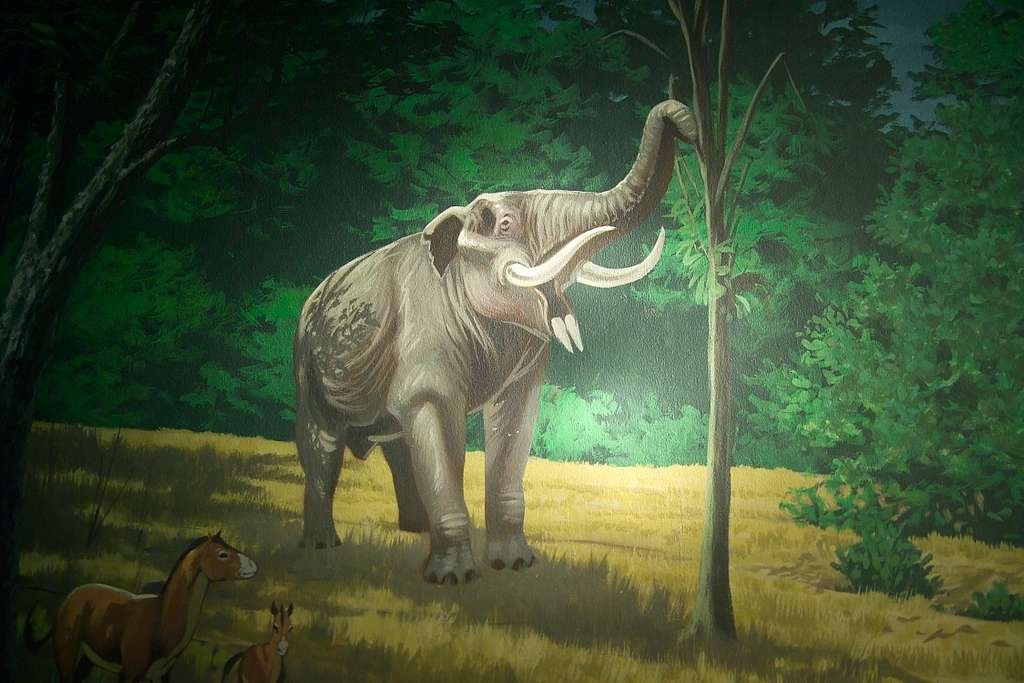
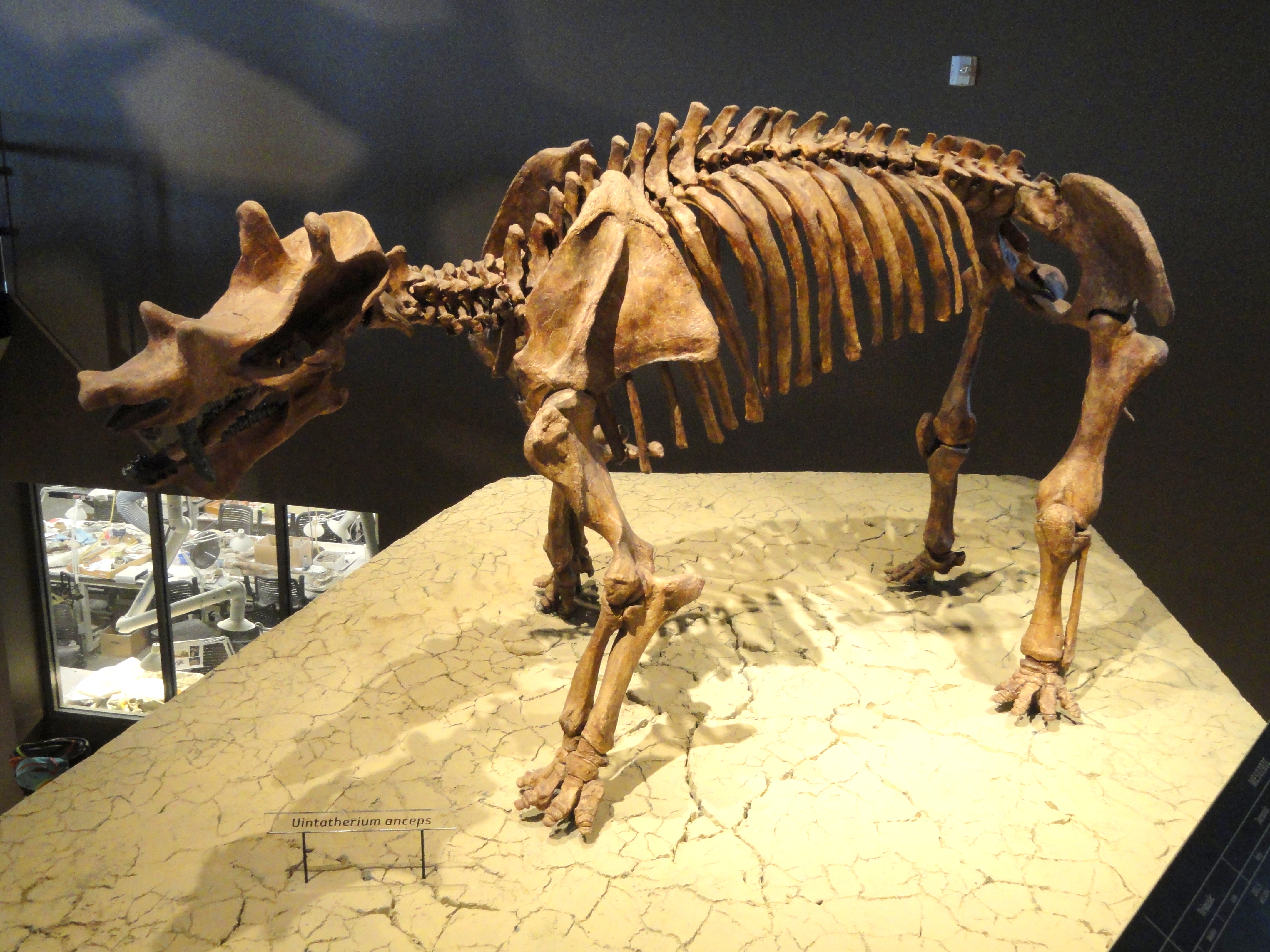
Image: File:Uintatherium anceps - Natural History Museum of Utah - DSC07254.JPG - Wikimedia Commons (CC BY-SA)
About Uintatherium
Uintatherium anceps was a large, rhinoceros-sized herbivorous mammal that roamed the subtropical forests of North America during the Middle Eocene epoch, approximately 52 to 46 million years ago. As one of the most visually striking examples of early Cenozoic megafauna, its name, meaning 'beast of the Uinta Mountains,' reflects the region of its initial discovery in Utah. Belonging to the extinct order Dinocerata, Uintatherium represents a fascinating and ultimately unsuccessful evolutionary experiment in mammalian gigantism, providing a crucial window into the diversification of life in the wake of the dinosaur extinction.
The physical appearance of Uintatherium was unlike any animal alive today, combining features reminiscent of a rhinoceros in build with a uniquely adorned skull. An adult Uintatherium anceps reached lengths of up to 4 meters (approximately 13 feet) from snout to tail, stood about 1.7 meters (5.6 feet) tall at the shoulder, and is estimated to have weighed between 2 and 4.5 metric tons, making it one of the largest land mammals of its time. Its body was massive and barrel-chested, supported by a robust, graviportal skeleton with stout, pillar-like legs designed to bear immense weight. The feet were plantigrade, meaning it walked on the soles of its feet, similar to bears or humans, which would have provided a stable base for its considerable bulk. The most distinctive features, however, were cranial. The skull was long, low, and concave on top, but its most bizarre characteristic was the presence of six prominent, bony knobs known as ossicones. These were arranged in three symmetrical pairs: a small pair on the snout near the nostrils, a larger, dagger-like pair above the eyes, and a final, rounded pair at the posterior of the skull. In life, these ossicones were likely covered in skin, similar to the horns of a modern giraffe, and probably served as display structures or weapons for intraspecific combat between males. Adding to its formidable appearance was a pair of enormous, saber-like upper canine teeth that could reach over 25 centimeters in length. These tusks, protected by a large bony flange on the lower jaw, were more developed in males, strongly suggesting they were used for display or fighting rivals rather than for predation.
Despite its intimidating arsenal of horns and tusks, Uintatherium was a placid herbivore. Its dental anatomy reveals a diet of soft, non-abrasive vegetation. The formidable canines were purely for show or combat, as the animal lacked upper incisors and had relatively small, simple cheek teeth (premolars and molars) with low crowns and lophs (ridges) suited for crushing and pulping leaves, fruits, and aquatic plants. This dental structure indicates a browsing feeding strategy, where it would have consumed vegetation from shrubs and low-hanging tree branches rather than grazing on tough grasses, which had not yet become widespread. Its massive body and graviportal locomotion suggest it was a slow-moving creature, incapable of sustained running. It likely moved with a deliberate, lumbering gait, traversing the lush, forested landscapes of the Eocene. The pronounced sexual dimorphism, particularly in the size of the canines and possibly the ossicones, points to a complex social structure. Males likely engaged in ritualized combat or display to establish dominance and secure mating rights, using their tusks to intimidate or slash at rivals. The ossicones may have been used for head-pushing or flank-butting contests, a behavioral pattern seen in various modern horned mammals.
Uintatherium lived during the Middle Eocene, a period characterized by a warm, humid, and stable global climate known as the Eocene Climatic Optimum. North America, including the region of the Uinta Basin in modern-day Utah and Wyoming, was covered in lush, subtropical forests and dotted with extensive lakes and swamps. This environment supported a rich and diverse ecosystem. Uintatherium occupied the niche of a large-bodied, low-level browser, a role today filled by rhinoceroses or tapirs. It shared its habitat with a variety of other mammals, including early primates like Omomys, the small, four-toed ancestor of the horse, Orohippus, and various predatory creodonts such as Patriofelis, a powerful cat-like hunter that may have preyed on young or infirm Uintatherium. The food web was complex, with Uintatherium positioned as a primary consumer of significant biomass, likely influencing the vegetation structure through its browsing habits. Its immense size would have protected healthy adults from most predators, making it an apex herbivore in its ecosystem. The stable, resource-rich environment of the Bridger and Uinta Formations allowed Uintatherium and its relatives to thrive for several million years before climatic shifts and the rise of more advanced herbivores led to their decline.
The discovery of Uintatherium is deeply intertwined with one of the most famous rivalries in the history of science: the "Bone Wars" of the late 19th century between American paleontologists Othniel C. Marsh of Yale University and Edward D. Cope of the Academy of Natural Sciences in Philadelphia. Fossils of the creature were first unearthed in the 1870s by expeditions exploring the newly accessible American West, particularly in the Bridger Basin of Wyoming. In their frantic race to discover and name new species, both Cope and Marsh independently described specimens of this animal under a plethora of different names. In 1872 alone, Cope named Loxolophodon and Eobasileus, while Marsh coined the names Dinoceras and Tinoceras. Joseph Leidy, a more senior paleontologist, had already named a fragment Uintatherium in 1872. As more complete skeletons were found, it became clear that these various names all referred to the same genus. Due to the rules of scientific nomenclature, which prioritize the earliest valid name given, Leidy's "Uintatherium" was eventually established as the official generic name. Marsh, however, secured some of the most spectacular and complete skeletons for the Yale Peabody Museum, including the iconic YPM VP 011034, which remains one of the best-preserved specimens ever found. This intense period of discovery rapidly brought Uintatherium to scientific and public attention, cementing its status as a symbol of prehistoric life.
Uintatherium belongs to the extinct order Dinocerata, a group of early, large-bodied herbivorous mammals that flourished during the Paleocene and Eocene epochs. The Dinocerata are considered an early, experimental branch of mammalian evolution that arose shortly after the extinction of the non-avian dinosaurs. Their evolutionary relationships to other mammalian groups have long been debated, but they are generally placed within the broad superorder Laurasiatheria, which includes modern ungulates, carnivorans, and bats. However, they are not directly ancestral to any living mammal group, representing a distinct lineage that ultimately left no descendants. The dinoceratans illustrate a pattern of rapid size increase and specialization seen in several mammalian clades in the early Cenozoic as they filled ecological niches vacated by the dinosaurs. Uintatherium itself represents the pinnacle of this lineage, being one of the largest and most specialized members of its order. Its unique combination of features—the six ossicones, saber-like canines, and simple grinding teeth—showcases a unique evolutionary path that proved highly successful for a time but was ultimately an evolutionary dead end, likely outcompeted by the more efficient digestive and dental systems of later ungulates like perissodactyls (horses, rhinos) and artiodactyls (deer, cattle).
The taxonomic history of Uintatherium has been a subject of considerable scientific debate, largely stemming from the chaotic circumstances of its discovery during the Bone Wars. The initial flood of names proposed by Cope and Marsh, including Dinoceras, Tinoceras, and Eobasileus, created significant confusion. For decades, paleontologists debated whether these represented distinct genera or were simply variations within a single, highly variable species. By the mid-20th century, a consensus emerged, led by researchers like Horace Wood, that most of these names were synonyms for Uintatherium anceps. The observed differences in skull ornamentation and canine size are now widely interpreted as evidence of sexual dimorphism and individual variation rather than distinct species. Another area of discussion has centered on the function of its bizarre cranial features. While the display and combat hypothesis for the ossicones and tusks is strongly supported by dimorphism, some early theories suggested the tusks were used for digging up roots or stripping bark, ideas that are now largely discounted due to the teeth's fragile, blade-like structure. Modern research continues to refine our understanding of its locomotion and biomechanics, using digital modeling to analyze how its massive skeleton supported its weight and how its jaws processed food.
The fossil record of Uintatherium is robust but geographically restricted primarily to the western United States, with the most significant discoveries coming from the Middle Eocene Bridger and Uinta Formations of Wyoming and Utah. These geological formations represent ancient lake and floodplain environments that provided excellent conditions for the preservation of large animal skeletons. Consequently, numerous well-preserved and often articulated skeletons of Uintatherium have been recovered, making it one of the best-known large mammals of the Eocene. Famous fossil sites in the Bridger Basin have yielded dozens of individuals, providing a comprehensive view of its anatomy, age-related changes, and sexual dimorphism. The abundance of fossils has allowed for detailed studies of its paleobiology and has made it a key index fossil for dating Middle Eocene terrestrial deposits in North America. While its close relatives in the Dinocerata family, like Gobiatherium, have been found in Asia, Uintatherium itself appears to have been endemic to North America, highlighting the distinct evolutionary pathways that mammalian faunas took on different continents during the early Cenozoic.
As one of the first truly gigantic and bizarre mammals to be discovered, Uintatherium quickly captured the public imagination in the late 19th century and has maintained a presence in popular culture ever since. Its mounted skeletons are prominent and awe-inspiring displays in major natural history museums around the world, including the Yale Peabody Museum of Natural History, the American Museum of Natural History in New York, and the Smithsonian National Museum of Natural History in Washington, D.C. These imposing exhibits serve as powerful educational tools, illustrating the strange and wonderful forms that mammalian evolution took in the deep past. Uintatherium frequently appears in illustrated books about prehistoric life, documentaries, and occasionally in paleoart, where its unique appearance makes it an unforgettable symbol of the "Age of Mammals."
Classification
Time Period
Discovery
Location
Uinta Mountains, Utah, USA
Formation
Bridger Formation
Frequently Asked Questions
What is Uintatherium?
Uintatherium anceps was a large, rhinoceros-sized herbivorous mammal that roamed the subtropical forests of North America during the Middle Eocene epoch, approximately 52 to 46 million years ago. As one of the most visually striking examples of early Cenozoic megafauna, its name, meaning 'beast of t...
When did Uintatherium live?
Uintatherium lived during the paleogene period of the cenozoic era approximately 52-46 million years ago.
Where was Uintatherium discovered?
Fossils of Uintatherium were discovered in Uinta Mountains, Utah, USA in the Bridger Formation.
What did Uintatherium eat?
Uintatherium was a herbivore. It lived in terrestrial habitats.
What type of fossil is Uintatherium?
Uintatherium is preserved as a body fossil. The preservation quality is good.
Related Specimens
From the cenozoic era · body fossils