Aspidella
Aspidella terranovica
Image: Image sourced via web search (Fair use / Educational)
About Aspidella
Aspidella terranovica is one of the most enigmatic and historically significant fossils from the Ediacaran Period, representing some of the earliest evidence of large, multicellular life on Earth. These disc-shaped impressions, found in ancient deep-sea sediments dating back approximately 570 to 560 million years ago, offer a crucial window into a world preceding the Cambrian Explosion, a time when the foundations of animal life were first being established. Its simple form belies a complex history of scientific interpretation, making Aspidella a cornerstone in the study of Precambrian life and the origins of complex organisms.
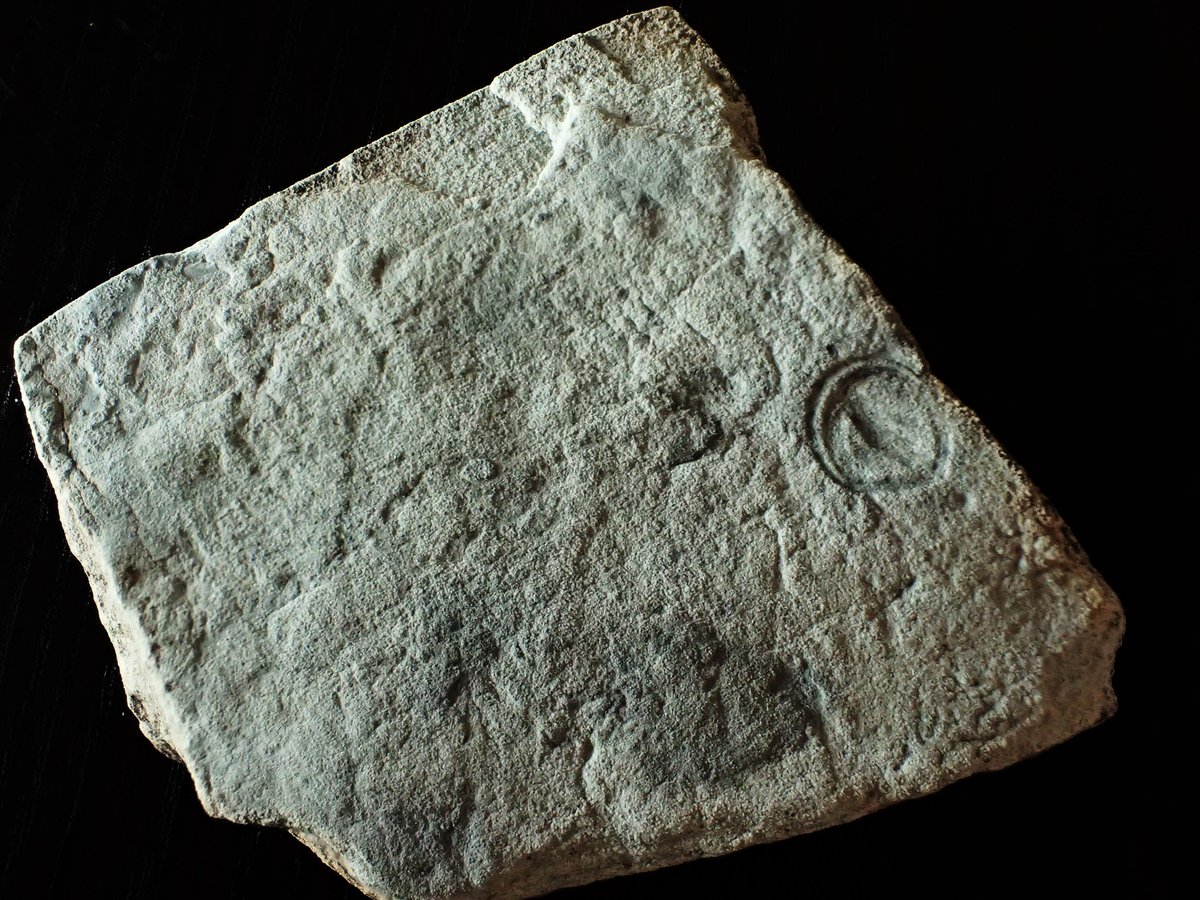
Aspidella fossils are preserved as impressions on the bedding planes of siltstones and sandstones, typically appearing as discoidal or elliptical shapes. Their size is highly variable, ranging from just a single millimeter to over 18 centimeters in diameter, though most specimens are between 5 and 10 millimeters. The fossils are characterized by a central, raised boss or a depressed pit, surrounded by concentric rings or radiating furrows, giving them a somewhat target-like appearance. These features are interpreted as the negative or positive relief impressions of the organism's base. There is no evidence of a skeleton or hard parts; Aspidella was entirely soft-bodied. The organism is thought to have had a holdfast structure that anchored it to the microbial mats covering the seafloor, with a possible stalk and an upper, frond-like body that is rarely, if ever, preserved. Its overall structure has been compared to the holdfasts of modern sea pens or the bulbs of some algae, but its simple, radial symmetry does not align perfectly with any living group. The variability in shape, from perfectly circular to highly elliptical, may reflect distortion during burial and fossilization or genuine biological variation within populations.
The paleobiology of Aspidella is a subject of considerable debate, primarily due to its simple morphology and the absence of preserved functional parts like mouths or guts. The prevailing hypothesis is that Aspidella was a sessile, benthic organism, permanently attached to the seafloor. Its mode of feeding is inferred to be osmotrophy, absorbing dissolved organic carbon directly from the surrounding seawater through its body wall. Alternatively, it may have been a detritivore, feeding on the rich microbial mats that it was anchored to. There is no evidence of motility; it was a stationary life form. Growth patterns appear to have been simple, with the organism increasing in diameter over its lifespan. Some fossil beds show vast aggregations of Aspidella, with thousands of individuals covering a single surface. This suggests a form of colonial or gregarious living, possibly a reproductive strategy involving the release of spores or larvae that settled in close proximity to the parent organisms. This 'gregarious' behavior is a key piece of evidence supporting its biological origin, as such dense, monospecific communities are characteristic of simple sessile animals. Its metabolism would have been slow, adapted to the low-oxygen conditions thought to be prevalent in the Ediacaran deep oceans.
Aspidella lived in a world vastly different from today's. During the late Ediacaran Period, the continents were coalescing into the supercontinent of Pannotia, and the oceans were beginning to oxygenate more fully, though deep-water environments remained largely anoxic. Aspidella fossils are found in sediments interpreted as deep-marine environments, below the storm wave base, where fine-grained sediments settled out of the water column after being delivered by turbidity currents. These habitats were dark, quiet, and populated by a strange assortment of organisms collectively known as the Ediacara Biota. Aspidella shared its environment with other enigmatic forms like Charnia, a frond-like organism, and Dickinsonia, a flat, segmented creature. As a primary consumer or decomposer, Aspidella likely occupied a basal position in the food web, feeding on microbial mats and dissolved nutrients. There were no known predators in the modern sense; the complex predator-prey dynamics of the Cambrian had not yet evolved. The ecosystem was dominated by stationary or slow-moving organisms competing for space and access to nutrients on the seafloor, a stark contrast to the bustling, bioturbated marine ecosystems that would follow.
The discovery of Aspidella is a pivotal moment in the history of paleontology. The fossils were first found in 1868 by Scottish geologist Alexander Murray in the Conception Group rocks near Portugal Cove South, Newfoundland. They were subsequently described and named in 1872 by Elkanah Billings, the chief paleontologist for the Geological Survey of Canada. Billings recognized their fossiliferous nature and named them Aspidella terranovica, meaning 'little shield of Newfoundland'. However, his interpretation was met with widespread skepticism. For nearly a century, the scientific community dismissed Aspidella as inorganic structures, such as gas escape marks or concretions, because the prevailing view was that no complex life existed in the Precambrian. It was not until the 1950s, with the discovery of the diverse and undeniably biological fossils at Charnwood Forest in England, that the scientific consensus began to shift. In 1958, Stanley Misra, a graduate student at Memorial University of Newfoundland, rediscovered vast fossil beds of Aspidella and other Ediacaran forms at Mistaken Point, Newfoundland. This site, now a UNESCO World Heritage Site, provided irrefutable proof of Aspidella's biological origin and established the importance of Precambrian fossils, vindicating Billings's original assessment after almost 90 years.
Aspidella's position in the tree of life is one of the most debated topics concerning the Ediacara Biota. Its simple, radial form has led to numerous, often conflicting, classifications. Early interpretations suggested it could be an early jellyfish, a type of cnidarian, or perhaps a holdfast for a frondose organism related to modern sea pens (pennatulacean octocorals). Other researchers have proposed it could be a type of fungus, a protist, or a member of a completely extinct kingdom of life, the Vendobionta, which experimented with a unique fractal body plan before vanishing at the end of the Precambrian. The most persistent and currently favored interpretation is that Aspidella and its relatives represent very early, stem-group animals (Metazoa). They may not belong to any modern phylum but instead represent an early 'experiment' in multicellular animal life that did not lead to modern lineages. The lack of key diagnostic features, such as spicules, a gut, or tentacles, makes definitive placement extremely difficult. Aspidella's significance lies in this very ambiguity; it demonstrates that before the Cambrian Explosion, life took forms that do not fit neatly into our modern classification systems, highlighting a period of profound evolutionary innovation and extinction.
The primary scientific debate surrounding Aspidella has always been its fundamental nature: is it biological or geological? While this has been largely resolved in favor of a biological origin, its specific identity remains contentious. Is Aspidella a distinct organism, or is it merely the holdfast of other Ediacaran fronds like Charnia? Fossils showing fronds attached to Aspidella-like discs (e.g., Charniodiscus) support the latter view in some cases. However, the existence of bedding planes covered exclusively by thousands of Aspidella discs, with no associated fronds, strongly suggests that Aspidella was also a standalone organism. This has led to the hypothesis that the name 'Aspidella' may be a form taxon, encompassing both the holdfasts of various frondose organisms and a separate, discoidal organism. Recent statistical analyses of Aspidella populations at Mistaken Point have shown patterns of spatial distribution and size-frequency consistent with ecological processes, further cementing their status as a biological entity and not a random geological feature.
The fossil record of Aspidella is extensive, making it one of the most common Ediacaran fossils. It is found globally in rocks of the appropriate age, with significant occurrences in Newfoundland, Canada; Charnwood Forest, England; the White Sea region of Russia; and Namibia. The most famous and important site is the Mistaken Point Ecological Reserve in Newfoundland. Here, vast bedding planes, protected from erosion, preserve entire communities of Aspidella and other Ediacaran organisms exactly as they lived on the deep seafloor. These surfaces, known as the 'E surface', contain tens of thousands of Aspidella specimens. The preservation is typically as high-fidelity molds and casts in fine-grained volcanic ash that fell and smothered the seafloor community, capturing a snapshot in time. This taphonomic window provides exceptional detail of the organisms' external morphology, though no internal anatomy or organic material is preserved.
While not a household name like Tyrannosaurus rex, Aspidella holds a significant place in the scientific and educational communities. It is a textbook example of Precambrian life and is featured prominently in museum exhibits on the origin of life and the Ediacara Biota. The displays at The Rooms museum in St. John's, Newfoundland, and the Natural History Museum in London feature remarkable casts and reconstructions of the Mistaken Point fossil surfaces, where Aspidella is the most numerous fossil. Its story—from being dismissed as a geological artifact to being recognized as a key piece of evidence for early animal life—serves as a powerful lesson in the history of science and the importance of challenging established dogma. As the first Precambrian fossil ever formally described, it represents the beginning of our quest to understand the mysterious world that existed before the Cambrian.
Classification
Time Period
Discovery
Location
Newfoundland, Canada
Formation
Fermeuse Formation, Conception Group
Frequently Asked Questions
What is Aspidella?
Aspidella terranovica is one of the most enigmatic and historically significant fossils from the Ediacaran Period, representing some of the earliest evidence of large, multicellular life on Earth. These disc-shaped impressions, found in ancient deep-sea sediments dating back approximately 570 to 560...
When did Aspidella live?
Aspidella lived during the ediacaran period of the precambrian era approximately 570-560 million years ago.
Where was Aspidella discovered?
Fossils of Aspidella were discovered in Newfoundland, Canada in the Fermeuse Formation, Conception Group.
What did Aspidella eat?
Aspidella was a osmotroph or detritivore. It lived in deep-sea marine habitats.
What type of fossil is Aspidella?
Aspidella is preserved as a impression fossil. The preservation quality is good.
Related Specimens
From the precambrian era · impression fossils