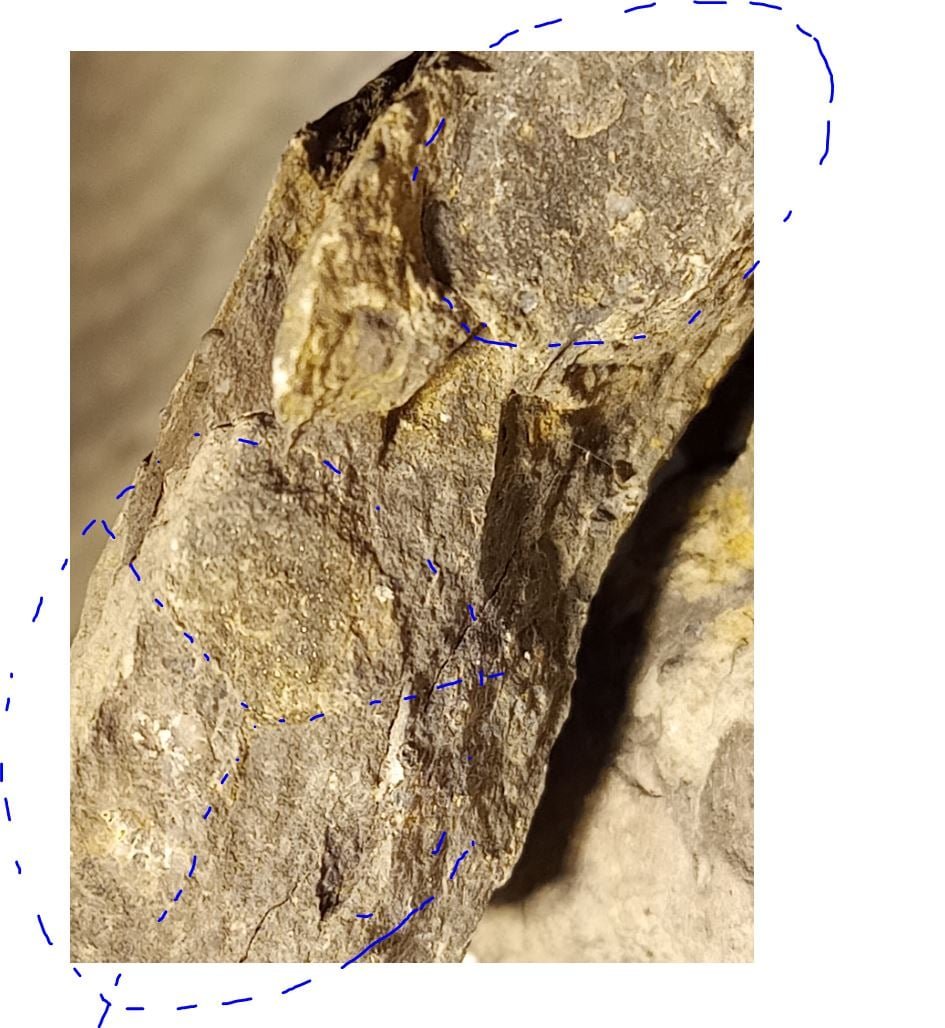
Tribrachidium
Tribrachidium heraldicum
Image: Image sourced via web search (Fair use / Educational)
About Tribrachidium
Tribrachidium heraldicum is an enigmatic disc-shaped organism from the late Ediacaran Period, approximately 555 million years ago, representing one of the most distinctive and puzzling members of the Ediacara Biota. Its fossils, found primarily in South Australia and the White Sea region of Russia, showcase a unique triradial symmetry, a body plan with three-part rotational symmetry that is virtually unknown in any later, more complex animals. This unusual morphology places Tribrachidium at the center of paleontological debates regarding the nature of early life, its relationship to modern phyla, and the evolutionary experiments that occurred just before the Cambrian Explosion.
Tribrachidium was a relatively small, benthic (sea-floor dwelling) organism, typically measuring between 3 and 5 centimeters in diameter, although some specimens have reached up to 9 centimeters. Its body was discoidal and dome-shaped in life, often compared in size and shape to a small cookie or a sand dollar. The most striking feature, preserved in negative relief as an impression on the underside of sandstone beds, is its complex pattern of three prominent, curved, or spiral arms that radiate from a central point. These arms, often described as 'vanes' or 'branches,' are themselves composed of smaller, repeating fractal-like branches, creating an intricate, quilted pattern. The entire structure is enclosed by a marginal rim or border. Unlike many later animals, Tribrachidium possessed no mineralized skeleton, no discernible head, gut, or limbs. Its body was entirely soft, and its internal anatomy remains a subject of speculation. The triradial symmetry is its defining characteristic, setting it apart from the bilateral symmetry of most modern animals (including humans) and the radial symmetry of cnidarians like jellyfish and sea anemones. This unique body plan suggests a fundamentally different way of organizing a multicellular body compared to nearly all subsequent life forms.
Due to the absence of a mouth, gut, or any recognizable feeding apparatus, the paleobiology of Tribrachidium is highly interpretive. The leading hypothesis is that it was an osmotroph, absorbing dissolved organic carbon directly from the surrounding seawater across its large, intricately branched body surface. The complex, fractal branching of its arms would have maximized the surface-area-to-volume ratio, making this an efficient strategy for nutrient uptake in the nutrient-rich Ediacaran seas. Alternatively, it may have been a detritivore, living on or within the extensive microbial mats that covered the seafloor and absorbing nutrients from the decaying organic matter beneath it. Locomotion was likely non-existent; Tribrachidium was a sessile organism, remaining stationary on the seabed throughout its adult life. There is no evidence of social behavior, and they are typically found as isolated individuals. Growth patterns are inferred from the range of sizes found in the fossil record, suggesting they grew isometrically, maintaining their overall shape as they increased in size. Its metabolism would have been slow, consistent with a low-oxygen environment and a passive feeding strategy, reflecting the general biological conditions of the late Precambrian.
Tribrachidium lived on the sandy bottoms of shallow, quiet marine environments, likely within the photic zone but below the turbulent wave base. The Ediacaran world was geologically and biologically alien compared to today. The continents were coalescing into the supercontinent of Pannotia, and the climate was emerging from a series of global glaciations known as 'Snowball Earth' events. The oceans were still relatively low in oxygen, but oxygenation was increasing, paving the way for larger, more complex life. The seafloor was dominated by vast microbial mats, which provided both a substrate and a food source for the Ediacara Biota. Tribrachidium shared its habitat with a bizarre assemblage of other early organisms, including the frond-like Charnia, the slug-like Kimberella, and the famously enigmatic, mattress-like Dickinsonia. In this ecosystem, Tribrachidium was likely a primary consumer, feeding on dissolved organics or microbial mat detritus. Given its sessile nature and soft body, it may have been vulnerable to predation, possibly from the more mobile Kimberella, which is thought to have grazed on the microbial mats and potentially on other organisms, as evidenced by trackways found near its fossils. The food web was simple, lacking the complex predator-prey dynamics that would characterize the subsequent Cambrian Period.
The discovery of Tribrachidium is credited to the paleontologist Martin Glaessner, who formally described the organism in 1959. The first specimens were found in the Ediacara Hills of the Flinders Ranges in South Australia, a region that has since become a world-renowned Lagerstätte for the Ediacara Biota. The fossils were discovered within the sandstone layers of the Rawnsley Quartzite formation. The name Tribrachidium is derived from the Greek 'tri' (three) and 'brachion' (arm), referring to its three-armed structure. The species name, 'heraldicum,' is a nod to the resemblance of its three-armed pattern to the triskelion, a symbol found in ancient heraldry, such as the coat of arms of the Isle of Man. There are no famous individually named specimens of Tribrachidium akin to 'Sue' the T. rex; rather, its significance lies in the collective fossil evidence from numerous specimens that together reveal its unique morphology. Glaessner's initial work was crucial in establishing the Ediacara Biota as a legitimate and globally significant assemblage of Precambrian metazoans, challenging the long-held view that complex life only appeared at the start of the Cambrian.
Tribrachidium heraldicum holds immense evolutionary significance as a prime example of a failed evolutionary experiment. It belongs to the phylum Trilobozoa, a group of extinct animals characterized by triradial symmetry. This entire phylum appears to have gone extinct at or before the end of the Ediacaran Period, leaving no direct descendants. Its unique body plan highlights a period of evolutionary innovation when fundamental aspects of animal body organization were highly variable. While bilateral and radial symmetry became the dominant templates for virtually all subsequent animal life, the existence of trilobozoans like Tribrachidium demonstrates that other symmetries were possible and, for a time, successful. This suggests that the Ediacaran was not simply a prelude to the Cambrian but a distinct evolutionary radiation with its own unique set of rules. Tribrachidium serves as a powerful reminder that the tree of life includes many dead-end branches and that the path of evolution was not a simple, linear progression towards modern forms. It represents a completely different way of being a multicellular animal, one that ultimately did not survive the ecological shifts at the Precambrian-Cambrian boundary.
The classification of Tribrachidium and its relatives has been a long-standing scientific debate. Initially, Glaessner and others attempted to place it within existing animal phyla, suggesting affinities with primitive echinoderms (like starfish) or cnidarians (like jellyfish). However, its fundamental triradial symmetry does not comfortably fit within the five-fold (pentaradial) symmetry of echinoderms or the typical four- or six-fold symmetry of cnidarians. In the 1980s, paleontologist Adolf Seilacher proposed that Tribrachidium and most other Ediacaran organisms were not animals at all, but belonged to an extinct kingdom of life he called 'Vendobionta,' characterized by a quilted, fluid-filled construction. While this view has been influential, the current consensus, supported by geochemical and morphological evidence, leans towards classifying most Ediacaran forms, including Tribrachidium, as early stem-group animals. The creation of the phylum Trilobozoa by Mikhail Fedonkin provided a formal classification for these triradial organisms, acknowledging them as a distinct and cohesive evolutionary group, likely representing an early, extinct branch of the animal kingdom.
Fossils of Tribrachidium are primarily known from two major locations: the Flinders Ranges in South Australia and the shores of the White Sea in the Arkhangelsk region of Russia. A few other occurrences have been reported, but these two regions have yielded the vast majority of the several hundred known specimens. The fossils are preserved as impressions, specifically as negative casts on the undersides of sandstone beds. This type of preservation, known as 'Ediacaran-style preservation,' occurred when the organisms were buried by sand, which then lithified. The soft body decayed, leaving a detailed mold of its external shape against the underlying microbial mat. The quality of preservation is often good, capturing the fine details of the radiating arms and fractal branching patterns. The entire organism is typically preserved, as it lacked hard parts that could become disarticulated. The Rawnsley Quartzite in Australia and the Verkhovka, Zimnegory, and Yorga Formations in Russia are the key geological units that have provided the world's best windows into the life of Tribrachidium.
Tribrachidium, while not a household name like Tyrannosaurus or Triceratops, holds a special place in the public's understanding of deep time and the origins of life. Its strange, alien-like appearance makes it a compelling subject in museum exhibits dedicated to early life. Notable displays featuring casts or reconstructions of Tribrachidium and its environment can be found at the South Australian Museum in Adelaide, which houses many of the original specimens, as well as major natural history museums globally, including the Smithsonian National Museum of Natural History. It frequently appears in documentaries and books about the Ediacaran Period, serving as a key visual icon for the evolutionary strangeness that preceded the Cambrian Explosion. For students of biology and paleontology, it is a classic textbook example of an extinct body plan and a testament to the diversity of evolutionary pathways explored by early life on Earth.
Classification
Time Period
Discovery
Location
Ediacara Hills, South Australia, Australia
Formation
Rawnsley Quartzite
Frequently Asked Questions
What is Tribrachidium?
Tribrachidium heraldicum is an enigmatic disc-shaped organism from the late Ediacaran Period, approximately 555 million years ago, representing one of the most distinctive and puzzling members of the Ediacara Biota. Its fossils, found primarily in South Australia and the White Sea region of Russia, ...
When did Tribrachidium live?
Tribrachidium lived during the ediacaran period of the precambrian era approximately 558-555 million years ago.
Where was Tribrachidium discovered?
Fossils of Tribrachidium were discovered in Ediacara Hills, South Australia, Australia in the Rawnsley Quartzite.
What did Tribrachidium eat?
Tribrachidium was a osmotroph or detritivore. It lived in marine, benthic habitats.
What type of fossil is Tribrachidium?
Tribrachidium is preserved as a impression fossil. The preservation quality is good.
Related Specimens
From the precambrian era · impression fossils
-bark/c858d48fc5cb.jpg)