Charnia
Charnia masoni
Image: File:Charnia masoni.jpg - Wikimedia Commons (CC BY-SA)
About Charnia
Charnia masoni is an iconic fossil organism from the late Precambrian, representing one of the earliest known, large, and architecturally complex life forms on Earth. This enigmatic, frond-like creature lived in the deep oceans of the Ediacaran Period, between approximately 575 and 555 million years ago, with its remains first discovered in the ancient rocks of Charnwood Forest, England. Its discovery fundamentally altered our understanding of early life, proving that macroscopic organisms thrived millions of years before the Cambrian explosion, an event previously considered the dawn of complex life.
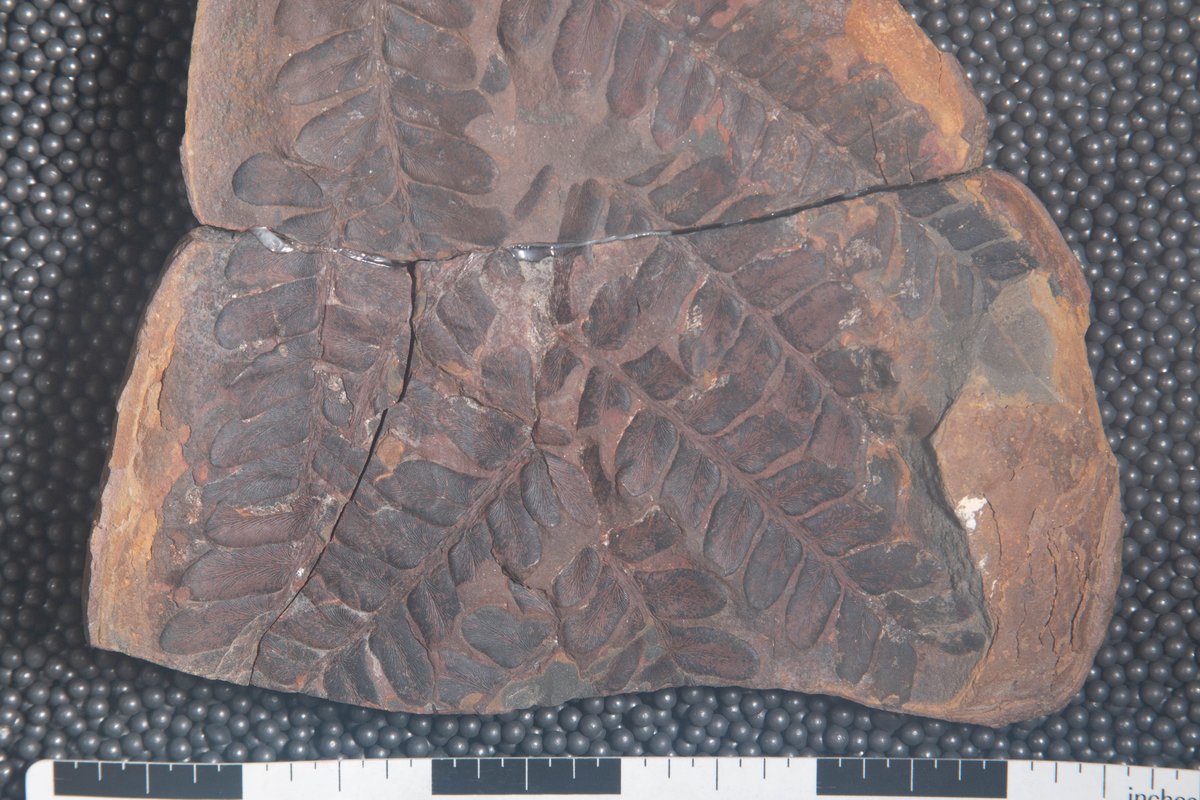
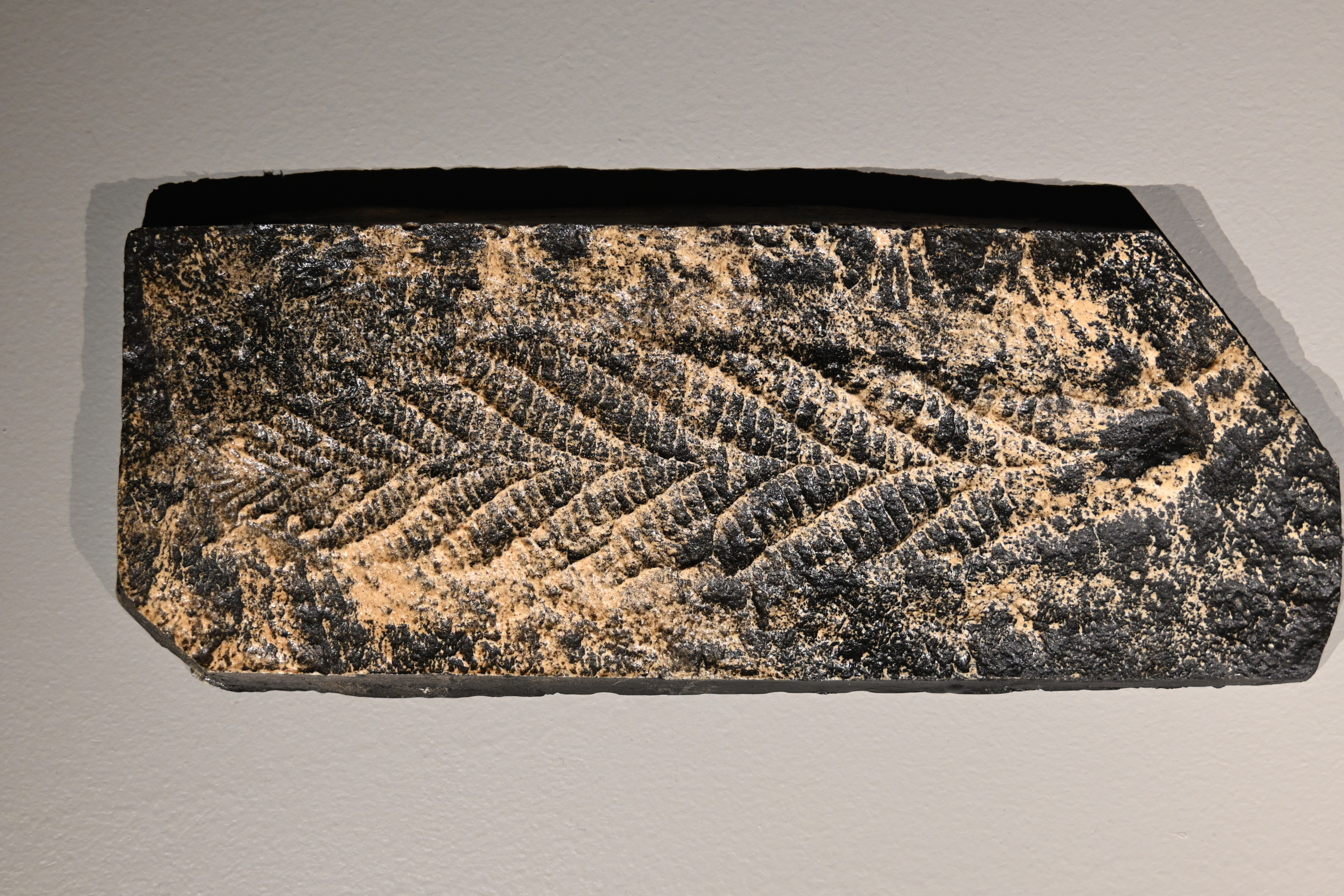
The physical form of Charnia is both simple in its overall plan and complex in its detailed construction. It possessed a bilaterally symmetrical, leaf-shaped body, often described as a frond, which could range in size from a mere 20 centimeters to an impressive two meters in length, making it one of the largest organisms of its time. This frond was not a true leaf, as it lacked any vascular system for transporting nutrients. Instead, it was composed of a series of primary branches that extended outwards from a central stalk or midline. These primary branches were themselves subdivided into smaller, secondary branches, which in turn were made of even smaller tertiary units. This hierarchical, self-similar branching pattern is a classic example of fractal geometry in a biological system. The entire structure was "quilted" or segmented, giving it a textured, mattress-like appearance characteristic of a group of Ediacaran organisms known as the Rangeomorphs. At its base, the frond was attached to a circular, disc-shaped holdfast, which anchored the organism to the muddy or silty substrate of the deep-sea floor. Unlike any modern animal, Charnia lacked obvious signs of a mouth, gut, anus, or sensory organs, indicating a fundamentally different body plan from the fauna that would later dominate the planet. Its construction was entirely soft-bodied, and it is known only from impressions left in fine-grained sedimentary rock.
The paleobiology of Charnia is a subject of intense scientific investigation, pieced together from its anatomy and the geological context of its fossils. Living in the aphotic zone, thousands of meters below the ocean surface, it existed in total darkness, ruling out photosynthesis as a means of sustenance. The prevailing hypothesis is that Charnia was an osmotroph, a passive feeder that absorbed dissolved organic carbon and other nutrients directly from the surrounding seawater. Its immense, fractal surface area would have been perfectly suited for this strategy, maximizing contact with the nutrient-rich water column. It was a completely sessile organism, fixed in one place for its entire life by its holdfast. Analysis of fossil beds containing Charnia populations, such as those at Mistaken Point in Newfoundland, reveal that these organisms were not randomly scattered. Instead, they show evidence of ecological succession and tiered communities, with larger individuals capturing currents higher up and smaller organisms living closer to the seafloor. Growth models developed by researchers like Jennifer Hoyal Cuthill suggest that Charnia grew by adding new branches at its base, pushing the older, larger parts of the frond upwards and outwards into the water column, a pattern known as apical-intercalary growth. This allowed it to efficiently expand its surface area for nutrient absorption throughout its life.
Charnia lived during the Ediacaran Period, a time when Earth was recovering from the extreme "Snowball Earth" glaciations of the Cryogenian. The global climate was stabilizing, and the oceans were becoming increasingly oxygenated, though likely not to modern levels, particularly in the deep sea. The geography of the late Precambrian was dominated by the supercontinent of Pannotia, and the locations where Charnia fossils are found, such as England and Newfoundland, were part of a microcontinent called Avalonia, situated in the southern hemisphere at high latitudes. Charnia was a key member of the Avalon Assemblage, the earliest of the three major Ediacaran faunal groups. This deep-water community was dominated by other Rangeomorphs like Fractofusus and Bradgatia, as well as frondose forms such as Charniodiscus. These organisms formed the world's first complex ecosystems, creating multi-level, tiered communities on the seafloor. As a primary consumer of dissolved organic matter, Charnia occupied a foundational position in the food web. There is no evidence of predation in these ecosystems; the organisms appear to have lived and died without being actively hunted, a stark contrast to the predator-prey dynamics that would define the subsequent Cambrian Period. The environment was one of relative tranquility, dominated by passive feeders carpeting the dark, silent ocean floor.
The discovery of Charnia is a landmark story in the history of paleontology. For over a century, the scientific consensus, heavily influenced by Charles Darwin, held that no complex life existed before the Cambrian Period. Precambrian rocks were widely considered barren of fossils. This view was challenged in April 1957 when a 15-year-old schoolboy named Roger Mason, climbing with friends in Charnwood Forest, Leicestershire, noticed an unusual leaf-like impression on a rock slab in a quarry. Recognizing it as a potential fossil, he sketched it and showed it to his father, a geology professor at the local university, who encouraged him to pursue it. After initial skepticism from the scientific establishment, the fossil was authenticated by the British Geological Survey. The following year, paleontologist Trevor Ford formally described the specimen, naming it Charnia masoni in honor of both the Charnwood Forest locality and its young discoverer. The holotype specimen, the very slab found by Mason, is now housed in the New Walk Museum in Leicester. This discovery was revolutionary, pushing back the known record of large, organized life by tens of millions of years and forcing a complete re-evaluation of the Precambrian. It opened the door for the recognition of the Ediacaran biota as a legitimate and globally significant chapter in the history of life.
The evolutionary significance of Charnia and its fellow Rangeomorphs is one of the most debated topics in paleobiology. Their unique, quilted, fractal anatomy has no direct modern analogue, making their placement on the tree of life exceptionally difficult. For many years, they were tentatively classified as early relatives of sea pens (Pennatulacea), a type of colonial cnidarian. However, their growth patterns and lack of clear cnidarian features, such as tentacles or individual polyps, have led most researchers to abandon this hypothesis. Another prominent theory, championed by paleontologist Adolf Seilacher, proposed that the Ediacaran biota, including Charnia, belonged to an entirely extinct kingdom of life he named "Vendobionta." In this view, they were a failed evolutionary experiment with a unique fluid-filled, quilted body plan that left no modern descendants. More recent analyses, however, have increasingly placed Charnia and the Rangeomorphs as stem-group Eumetazoa, meaning they are located on the branch leading to true animals, after the divergence of sponges but before the last common ancestor of cnidarians and bilaterians. Under this interpretation, they represent an early, experimental phase in animal evolution, exploring body plans that were ultimately unsuccessful but were nonetheless part of the lineage that would eventually give rise to all modern animals.
The precise biological affinity of Charnia remains a source of considerable scientific debate. While the stem-group animal hypothesis is currently favored by many, its status is far from settled. The lack of preserved soft tissues or genetic material means that interpretations are based entirely on morphology and the context of the fossils. Some researchers have proposed affiliations with fungi or protists, though these ideas have gained less traction. The "Vendobionta" concept, while less popular now, still highlights the genuine strangeness of these organisms and the possibility that they represent a fundamentally different way of building a large, multicellular body. Even their method of reproduction is unknown; suggestions range from the release of waterborne spores or gametes to the generation of new fronds from fragments that broke off the parent organism. Recent studies using advanced imaging techniques and fluid dynamics modeling continue to refine our understanding of how Charnia might have fed and interacted with its environment, but conclusive answers about its biology and evolutionary relationships remain elusive, ensuring it will be a subject of active research for years to come.
The fossil record of Charnia, while restricted to the Ediacaran Period, is globally significant. Following its initial discovery in Charnwood Forest, England, identical or closely related species have been found in rocks of similar age around the world. The most famous and exceptionally preserved specimens come from the coast of Newfoundland, Canada, particularly at the Mistaken Point Ecological Reserve, a UNESCO World Heritage Site. Here, vast bedding planes are covered with thousands of Ediacaran fossils, including countless Charnia, all preserved in situ by layers of fine volcanic ash that smothered the entire seafloor community. These "fossilized ecosystems" provide an unparalleled snapshot of the deep-sea communities of the Ediacaran. Other notable occurrences of Charnia have been reported from the White Sea region of Russia and parts of Australia, though these are often less well-preserved. The quality of preservation is remarkable for such ancient, soft-bodied organisms. They are preserved as impressions, or natural molds and casts, in sandstone and siltstone, capturing the fine details of their fractal branching structure.
Though an extinct organism from a deep and alien past, Charnia masoni has had a notable cultural impact. It serves as a powerful symbol of the vastness of geological time and the unexpected nature of scientific discovery. The story of Roger Mason, a teenager whose curiosity overturned a century of scientific dogma, is frequently cited to inspire young people and amateur scientists. The holotype fossil is a prized exhibit at the New Walk Museum in Leicester, and replicas are displayed in major natural history museums worldwide, including the Smithsonian and the Natural History Museum in London. Charnia is often the poster organism for the Ediacaran Period in textbooks and documentaries, representing the dawn of large life forms. Its name has even been honored in space, with an asteroid being named 8471 Charniamasoni. Its striking, elegant form and profound implications for the origins of life ensure its place as one of the most important fossils ever found.
Classification
Time Period
Discovery
Location
Charnwood Forest, Leicestershire, England
Formation
Bradgate Formation
Frequently Asked Questions
What is Charnia?
Charnia masoni is an iconic fossil organism from the late Precambrian, representing one of the earliest known, large, and architecturally complex life forms on Earth. This enigmatic, frond-like creature lived in the deep oceans of the Ediacaran Period, between approximately 575 and 555 million years...
When did Charnia live?
Charnia lived during the ediacaran period of the precambrian era approximately 575-555 million years ago.
Where was Charnia discovered?
Fossils of Charnia were discovered in Charnwood Forest, Leicestershire, England in the Bradgate Formation.
What did Charnia eat?
Charnia was a osmotroph. It lived in marine (deep sea) habitats.
What type of fossil is Charnia?
Charnia is preserved as a impression fossil. The preservation quality is good.
Related Specimens
From the precambrian era · impression fossils