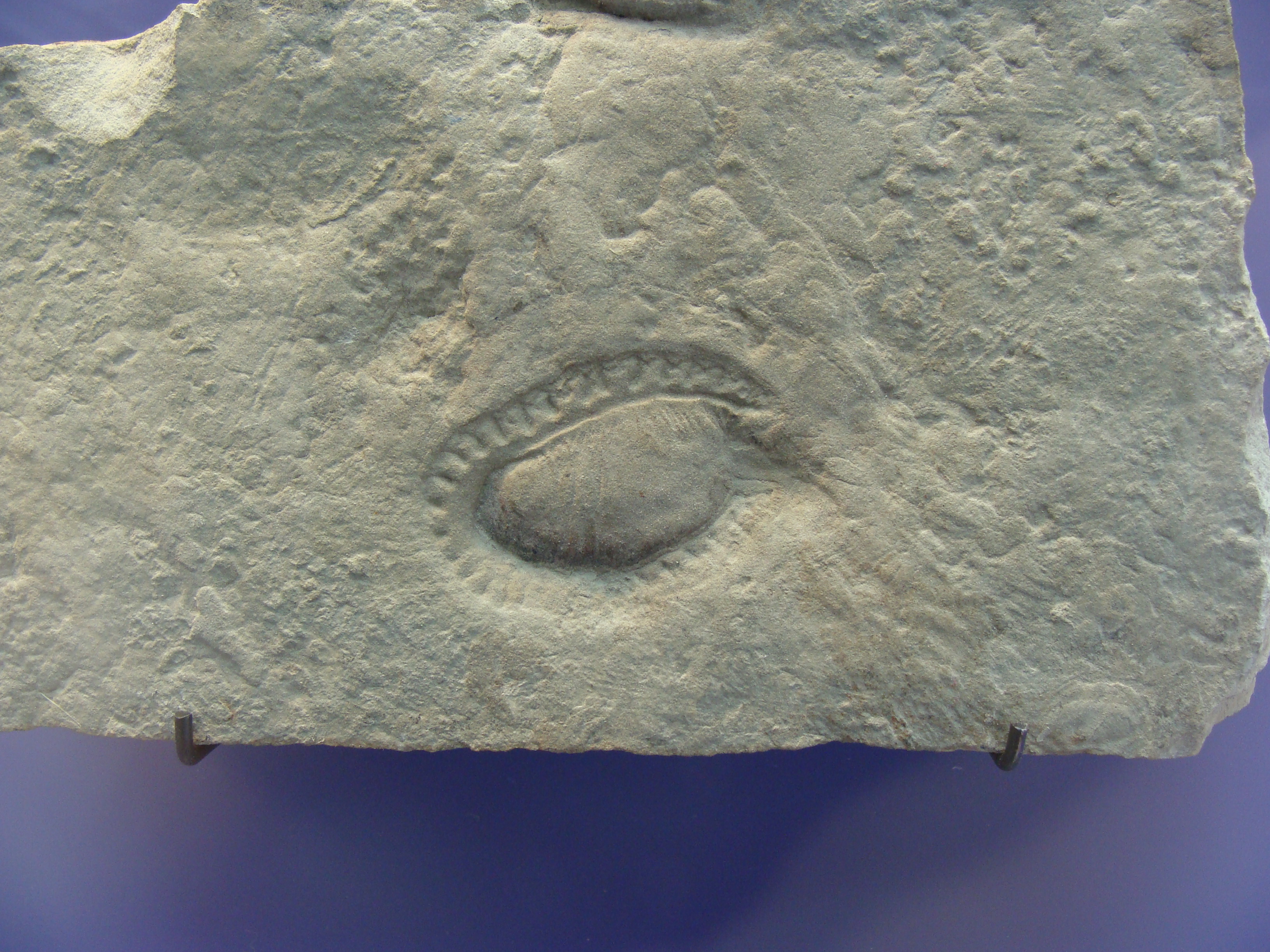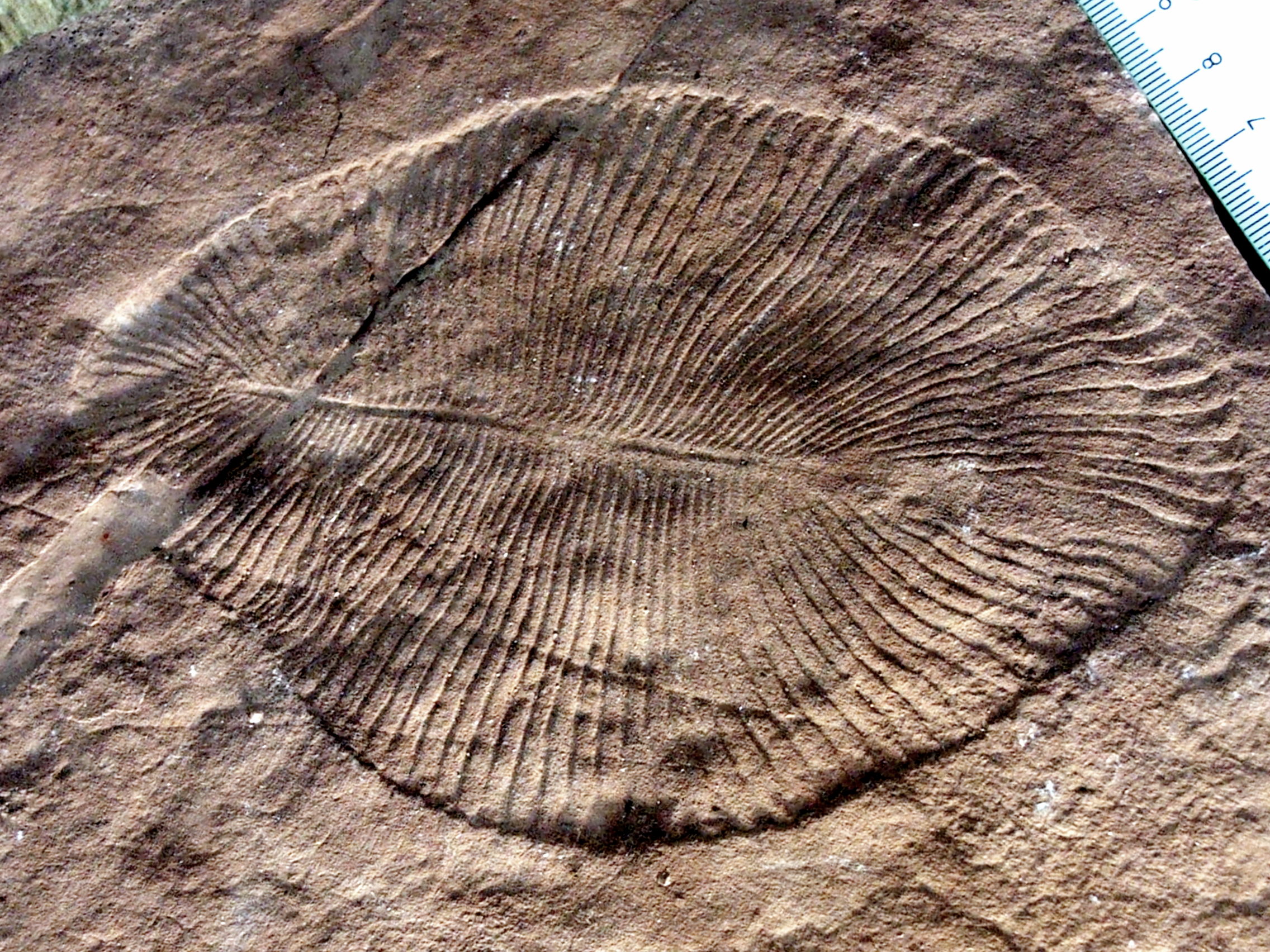
Dickinsonia
Dickinsonia costata
Image: File:DickinsoniaCostata.jpg - Wikimedia Commons (CC BY-SA)
About Dickinsonia
Dickinsonia costata is an iconic and enigmatic extinct organism from the Ediacaran period, representing one of the earliest known complex, multicellular life forms on Earth. Living approximately 575 to 541 million years ago during the late Precambrian era, this remarkable creature inhabited shallow marine environments and is most famously preserved in the Ediacara Hills of South Australia. Its discovery and subsequent biochemical analysis have profoundly shaped our understanding of the dawn of animal life, offering a crucial glimpse into the biological innovations that preceded the Cambrian Explosion.
The physical anatomy of Dickinsonia is entirely unique when compared to modern fauna, characterized by a flat, bilaterally symmetrical, and broadly oval-shaped body. Specimens discovered to date exhibit an extraordinary size range, from minuscule juveniles measuring a mere 0.2 centimeters to massive adults stretching up to 140 centimeters in length, making it one of the largest known organisms of the Ediacaran biota. The body of Dickinsonia was composed of numerous rib-like segments, referred to scientifically as isomers, which radiated outward from a central longitudinal groove or ridge. Unlike the true bilateral symmetry seen in modern arthropods or vertebrates, where the left and right sides are exact mirror images, Dickinsonia exhibited a peculiar geometric arrangement known as glide reflection symmetry. In this configuration, the isomers on the left side of the central axis were slightly offset or staggered relative to those on the right side, much like the alternating pattern of a zipper or the leaflets of a fern. This structural quirk suggests a fundamental difference in embryonic development compared to extant bilaterians. The organism lacked any evidence of a centralized nervous system, digestive tract, mouth, or specialized sensory organs. Its body was exceptionally thin, likely measuring only a few millimeters in thickness even in the largest specimens, which maximized its surface area to volume ratio. Because it lacked mineralized hard parts like shells or bones, its weight would have been negligible, supported entirely by the buoyancy of the surrounding seawater and the hydrostatic pressure of its internal fluids.
In terms of paleobiology, Dickinsonia is widely believed to have been an osmotroph, an organism that feeds by absorbing dissolved nutrients directly through its outer body surface. The Ediacaran seafloor was not covered in loose sediment as it is today, but was instead bound together by thick, ubiquitous microbial mats composed of cyanobacteria and other microorganisms. Dickinsonia is thought to have lived as a mobile benthic organism, resting flat against these microbial mats. By secreting digestive enzymes from its ventral surface, it could externally digest the organic matter of the mat and absorb the resulting nutrient-rich fluids directly into its tissues. This feeding strategy explains its incredibly flat, expansive body plan, which would have maximized the surface area available for nutrient absorption. Evidence for this behavior comes from trace fossils known as Epibaion, which are essentially resting traces or feeding footprints left behind by Dickinsonia. These trace fossils often appear in sequential series, indicating that the organism would rest in one spot to feed, deplete the local nutrients, and then slowly glide or crawl to a new, unexploited patch of the microbial mat. The exact mechanism of its locomotion remains a subject of study, but it may have utilized muscular contractions, ciliary action, or a combination of both to slowly propel its flat body across the ocean floor. Growth in Dickinsonia occurred through the continuous addition of new isomers at one end of the body, likely the posterior, while existing segments expanded in size, allowing the organism to scale up significantly over its lifespan without altering its fundamental shape.
The ecological context in which Dickinsonia thrived was vastly different from modern marine ecosystems. During the Ediacaran period, the Earth was recovering from the severe global glaciations of the Cryogenian period, leading to a warmer, more hospitable climate and rising oxygen levels in the oceans. The shallow marine environments inhabited by Dickinsonia were characterized by low wave energy and the absolute dominance of benthic microbial mats, which formed the foundation of the Ediacaran food web. This era is often referred to as the Garden of Ediacara due to the apparent absence of macroscopic predators. There is no fossil evidence of bite marks, defensive armor, or complex predator-prey dynamics during the time of Dickinsonia. Instead, the ecosystem was populated by a peaceful community of bizarre, soft-bodied organisms. Dickinsonia shared its habitat with other famous Ediacaran biota, such as the frond-like Charnia, the segmented Spriggina, and the tri-radially symmetrical Tribrachidium. In this tranquil environment, Dickinsonia occupied the ecological niche of a primary consumer, grazing on the microbial mats without the selective pressure of predation. This lack of predators allowed organisms like Dickinsonia to grow to massive sizes without needing to invest biological resources into speed, armor, or complex sensory organs, resulting in an ecosystem driven entirely by competition for space and nutrient absorption on the seafloor.
The discovery history of Dickinsonia is a fascinating chapter in the annals of paleontology, beginning in 1947 with the pioneering work of Australian geologist Reginald Sprigg. While exploring the rugged Ediacara Hills in the Flinders Ranges of South Australia, Sprigg uncovered a trove of ancient, soft-bodied fossils preserved as impressions in the Rawnsley Quartzite formation. Among these was a striking, ribbed, oval-shaped fossil that Sprigg initially interpreted as an early jellyfish or medusoid. He formally named the genus Dickinsonia in honor of Ben Dickinson, the Director of Mines for South Australia at the time, and designated Dickinsonia costata as the type species. For decades, these fossils were considered a localized geological oddity. However, subsequent expeditions in the mid-to-late twentieth century, led by prominent paleontologists such as Martin Glaessner, expanded the known diversity of the Ediacara biota and established their Precambrian age, pushing the timeline of complex life back millions of years before the Cambrian period. Key specimens of Dickinsonia have since been recovered not only in South Australia but also in the White Sea region of Russia, where the fossils are exceptionally well-preserved in fine-grained sandstones and siltstones. These Russian discoveries, particularly those excavated by researchers from the Paleontological Institute in Moscow, provided specimens with preserved organic material, setting the stage for groundbreaking biochemical analyses decades later.
The evolutionary significance of Dickinsonia cannot be overstated, as it occupies a critical and highly informative position near the very base of the animal tree of life. For a long time, the sudden appearance of complex animal body plans during the Cambrian Explosion puzzled scientists, a dilemma famously noted by Charles Darwin. Dickinsonia and its Ediacaran contemporaries provide the missing transitional link, demonstrating that large, multicellular life existed tens of millions of years prior to the Cambrian. While its exact phylogenetic placement remains a topic of active research, Dickinsonia is widely regarded as a stem-group animal, meaning it belongs to an early lineage that branched off before the last common ancestor of all living bilaterian animals. The most definitive proof of its animal affinities came in 2018, when a team of researchers led by Ilya Bobrovskiy and Jochen Brocks from the Australian National University analyzed exceptionally preserved Dickinsonia fossils from the remote White Sea region of Russia. Using advanced gas chromatography and mass spectrometry, they extracted and analyzed lipid biomarkers from the organic films left by the fossils. They discovered that the remains contained remarkably high concentrations of cholesteroids, specifically cholesteryl molecules, which are a hallmark of animal cell membranes. This groundbreaking biochemical evidence effectively ruled out alternative hypotheses that Dickinsonia was a fungus, a giant single-celled protist, or a lichen, cementing its status as one of the oldest confirmed macroscopic animals in the fossil record.
Despite this monumental 2018 discovery, the scientific debates surrounding Dickinsonia have been historically fierce and varied. Before the lipid biomarker analysis, the taxonomic affinity of Dickinsonia was one of the most contentious issues in paleontology. Some researchers, such as Adolf Seilacher, argued that Dickinsonia and other Ediacaran organisms belonged to a completely extinct, separate kingdom of life called the Vendobionta, characterizing them as a failed evolutionary experiment with a quilted, fluid-filled internal structure unlike any modern biology. Others proposed it was a giant, multinucleated single-celled organism akin to modern deep-sea xenophyophores, while some suggested it was a terrestrial lichen that had been washed into marine sediments. Even its behavior was debated, with some scientists arguing it was permanently attached to the seafloor, while others championed the mobile crawler hypothesis. The confirmation of its animal nature through cholesterol biomarkers has resolved the broadest taxonomic dispute, but debates continue regarding its exact relationship to modern phyla. Some researchers suggest similarities to Placozoans, simple, flat marine animals that also feed by external digestion, while others argue its glide reflection symmetry places it in a completely extinct, dead-end lineage of early animal experimentation.
The fossil record of Dickinsonia is surprisingly robust for a soft-bodied Precambrian organism, with thousands of individual specimens having been collected and cataloged globally. The most famous and prolific sites remain the Ediacara Member of the Rawnsley Quartzite in South Australia and the Verkhovka and Zimnegory formations along the White Sea coast in Russia. Additional specimens have been identified in the Podolia region of Ukraine and possibly in the central United States. The preservation of Dickinsonia is a geological marvel, typically occurring through a process known as death mask preservation. When the organism died or moved on, its body or footprint was rapidly buried by fine sand, often carried by storm surges. The microbial mats beneath the organism facilitated the precipitation of iron-rich minerals like pyrite, which formed a rigid mineralized mask over the soft tissues before they could completely decay. This process created the highly detailed negative impressions and positive casts found in sandstone beds today. The quality of preservation in the Russian sites is particularly notable, as the fossils are sometimes found with thin films of original organic carbon still intact, allowing for the revolutionary biomarker studies that defined its animal nature.
The cultural impact of Dickinsonia extends far beyond the confines of academic paleontology, serving as a powerful symbol of Earth's deep history and the origins of complex life. Recognizing its immense scientific and historical value, the government of South Australia officially designated Dickinsonia as the state fossil emblem in 2017, celebrating the region's unique contribution to our understanding of early evolution. The organism is a staple in natural history museums worldwide, with prominent displays at the South Australian Museum, the Smithsonian National Museum of Natural History, and the Oxford University Museum of Natural History. It frequently features in scientific documentaries, educational textbooks, and popular science literature as the quintessential representative of the Ediacaran biota. By capturing the public imagination, Dickinsonia plays a crucial educational role, helping to communicate the vastness of geological time and the bizarre, alien nature of the world's first animals to students and enthusiasts across the globe.
Classification
Time Period
Discovery
Location
Ediacara Hills, South Australia
Formation
Ediacara Member of the Rawnsley Quartzite
Frequently Asked Questions
What is Dickinsonia?
Dickinsonia costata is an iconic and enigmatic extinct organism from the Ediacaran period, representing one of the earliest known complex, multicellular life forms on Earth. Living approximately 575 to 541 million years ago during the late Precambrian era, this remarkable creature inhabited shallow ...
When did Dickinsonia live?
Dickinsonia lived during the ediacaran period of the precambrian era approximately 575-541 million years ago.
Where was Dickinsonia discovered?
Fossils of Dickinsonia were discovered in Ediacara Hills, South Australia in the Ediacara Member of the Rawnsley Quartzite.
What did Dickinsonia eat?
Dickinsonia was a osmotroph. It lived in marine habitats.
What type of fossil is Dickinsonia?
Dickinsonia is preserved as a impression fossil. The preservation quality is good.
Related Specimens
From the precambrian era · impression fossils
/e07139fdd52e.jpg)